Blog

  • jya.io – The “10‑Year‑Old” Domain That Was Dropped, Then Picked, Then Lied About

    jya.io – The “10‑Year‑Old” Domain That Was Dropped, Then Picked, Then Lied About

    Few things in the domain world are as predictable as the unsolicited email. It arrives with a too‑good‑to‑be‑true offer, a fake deadline, and a seller who hopes you will not check the facts. This week, a Defequer reader forwarded us a classic. But this time, the seller had a backup excuse.

    The original email:

    “Hello there. I come up with a fantastic deal for you jya.io 10 years old aged name with the atom appraisal of $34000, pronounceable and high market value only for $350 if you need let me know, first come first serve. I already have an offer and now its your choice. Soon it will also be gone, better to take it. Thanks”

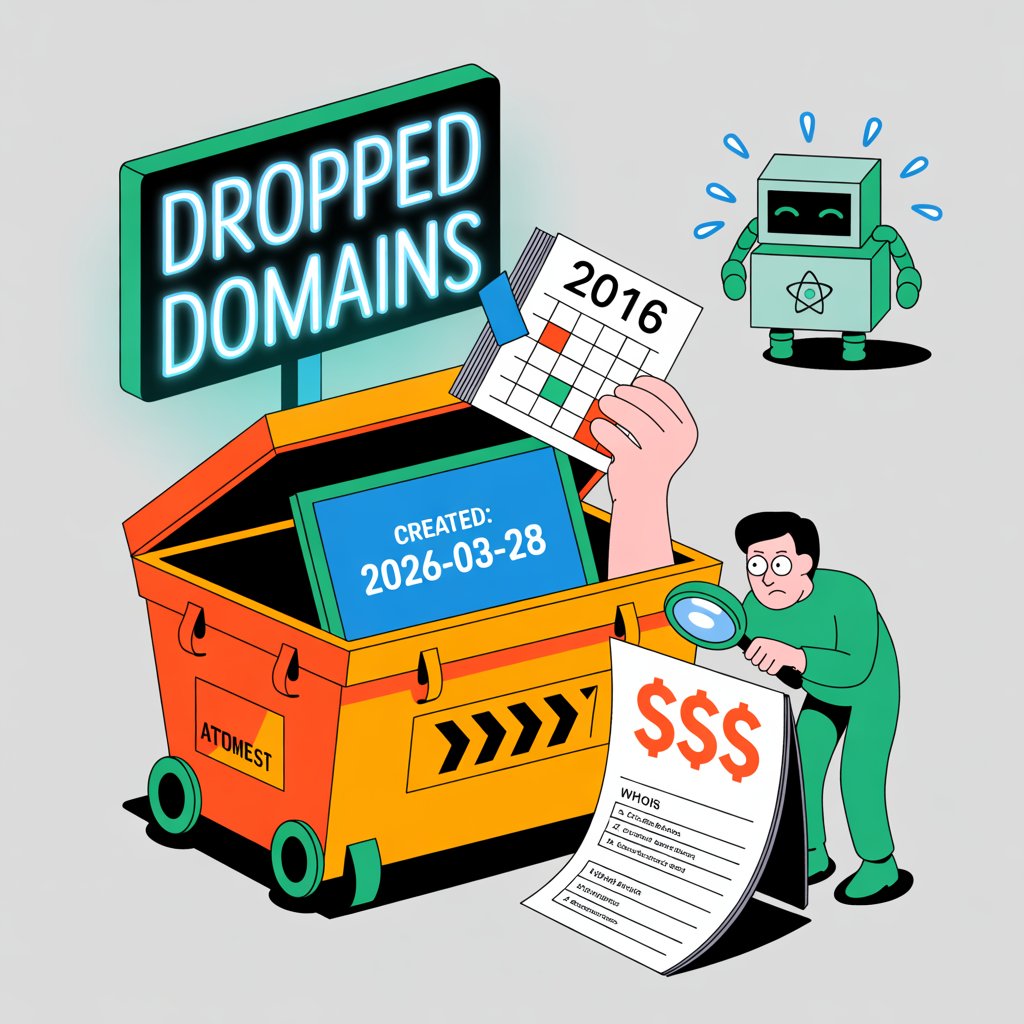
    Our reader, being no fool, checked the public WHOIS. Creation date: 2026‑03‑28. At the time of this article, that makes the domain 16 days old – not ten years. The reader challenged the seller.

    The seller’s follow‑up email (we have the receipts):

    “That I registered it, recently when I found it’s aged domain and available to register, you might be looking at whois.com but go to https://whois-history.whoisxmlapi.com/lookup . Which is the same website of whois.com but it allows you to see the history of domain when it first appears on web. Whois.com only shows it’s history if the domain was renewed and did not get drop. But it got dropped and I was there to pick it 😉 And hurry someone else is on line to get do not blame me after it sold to someone else”

    Ah. The classic “it dropped, so the age is in the history, not the current record” defense. Let us unpack this beautifully crafted pile of misinformation.

    What Does “Dropped” Actually Mean – And Why It Kills “Age”

    A domain “drops” when the previous owner fails to renew it. After a grace period and a redemption period, the domain is deleted from the registry and becomes available for anyone to register again – as a brand new registration. The new registrant gets a fresh creation date, a clean slate, and none of the previous owner’s history.

    Why does this matter? Because the value of an “aged domain” comes from continuous registration – the same owner (or at least uninterrupted ownership) building backlinks, content, and trust over years. Once a domain drops, that chain is broken. The new owner starts from zero.

    The seller is trying to have it both ways: they want the cachet of a domain that was first registered in (say) 2016, but they also want the low price of picking it up after it dropped. That is not how domain valuation works. A dropped domain is not an aged domain. It is a recycled string with a possibly interesting past – but no residual value unless the previous owner left behind a clean, high‑authority backlink profile. And a whois-history lookup does not measure backlinks.

    The Seller’s “Proof” – A WHOIS History API That Proves Nothing Useful

    The seller directs potential buyers to whois-history.whoisxmlapi.com. That is a paid API that aggregates historical WHOIS records. Yes, it might show that jya.io was first registered in 2016, then dropped, then re‑registered multiple times. But here is what the seller conveniently omits:

    • Search engines do not care about WHOIS history. Google indexes the domain as it exists now. A domain that has been dropped and re‑registered loses its previous rankings and trust. The “history” is just a footnote.
    • Trademark and brand value reset. Any previous branding associated with the domain is gone. The new owner cannot claim “since 2016” in any legal or marketing sense.
    • The seller paid a hand‑reg fee. They did not buy an aged domain from a previous owner. They waited for it to drop and paid standard registration. That is worth $10–20, not $350.

    The seller’s link is a smokescreen. It is like buying a wrecked car from a scrapyard, bolting on a new bumper, and claiming it is a “vintage classic because the original was made in 1990.”

    The $34,000 Atom Appraisal – Still Nonsense

    The seller repeats the claim of a $34,000 Atom (formerly Squadhelp) appraisal. Even if we accept that Atom once gave that number for jya.io (unlikely), appraisals are not binding offers. Atom itself states that appraisals are algorithmic estimates, not market guarantees. And critically, Atom’s algorithm does not factor in “historical WHOIS” – it looks at the current domain, its length, pronounceability, extension, and comparable sales. A dropped‑and‑re‑registered domain gets no bonus points for a past life.

    We checked: three‑letter .io domains that are true pronounceable acronyms can sell for mid‑three to low‑four figures. jya.io is not api.io or fly.io. It is a mediocre string. Realistic reseller value: $50–150. End‑user value with a great brand story: maybe $500–800. $34,000 is a fantasy number pulled from the same place as the “10 years” lie.

    The Urgency Trick – “Someone else is on line”

    The seller ends with the oldest trick in the spam book: “hurry someone else is on line to get do not blame me after it sold to someone else.” This is the domain equivalent of a street vendor saying “last one, bargain!” It is designed to bypass your rational brain and trigger FOMO (fear of missing out).

    But think about it logically. If there really was another buyer “on line,” why would the seller be emailing strangers with a discount? They would simply sell to that buyer. The only reason to broadcast urgency is because there is no urgency – only a desperate hope that someone will bite before checking WHOIS.

    Our reader did check. And the seller’s defense (“it dropped”) only confirmed that the domain is not worth $350, let alone $34,000.

    The Ethics – Spam + Misleading “Dropped” Pitch = Still Unacceptable

    Let us be absolutely clear: sending unsolicited commercial emails is already spam. Adding a misleading claim like “10 years old” – even if you later clarify “it dropped” – is deceptive. The average buyer sees “10 years old” and thinks continuous registration, not “it was registered a decade ago by someone else and then deleted.”

    The seller’s follow‑up email tries to sound clever. But it is not clever. It is a confession: “I registered it recently” (yes, 16 days ago) and “it got dropped and I was there to pick it.” That is the opposite of a 10‑year‑old aged domain. That is a 16‑day‑old hand‑reg with a story.

    Defequer does not oppose domain flipping. We oppose lies, spam, and preying on inexperienced buyers. This seller ticks all three boxes.

    The Bottom Line – A Dropped Domain Is Not an Aged Domain

    jya.io may have a history. That history is irrelevant. What matters is:

    • The current registration is 16 days old (as at today).
    • The seller paid a standard registration fee.
    • There is no $34,000 appraisal – that number is fabricated or misapplied.
    • The “someone else” urgency is a lie.

    The domain itself is not worthless. A three‑letter pronounceable .io has some floor value. But $350 is already too high for a fresh‑drop domain with no traffic or backlinks. And the seller’s dishonest marketing makes it radioactive. No informed buyer would touch it now.

    Defequer Rating: 💩💩💩💩💩 (5/5 shits)

    Five shits. Not just for the domain – which is mediocre – but for the layered deception. First email: “10 years old” (lie). Second email: “it dropped, check WHOIS history” (misleading half‑truth). Plus fake appraisal, fake urgency, and unsolicited spam. This seller is running a masterclass in bad faith. The Delusion Olympics have a new champion.

    Roast served. History lesson delivered. Next spammer, please.

    Post‑Roast Note to the Seller

    Dear “I was there to pick it” seller,

    You are not clever. You are not a domain archaeologist unearthing a lost treasure. You are someone who registered a dropped domain for $10 and tried to flip it for $350 by lying about its age.

    Your defense – “it dropped, so the original registration date is in the history” – is a textbook example of technically true but practically worthless. Yes, the string might have been first registered in 2016. But that gives you zero rights, zero SEO benefit, and zero credibility. You own a 16‑day‑old registration. That is all.

    If you had been honest – “I picked up this dropped .io domain, it has a short three‑letter name, asking $50” – you might have earned respect. Instead, you chose spam, lies, and fake urgency. And now you have earned a Defequer roast that will outrank your domain on Google.

    Next time, try honesty. It costs nothing and works better.

    We will be here. Watching. And roasting.
  • SellsMan.com, Part 2: The Hyphen‑Hugging, Conspiracy‑Theorizing, Feedback‑Ignoring VIP

    SellsMan.com, Part 2: The Hyphen‑Hugging, Conspiracy‑Theorizing, Feedback‑Ignoring VIP

    Introduction: The VIP Who Won’t Listen

    In our first roast of SellsMan.com, we looked at a portfolio full of misspellings, hyphens, and transliterations. We saw a domainer who blamed the industry when his outbound spam failed.

    He didn’t take the hint.

    Since that thread, SellsMan.com has continued posting on NamePros – asking for appraisals, complaining about auction platforms, hunting for Russian brokers, and even soliciting feedback on his own brand name “SellsMan.com” (which experienced members politely told him was awkward).

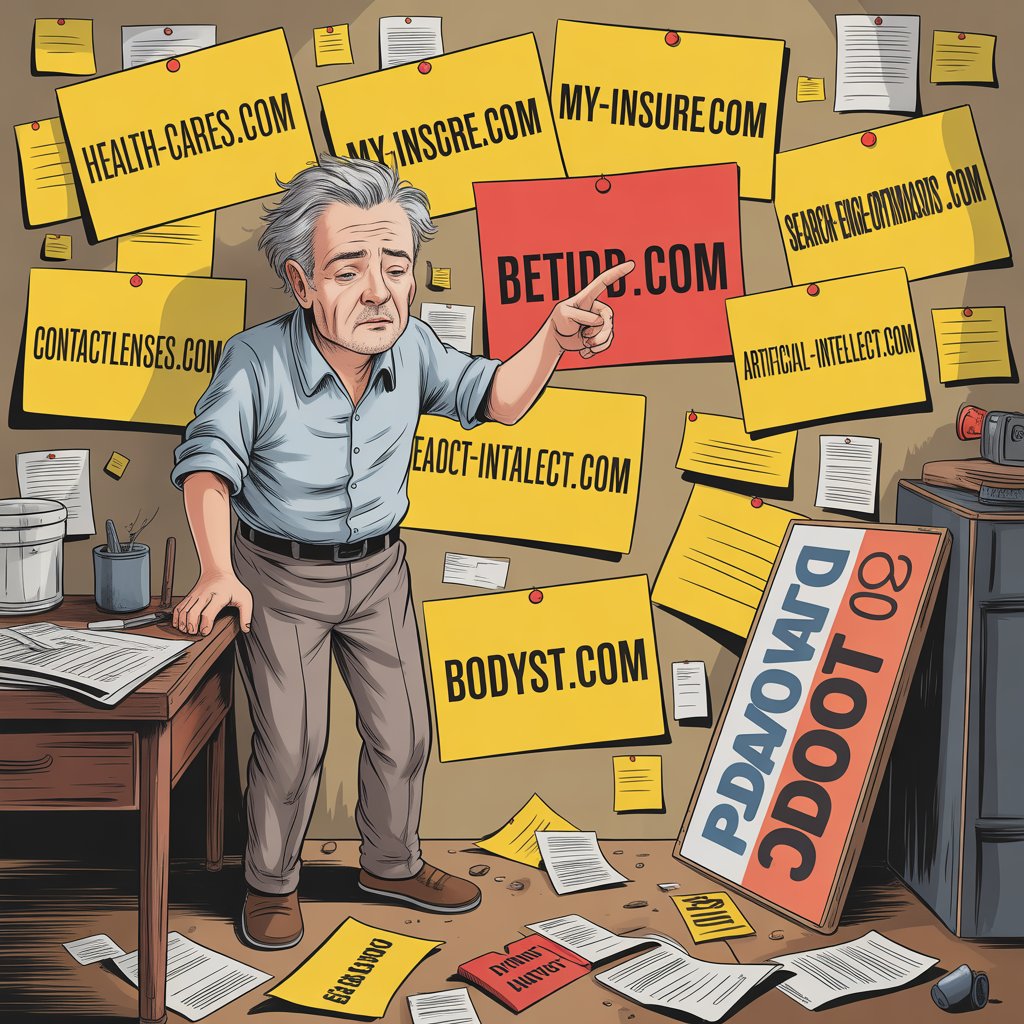
    He rejects low‑ball offers. He cites irrelevant comparables (German .de sales from 2010, a .net sale from 2025). He claims “anomaly traffic” of 4,000 visitors on a hyphenated insurance domain. He thinks a 31‑character, triple‑hyphenated SEO domain is worth $10,000–$25,000.

    The market isn’t broken. His domains are.

    Let’s take a second tour through the SellsMan.com graveyard – and this time, we’ll bring receipts.


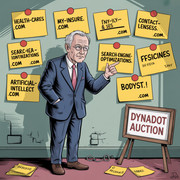
    Part 1: Health-Cares.com – The Hyphen That Keeps on Giving

    Thread: Health-Cares.com

    SellsMan.com asks for an appraisal of Health-Cares.com. The community immediately points out the fatal flaws:

    • A hyphen
    • An unnecessary “s” at the end (“health cares” is not a phrase)
    • The correct term is “healthcare” or “health care”

    “Even the trustworthy Atom appraisal recognizes this.” – community member, pointing to Atom’s low score.

    SellsMan.com’s response? He claims he was getting “lowball $XXX offers” at a previous registrar and rejected them. He says the domain was getting “colossal view stats” because Google ranked it for the query “health cares.”

    The community patiently explains:

    “Health care / healthcare is a mass noun. It does not take a plural. Maybe ‘cares’ be a verb, as in ‘health cares for you’? That sentence just sounds strange.”

    “HealthCare.com – amazing. Health-Care.com – really good, even with a hyphen. HealthCares.com – solid. Health-Cares.com – not great. The plural + hyphen is the issue.” – Brad

    SellsMan.com then pivots: he brings up German hyphenated .de sales from 2010 (free-sms.de, online-casino.de) and a 2025 .net sale of Health-Cares.net for $1.5K. He argues that his .com should be worth $15K based on a 10x multiplier.

    “You can’t just take some random .NET sale and use a 10x or 20x multiplier. That is not how it works.” – Brad

    Verdict: A domain with two fatal flaws (hyphen + plural), propped up by irrelevant comparables and a refusal to accept basic English grammar.


    Part 2: My-insure.com – The 4,000 “Anomaly” Visitors

    Thread: My-insure.com unsold for $10 anomaly traffic 4k visitors

    SellsMan.com writes:

    “Please appraise my-insure.com. Anomaly Traffic. Any Value? #insurance One day it had around 4K visitors.”

    No explanation of where the traffic came from. No screenshots. No evidence that it was relevant or convertible. Just “anomaly” – as if a random spike from bots or a misconfigured redirect proves the domain has value.

    The domain itself: My-insure.com. A hyphen. “My insure” is not a natural phrase (usually “my insurance”). The hyphen kills any chance of type‑in traffic.

    Even at a $10 starting bid, no one wanted it. He later admits in another thread that his Dynadot auctions end up “unpaid” or with a single $1 bid.

    Verdict: A hyphenated insurance domain with a mystery traffic spike that didn’t lead to a single offer. The anomaly isn’t the traffic – it’s his belief that it matters.


    Part 3: ContactLensess.com – The Extra ‘s’ No One Wants

    Thread: $10 Dynadot auction ContactLensess.com ending soon

    He lists ContactLensess.com – note the double ‘s’ at the end (“Lensess”). He bumps the thread repeatedly, but there are no participants. Even at $10, no one bites.

    The correct term is “contact lenses.” This domain has an extra ‘s’ that makes it a typo. Typos have no resale value unless they’re for a multi‑billion dollar brand (and even then, you’ll lose the UDRP).

    Verdict: A misspelled typo that couldn’t sell for the price of a pizza. He still thinks it’s a “keyword‑rich domain.”


    Part 4: Search-Engine-Optimizations.com – The 31‑Character Horror

    Thread: $10 Search-Engine-Optimizations.com SEO my-insure.com

    Here, SellsMan.com outdoes himself. He lists Search-Engine-Optimizations.com – a domain that is:

    • 31 characters long (excluding .com)
    • Three hyphens
    • Plural (“optimizations” – no one says that)
    • Clunky and impossible to type

    He then writes a full marketing pitch:

    *“Exact-match domains like this boost click-through rates… Google recognizes keyword-aligned domains as topical authorities… The hyphens mirror the natural structure of SEO itself… Valued at $10,000–$25,000.”*

    He also claims it was “previously owned by BuyDomains.com” – as if that transfers any credibility.

    The community’s response to this thread was silence. No bids. No offers. No one wants a domain that takes half a minute to type and looks like a spam link.

    Verdict: A domain that is the opposite of “premium.” The only thing longer than the domain name is the seller’s delusion.


    Part 5: Artificial-intellect.com – When “Intelligence” Is Too Hard

    Thread: Artificial-intellect.com #AI

    Artificial-intellect.com – hyphenated, 21 characters, and using “intellect” instead of the common term “intelligence.” No one searches for “artificial intellect.” The AI industry uses “artificial intelligence” or “AI.”

    He lists it with “Min offer $XX” – no takers.

    Verdict: A domain that sounds like a 19th‑century philosopher’s term, not a 21st‑century tech brand.


    Part 6: The “Bodyst, Mickye, TopnotchSites, Cliccs, Shejh” Collection

    Thread: $10 Bodyst.com, Mickye.com, TopnotchSites.com, Cliccs.com, Shejh.com

    In one thread, he dumps five domains:

    • Bodyst.com – What is it? “Body” + “st”? A typo of “bodystyle”? Worthless.
    • Mickye.com – A made‑up name that sounds like “Mickey” misspelled. No brand value.
    • TopnotchSites.com – Three words, 15 characters, no one types this.
    • Cliccs.com – “Clicks” with an extra ‘c’. Why?
    • Shejh.com – An alternative spelling of “sheikh” that no one uses. The correct spelling is taken. This is a typo.

    He asks for minimum offers of $10. Even at that price, the thread has zero replies. The market has spoken.

    Verdict: Five domains that are either misspellings, nonsense, or typos. Even at $10, they’re overpriced.


    Part 7: The Russian Broker Fantasy – Vaktsina.com

    Thread: Need fluent Russian broker to sell Vaktsina.com

    SellsMan.com is still trying to sell Vaktsina.com. This time, he wants a Russian‑speaking broker because “Dynadot landers don’t load for Russian IP addresses.”

    He claims the domain is “very high‑quality,” currently listed at $999 (previously $xx,xxx). He thinks a broker can “easily double or triple the price.”

    Reality check: Russian vaccine manufacturers use .ru domains. The word “vaktsina” is a transliteration, not a natural .com. No one is paying $999, let alone $2,000 or $3,000. The broker search will come up empty – because there’s no market.

    Verdict: A solution in search of a problem. The domain isn’t blocked; it’s unwanted.


    Part 8: The “SellsMan.com” Brand Feedback – Ignored Again

    Thread: Opinion needed: Brand feedback for SellsMan.com domain store

    SellsMan.com asks the community whether SellsMan.com is a good name for a domain marketplace. He lists concerns about grammar, branding, and misspellings.

    The community responds clearly:

    • snake_case: “I don’t like the keyword ‘sells.’ Keep looking.”
    • Brad: “I don’t like it. The problem is ‘sellsman’ is just an awkward term. A domain marketplace should have a pretty good domain. Presentation matters. Otherwise, it’s like a dentist with bad teeth.”
    • Ali Mustafa: “Not a strong brand honestly. ‘SellsMan’ sounds awkward and confusing. For a marketplace, clarity and trust matter a lot.”

    SellsMan.com’s response? He doesn’t respond. He simply ignores the feedback and continues using the name.

    Verdict: He asked for advice, got honest answers, and did nothing. The pattern is clear: he only listens when the feedback confirms his delusion.


    Part 9: The Conspiracy Continues – Dynadot Auctions Are “Ineffective”

    Thread: Dynadot auction sales – has anyone actually sold a domain there?

    SellsMan.com complains that his Dynadot auctions end up “unpaid,” “NOT SOLD,” or with a single $1 bid. He suggests a countdown timer after the last bid.

    The community’s silent answer: It’s not the platform. It’s the domains. His auctions fail because the domains are bad. No bidding system can turn ContactLensess.com into a hot asset.

    Verdict: Blaming the auction house is a classic move. The problem is the inventory.


    The Delusion Index: 9.5/10 (Holding Steady)

    FactorRatingExplanation
    Domain Quality1/10Hyphens, misspellings, extra letters, nonsense words.
    Use of Comparables1/10German .de sales from 2010? A .net sale to justify a .com? Irrelevant.
    Receptiveness to Feedback0/10Asked for appraisals, ignored them. Asked for brand feedback, ignored it.
    Market Awareness1/10Still thinks Vaktsina.com is a five‑figure domain. Still blames platforms.
    Persistence10/10He never gives up. That’s almost admirable. Almost.

    Overall Delusion Index: 9.5/10 – The second roast confirms the first. SellsMan.com has not learned a single lesson. He continues to register bad domains, ignore expert advice, and blame everyone but himself.


    The Defequer Verdict

    CategoryRating
    Portfolio Quality⭐☆☆☆☆ (1/5)
    Appraisal Accuracy⭐☆☆☆☆ (1/5)
    Use of Comparables⭐☆☆☆☆ (1/5)
    Response to Feedback⭐☆☆☆☆ (1/5)
    Platform Complaints⭐☆☆☆☆ (1/5)

    Final Word:

    “SellsMan.com is back with more of the same: hyphenated horrors, misspelled typos, and a complete refusal to accept reality. Health-Cares.com – a hyphen and a plural that even Atom’s algorithm hates. My-insure.com – a 4,000‑visitor ‘anomaly’ that led to zero sales. Search-Engine-Optimizations.com – a 31‑character disaster that he thinks is worth $25,000. And the pièce de résistance: he asked for feedback on his own brand name ‘SellsMan.com,’ was told it’s awkward, and ignored everyone. The market isn’t broken. The platforms aren’t rigged. His domains are just bad. And until he looks in the mirror, he’ll keep paying renewal fees and blaming the industry.”


    What Should Actually Happen (If He Ever Listens)

    1. Stop registering domains with hyphens. Hyphens kill value. Period.
    2. Stop registering misspellings. Extra ‘s’ letters, missing vowels, random ‘c’s – they’re not clever, they’re typos.
    3. Delete the 31‑character SEO domain. It’s not worth $10,000. It’s not worth $10. It’s a renewal fee trap.
    4. Let Vaktsina.com expire. No Russian broker will save it. The market for transliterated .coms does not exist.
    5. Rename his marketplace. “SellsMan.com” is awkward. The community told him. He ignored them. He should listen.

    For buyers: If you see a domain from SellsMan.com, run a spell check. If it has a hyphen, an extra letter, or a nonsense word, don’t pay more than $1.


    The Bottom Line

    SellsMan.com’s second act is a carbon copy of the first: bad domains, irrelevant comparables, ignored feedback, and misplaced blame.

    He asked the community for appraisals, got honest answers, and rejected them. He asked for brand feedback, got honest answers, and ignored them. He blames Dynadot, NamePros bump limits, and Russian IP blocks – anything but his own poor choices.

    The market isn’t dead. His domains are.

    Defequer Rating: 💩💩💩💩💩 (5/5 shits – the sequel is just as delusional as the original.)

    Sellsman

    Have a portfolio full of hyphens and misspellings? Submit it here. We’ll tell you why it’s not working – again.

    Defequer.com – because someone had to flush.

  • One Seller, Six Domains, Seven Figures of Delusion – An Atom.com Portfolio Roast

    One Seller, Six Domains, Seven Figures of Delusion – An Atom.com Portfolio Roast

    Atom.com (formerly Squadhelp) is known for curated brandable domains. But sometimes, a seller slips through with a collection that makes you question the platform’s vetting process. This week, Defequer discovered a single seller offering six domains at prices that range from merely optimistic to outright hallucinatory.

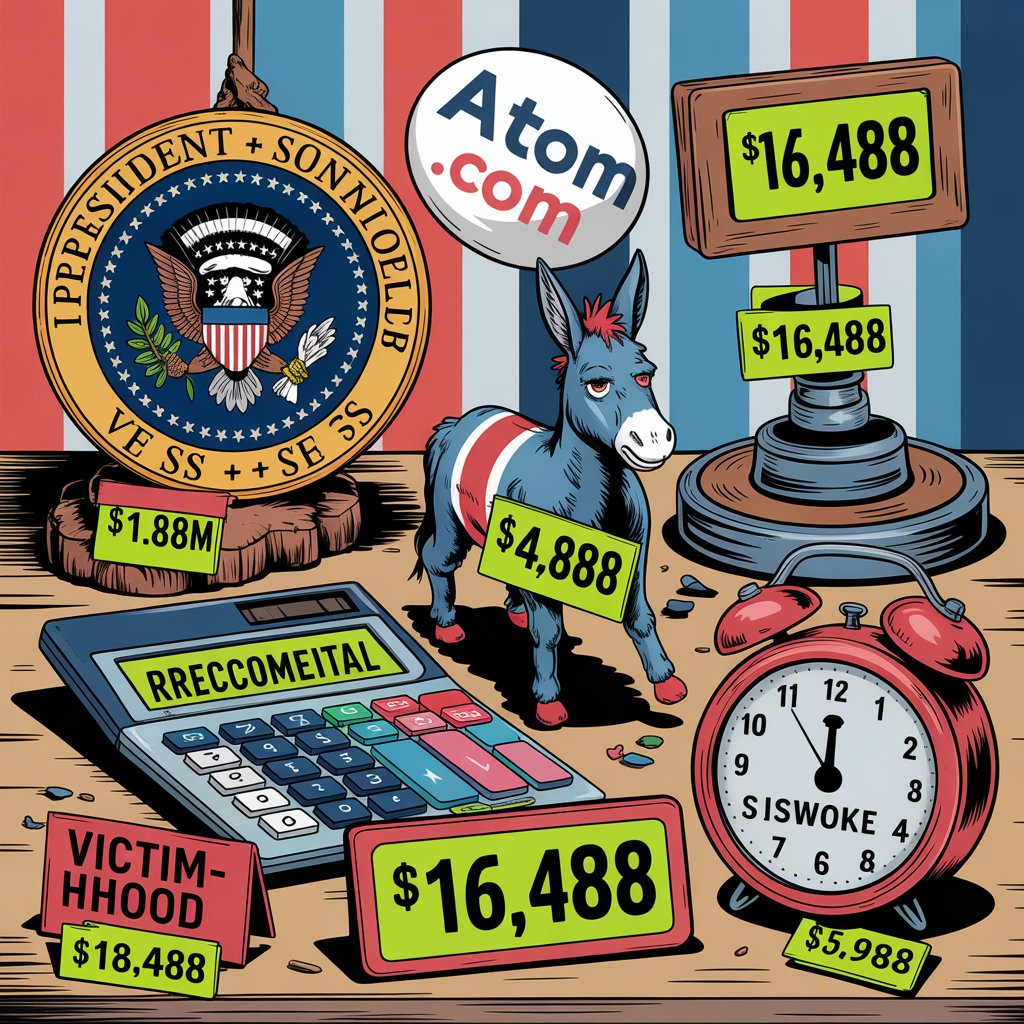
    Let us meet the domains:

    DomainPrice
    NotMyPresident.com$1,886,488
    NotMyPresident.us$4,888
    ResolveCapital.com$16,888
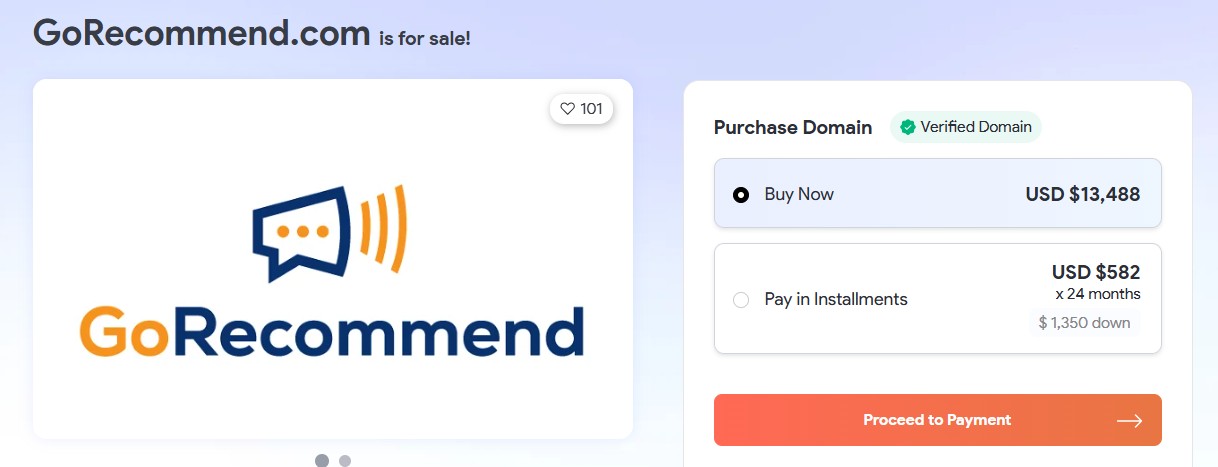
    GoRecommended.com$13,488
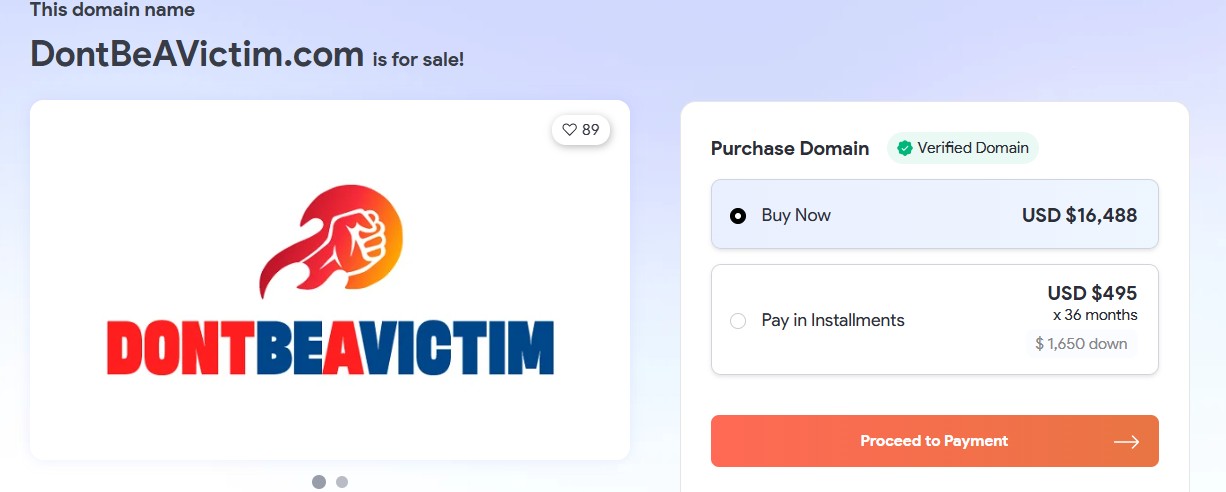
    DontBeAVictim.com$16,488
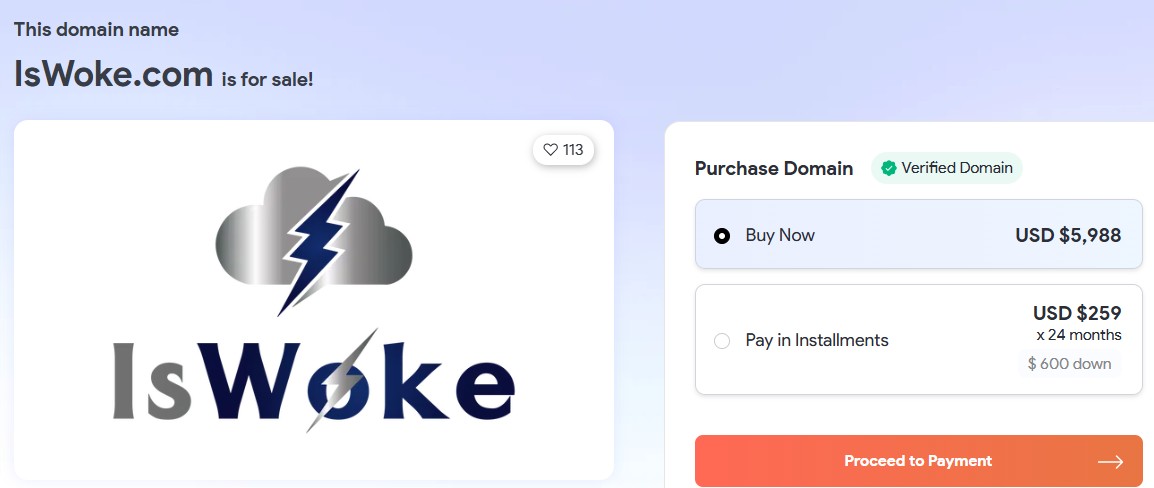
    Iswoke.com$5,988

    The seller appears to have a political axe to grind, a vague interest in finance, and absolutely no grasp of domain valuation. We will roast each one in turn, then deliver a verdict on the seller’s overall strategy – if you can call it that.

    H2: NotMyPresident.com – $1.89 Million for a Political Slogan That Expires Every Four Years

    Not-My-President

    Let us start with the headliner: NotMyPresident.com at $1,886,488. The number is oddly specific – perhaps the seller added their rent money to a base delusion. But what does this domain actually offer?

    A political slogan that is relevant only during a specific presidency. The moment a new president takes office, “Not My President” either becomes outdated or shifts to target the new incumbent. That is a very short shelf life for a domain that costs nearly two million dollars. Even during its peak relevance (e.g., the Trump or Biden years), such domains rarely sell for more than a few thousand dollars – usually to activists or meme sites. The highest reported sale of a political slogan domain is Trump2020.com for around $25,000, and that was a campaign‑year exact match. NotMyPresident.com is generic, negative, and impossible to brand into a legitimate business.

    Furthermore, the domain carries inherent risk: it could be seen as defamatory or used for political attacks, limiting its appeal to serious buyers. A corporation will not touch it. A non‑profit might pay a few hundred dollars. $1.89 million? That is not a price. It is a protest sign with a decimal point.

    Defequer Rating for this domain alone: 💩💩💩💩 (4/5 – the price is insane, but at least it’s a .com)

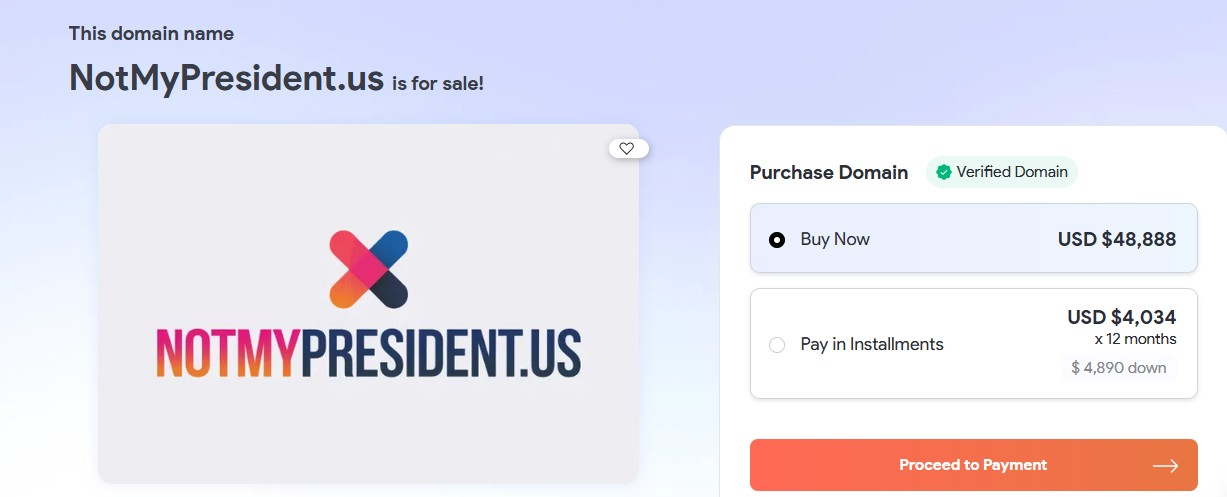
    H2: NotMyPresident.us – $4,888 for a .us Afterthought

    Not-My-President

    The same seller lists NotMyPresident.us for $4,888. The .us extension is a country code for the United States with strict nexus requirements – registrants must be US citizens or entities. It is also notoriously underused and undervalued. Most .us domains sell for low three figures, if at all.

    Adding “Not My President” to .us makes little sense. The phrase is inherently divisive, and .us has no brand cachet. A realistic value for this domain is $0–$100 – it might get picked up by a political blogger for a laugh, but not for $4,888. The seller seems to think that slapping a lower price on the inferior extension creates a bargain. It does not. It creates clutter.

    Defequer Rating: 💩💩💩 (3/5 – lower price, but still delusional)

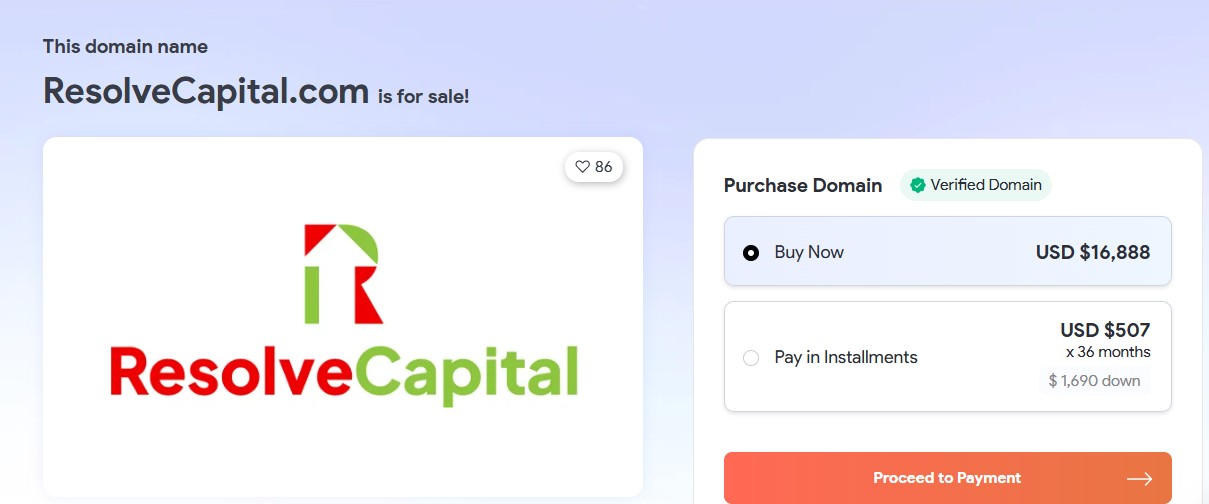
    H2: ResolveCapital.com – $16,888 for a Finance Name That Sounds Like a Therapy Practice

    Resolve-Capital

    Moving away from politics, we have ResolveCapital.com. “Resolve” can mean determination or settling a dispute. “Capital” suggests finance. Together, they sound like a small investment firm – or a debt collection agency. The problem is that “Resolve” is a weak modifier. Strong finance domains use words like “First,” “Bridge,” “Oak,” “Stone,” or actual surnames. ResolveCapital feels generic and forgettable.

    A quick check: similar two‑word finance .com domains sell at reseller prices of $500–$2,000. End‑user sales might reach $5,000–$10,000 if the name is exceptional. ResolveCapital is not exceptional. The seller’s $16,888 asking price is roughly 3–5x the realistic ceiling. It is not the worst we have seen, but it is still firmly in delusion territory.

    Defequer Rating: 💩💩💩 (3/5 – mildly overpriced, not insane)

    GoRecommended.com – $13,488 for a Clunky Call‑to‑Action

    Resolve-Capital

    GoRecommended.com – what does that even mean? “Go recommended” is not a natural phrase. A recommendation is something you get, not somewhere you go. The domain might work for a review aggregator or a referral service, but the phrasing is awkward. Compare it to GetRecommended.com (smoother) or Recommend.com (much better). GoRecommended feels like a translation error.

    The market for “recommendation” domains is modest. The word is long (11 letters), and the “Go” prefix adds little value. Realistic reseller price: $200–$800. End‑user: maybe $2,000–$3,000 if a startup falls in love with it. $13,488 is a fantasy. The seller seems to have added a “4” to every price for symmetry – $13,488, $16,488 – which suggests they are pulling numbers from aesthetic preference, not market data.

    Defequer Rating: 💩💩💩💩 (4/5 – clunky name + bad price)

    DontBeAVictim.com – $16,488 for a Preachy Safety Slogan

    Resolve-Capital

    DontBeAVictim.com is the kind of domain you would see on a self‑defense blog or a cybersecurity awareness campaign. It has a clear message, but it is long (15 characters plus hyphens? No hyphen, but still long), preachy, and negative. Brands usually avoid negative messaging because it is off‑putting.

    What is the commercial use? A self‑defense product company might use it, but they would prefer StaySafe.com or NotAVictim.com (which is shorter). The phrase “Don’t Be a Victim” is common and not trademarkable. The domain’s value is primarily as an affiliate landing page – worth maybe $500–$1,500 to the right buyer. $16,488 is about 10x too high.

    Defequer Rating: 💩💩💩💩 (4/5 – negative slogan + absurd price)

    Iswoke.com – $5,988 for a Misspelling of “I Woke”

    Resolve-Capital

    Finally, Iswoke.com. This appears to be a typo. The intended phrase might be “I woke” (as in “I woke up”) or “Iswoke” as a brandable. But “Iswoke” is not a word. It looks like a misspelling of “I woke” without a space. The domain could be read as “is woke” – which has political connotations but is grammatically weird.

    Three‑letter and four‑letter brandables can have value, but Iswoke is five letters, not memorable, and difficult to pronounce. Realistically, this is a $50–$200 domain for a reseller. An end‑user might pay $500 if they have a clever brand idea. $5,988 is outrageous for a misspelled non‑word.

    Defequer Rating: 💩💩💩💩💩 (5/5 – misspelling + high price = top delusion)

    The Seller’s Overall Strategy – A Random Number Generator with Political Feelings

    Taken together, these six domains reveal a seller who has no coherent pricing strategy. The prices are oddly specific ($1,886,488, $16,888, $13,488) – as if they came from a numerology session or a dream. The domains mix politics, finance, safety, and nonsense. There is no portfolio theme beyond “stuff I registered that I think is valuable.”

    A professional domain investor would:

    • Price based on comparable sales
    • Focus on a niche (e.g., political domains or finance domains, not both)
    • Avoid negative or divisive names that limit buyer pools
    • Spell check their domains

    This seller does none of those things. They are throwing spaghetti at the wall and hoping a millionaire with bad taste buys it. That is not investing. That is hoping.

    The Bottom Line – A Portfolio Best Left Unbought

    No single domain in this list is worth more than a few thousand dollars, and most are worth less than $500. The total realistic value of all six domains combined is under $10,000. The seller is asking for roughly $1.94 million – a 194x markup on reality.

    Atom.com is a legitimate platform, but it has become a haven for sellers who confuse “brandable” with “anything I can type.” We hope Atom reviews its listings more carefully. And we hope this seller one day discovers domain sales reports.

    Until then, this portfolio stands as a monument to overpriced ambition.

    Overall Defequer Portfolio Rating: 💩💩💩💩 (4/5 shits)

    We cannot give five shits because ResolveCapital.com is merely overpriced (not insane) and NotMyPresident.us is cheap enough to be harmless. But the combination of a near‑$1.9 million political slogan, a misspelled “Iswoke,” and a preachy victim domain earns a solid four. The seller has potential for a five‑shit portfolio with a few more bad decisions.

    Roast served. Reality check delivered. Next portfolio, please.

    Post‑Roast Note to the Seller

    Dear Atom seller with expensive tastes,

    We have a few questions:

    1. Where did $1,886,488 come from? Did you add your birthday to your shoe size?
    2. Why is the .us version only $4,888? That is a 386x price drop. Is the .com really 386 times better?
    3. Did you mean “I woke” or “is woke”? Either way, it is misspelled.
    4. Have you ever looked at actual domain sales data? NameBio is free.

    We are not saying your domains have zero value. ResolveCapital.com could be a decent name for a small finance startup – at $1,000. GoRecommended might work for a review site – at $500. But your prices are so far above market that you will never sell a single one.

    Lower your expectations. Better yet, lower your prices by 90–99%. Then you might get an offer.

    We will be here. Watching. And hoping you find a copy of “Domain Investing for Dummies.”

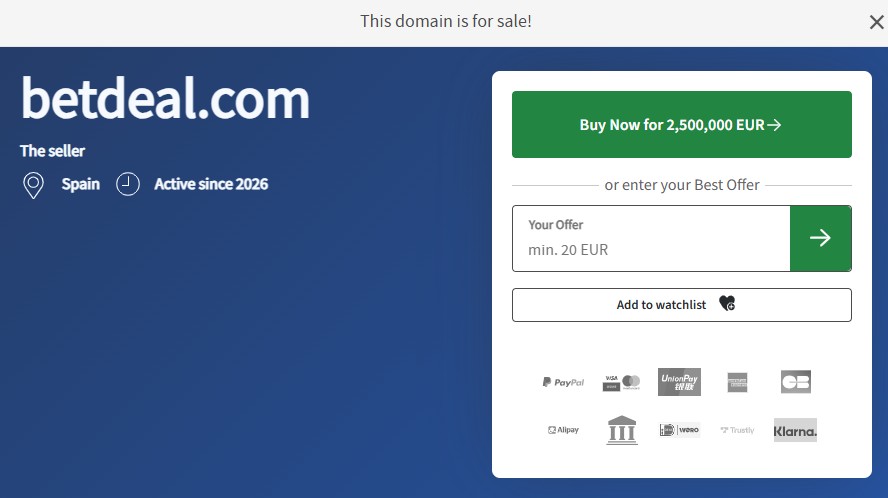
  • betdeal.com – A €2.5 Million “Bet” That Nobody Will Take

    betdeal.com – A €2.5 Million “Bet” That Nobody Will Take

    There is a certain courage required to list a domain for €2.5 million. It is the courage of a new seller who has not yet been bruised by the cold reality of the aftermarket. This week, Defequer found a prime example of that courage – or perhaps just a complete disregard for market data.

    The domain: betdeal.com. The asking price: €2,500,000 (roughly $2.7 million USD). The seller: based in Spain, and – according to Sedo – a member since 2026. That means they have been on the platform for roughly three months. Three months, and already they are asking for a sum that would make most seasoned domain investors choke on their morning coffee.

    The domain itself was registered in 2012. That gives it a respectable age of around 14 years. But age alone does not a seven‑figure domain make. Let us examine why this particular “bet” is almost certain to lose.

    The Name – An Awkward Mashup of Two Mediocre Keywords

    betdeal.com combines “bet” (gambling, wagering) with “deal” (transaction, agreement, bargain). On paper, it seems like a plausible brand for a betting affiliate site, a gambling comparison portal, or even a casino deals aggregator. In reality, it is clunky.

    The word “deal” is overused in domains and often conveys discount or low‑quality. Pairing it with “bet” creates a phrase that sounds like a cheap affiliate offer rather than a premium brand. Compare it to domains like Bet365.com (which includes a memorable number) or Betfair.com (a single, strong word). Those are multi‑billion‑dollar brands. betdeal.com is not in their league.

    Moreover, the domain lacks the crispness of a two‑word exact‑match that commands high prices. “Bet” is a high‑value keyword, but “deal” dilutes it. A true premium would be Bet.com (impossible) or SportsBet.com (taken and valuable). betdeal sits in a murky middle zone: it is descriptive enough to have some use, but not so strong that it would generate a bidding war among gambling operators.

    The Price – What €2.5 Million Actually Buys in Domain World

    To appreciate the absurdity of €2.5 million, one must look at what that sum can acquire in the actual domain aftermarket. According to public sales records, €2.5 million would comfortably buy:

    • A top‑tier one‑word .com like Voice.com (sold for $30 million – okay, maybe not that, but you get the idea)
    • Multiple ultra‑premium two‑word .com domains with proven commercial intent
    • A portfolio of dozens of high‑quality, revenue‑generating domains

    Even in the gambling niche, seven‑figure sales are extremely rare and reserved for names like Casino.com (sold for $5.5 million) or Poker.com (undisclosed but certainly seven figures). betdeal.com is nowhere near that league. It is a mid‑tier brandable at best.

    The seller’s €2.5 million asking price represents a 250,000x markup on the registration cost (assuming a typical $10 registration). That is not investing; it is hoping for a lottery win.

    The Seller – A Newcomer with Ambitious Math

    Sedo shows that the seller joined in 2026. That is this year. They have been active on the platform for perhaps three months. In that short time, they have likely seen headlines about record domain sales and thought, “Why not me?”

    But domain investing is not about randomly picking a phrase and slapping a seven‑figure price tag on it. It requires research, patience, and a realistic understanding of what end‑users actually pay. A seller with three months of experience asking for €2.5 million is like a teenager who just got a driver’s license trying to sell their used sedan as a Formula 1 car.

    We are not saying the seller cannot eventually sell betdeal.com – but if they do, it will be for a price that starts with four figures, not seven.

    The Age Factor – 2012 Registration, But No Legacy

    The domain was registered in 2012. Fourteen years of continuous registration can add value – but only if the domain has been developed, has backlinks, or carries some form of established authority. A quick check (which any buyer would do) reveals that betdeal.com has no significant history of active use. It appears to have been parked or held speculatively for most of its life.

    Without a clean backlink profile, archived content, or brand recognition, the 2012 registration date is just a number. It does not confer any SEO advantage, nor does it make the domain “premium.” In the aftermarket, age matters only when it correlates with genuine trust signals.

    The Bottom Line – A Bet That Has Already Lost

    betdeal.com is not the worst domain we have ever seen. It has a plausible use case, a decent extension, and a registration date that is not embarrassing. But it is not a seven‑figure asset. It is not even a six‑figure asset. A realistic reseller price would be in the low to mid four‑figure range – perhaps $3,000–$8,000 if a buyer sees potential. An end‑user might go up to $15,000–$20,000 if they are building a gambling affiliate site and want an exact‑match .com. But €2.5 million? That is not a price. It is a fantasy.

    The seller’s newness to Sedo explains the optimism, but optimism does not pay the renewal fees. Every year that this domain sits unsold at an absurd price, the seller burns money on renewals. Eventually, reality sets in.

    Defequer Rating: 💩💩💩💩 (4/5 shits)

    We reserve five shits for truly legendary delusions. betdeal.com earns four shits for the sheer audacity of a brand‑new seller asking €2.5 million for a middling gambling domain. The combination of inexperience, unrealistic pricing, and a name that is merely okay makes this a solid roast, but not quite a hall‑of‑famer. Yet.

    Roast served. Price reality check administered. Next fantasy, please.

    Post‑Roast Note to the Seller

    Welcome to Sedo. We hope your first few months have been educational. Let us give you a quick piece of advice: start with a realistic price.

    Domain investing is a long game, but it is not a magic trick. The most successful sellers price their domains based on comparable sales, not on what they “feel” the domain is worth. Take a look at recent sales of gambling‑related .com domains. See what actually sold for five figures, and what sold for six. You will quickly notice that betdeal.com is not in those leagues.

    We are not saying give it away. But €2,500,000 is a number that guarantees you will be renewing this domain for years to come. Drop it to something reasonable – $5,000 or $10,000 – and you might actually get a buyer. Or, if you want to keep the dream alive, at least understand that the dream is costing you renewal fees.

    We will be here. Watching. Hoping you find the sales data before the renewal bill finds you.

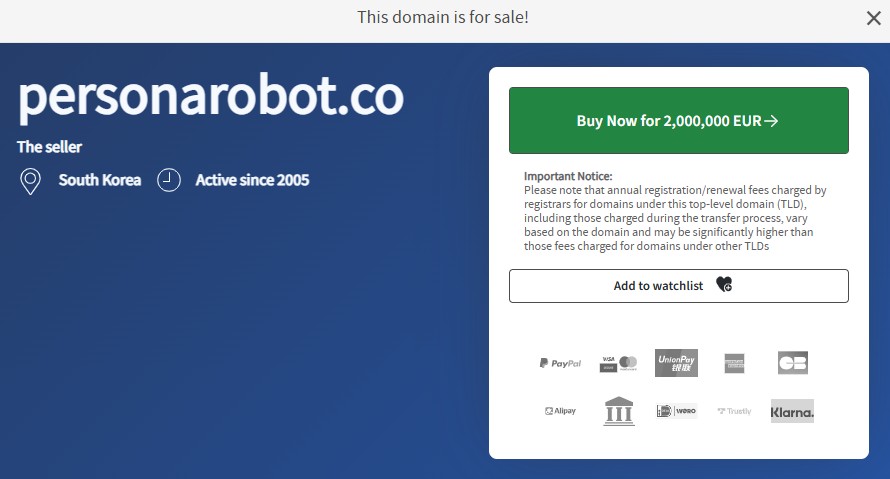
  • personarobot.co: When a Freshly Registered .co Thinks It’s a Tech Unicorn

    personarobot.co: When a Freshly Registered .co Thinks It’s a Tech Unicorn

    €2 Million for a Six‑Month‑Old .co? Welcome to the Delusion Zone

    There is a special kind of magic in the domain aftermarket. It is the magic that makes a freshly registered domain feel like a crown jewel. This week, Defequer stumbled upon a Sedo listing so spectacularly overpriced that we had to check whether the decimal point had wandered off for a holiday.

    The domain in question: personarobot.co. The asking price: €2,000,000 (roughly $2.1 million USD at current exchange rates). The seller’s location: South Korea. The seller’s experience: on Sedo since 2005 — meaning they have had two decades to learn how domain valuation actually works. And yet, here we are.

    But wait. It gets better.

    The domain was registered on 2025-10-28. At the time of this writing, that makes it approximately six months old. Six Months. The next renewal is due 2026-10-28, meaning the seller has owned this digital asset for less time than it takes a human infant to learn how to roll over.

    Let us roast accordingly.

    The “Persona Robot” Problem — A Brand That Already Exists (And It’s Not You)

    Before we even discuss price, let us address the elephant in the server room.

    Persona AI is a real, funded, operational humanoid robotics company. It raised $27 million in an oversubscribed pre‑seed round. It was co‑founded by Nicholas Radford, a former NASA robotics engineer. It has attracted investment from South Korea’s POSCO Group. It is a legitimate player in the industrial humanoid robotics space.

    And its brand is Persona. Not “Persona Robot.”

    What does this mean for personarobot.co? Three things, none of them good:

    1. Trademark risk. The seller is sitting on a domain that mimics an established brand’s core identifier. This is not a “clever catch” — it is a liability waiting to happen.
    2. Confusion, not value. An end‑user searching for “Persona Robot” will find the actual Persona AI company. They will not find this domain. And if a buyer did acquire it, they would face an uphill battle against an existing trademark holder.
    3. No scarcity value. “Persona” plus “Robot” is not a unique or defendable combination. It is a descriptive phrase that anyone could use — and that a funded startup is already using as their actual brand.

    The seller may be hoping that Persona AI or a competitor will panic‑buy this domain to “protect” something. But here is the truth: established companies do not pay €2 million for domains that vaguely resemble their brand. They file a UDRP complaint and take it for a few thousand dollars in legal fees. Or they simply ignore it because nobody is confusing personarobot.co with persona.ai.

    The .co Reality Check — What This Extension Actually Sells For

    Let us talk about the humble .co extension. It is not .com. It is not .ai. It is a country‑code TLD for Colombia that has been marketed as “company” or “corporation” — but it has never, ever commanded seven‑figure prices for unremarkable keyword combinations.

    According to Efty Pay’s 2024 review, the largest .co sale on their platform was $50,000. Not $2 million. Not $1 million. Not even $500,000. Fifty thousand dollars — and that was likely for a genuinely premium, one‑word or ultra‑short .co domain.

    The average .co sale price was $7,024. The median was $3,000.

    Let us put that in perspective. The seller is asking for €2,000,000. That is roughly 286 times the average .co sale price. Or to put it another way: you could buy 285 average .co domains for the same money and still have change for lunch.

    Even the most optimistic .co aftermarket data shows that while .co sales volume has increased, the extension still lags far behind .com, .ai, and .io in both volume and price. A .co domain can sell for five figures — but only if it is exceptional. personarobot.co is not exceptional. It is a three‑word, hyphen‑free, mildly descriptive domain that is six months old.

    Fresh Registration — The Opposite of Aged Premium

    Domain valuation 101: age matters. Continuous, uninterrupted registration since the early days of the internet adds trust, backlink equity, and perceived authority. A domain registered six months ago has none of that.

    The seller has owned personarobot.co for less than half a year. There is no “legacy” here. There is no “historical SEO trust.” There is no “brand seniority.” There is a registration receipt from October 2025 and a dream.

    What makes this particularly amusing is that the seller has been on Sedo since 2005. Twenty years of domain marketplace experience — and they still think a six‑month‑old .co with trademark adjacency issues is worth €2 million. That is not inexperience. That is willful ignorance.

    The €2 Million Fantasy — Let’s Do The Maths

    At €2,000,000, this domain would need to generate a return on investment that defies all known market logic.

    Consider this: the annual renewal fee for a .co domain is roughly $25–30. The seller has paid maybe $30 to register it. They are asking for a 66,666x markup on their registration cost.

    To justify a €2 million price tag, the domain would need to:

    • Be a genuine one‑word .com premium (it is not)
    • Have an established brand with millions in annual revenue (it does not)
    • Be actively generating traffic or leads (it is not even developed)
    • Have a clear, defensible trademark (it arguably infringes on an existing one)

    None of these conditions are met.

    The seller may argue that “persona” + “robot” is a hot AI keyword combination. And yes, AI domains have seen strong demand — but that demand is overwhelmingly for the .ai extension, not .co. Even then, the highest publicly reported .ai sale is $1.2 million for bot.ai — a one‑word, ultra‑premium domain that actually belongs in the seven‑figure conversation. personarobot.co is not bot.ai. It is not even close.

    The Bottom Line — A Dream That Won’t Renew Itself

    personarobot.co joins the Defequer Hall of Shame as a case study in aspirational pricing detached from market reality.

    Six months old. .co extension. Trademark adjacency to a funded robotics startup. A 66,666x markup on registration cost. And a seller who has been in the domain game since 2005 but apparently never bothered to check what .co domains actually sell for.

    The market has spoken, continues to speak, and will keep speaking: this domain is not worth anywhere near €2 million. It might be worth low three figures to a desperate buyer with poor legal advice. It might be worth reg fee to someone who thinks “persona robot” is a cute phrase. But €2 million?

    That is not a price. That is a cry for help.


    Defequer Rating: 💩💩💩💩💩 (5/5 shits)

    The combination of a six‑month‑old registration, a .co extension masquerading as premium, trademark adjacency to a real AI robotics company, and a €2 million asking price earns top marks in the Delusion Olympics. This is not domain investing. This is domain sleepwalking.

    Roast delivered. Reality check administered. Next fantasy, please.


    Post‑Roast Note to the Seller

    Dear seller with two decades of Sedo experience,

    We are genuinely curious: what market data led you to €2 million?

    Did you see that bot.ai sold for $1.2 million and think, “Close enough”? Did you confuse .co with .com? Did you misplace a decimal point and just never correct it?

    Twenty years in this business should have taught you that domain valuation is not a lottery ticket. It is a function of extension quality, keyword strength, brandability, length, age, and demand. Your domain fails on most of these metrics — and spectacularly so on price.

    Here is some free advice, since you clearly need it: drop the price to something that begins with a three‑digit number. Or two digits. Let it go. Buy something better. Or just save yourself the renewal fee.

    Because at €2 million, the only thing this domain will sell is delusion.

    We will be here. Watching. Hoping you eventually check the actual .co sales data.

  • InvestmentsNYC.com: Aged Like Milk, Priced Like Manhattan Penthouses

    InvestmentsNYC.com: Aged Like Milk, Priced Like Manhattan Penthouses

    There is a special kind of magic in the domain aftermarket. It is the magic that turns a dropped, dust‑covered, repeatedly‑deleted domain into a “legacy asset” worthy of a mid‑to‑high five‑figure exit. This week, Defequer stumbled upon a thread on NamePros that smelled so strongly of overpriced ambition, we had to open all windows.

    The domain in question: InvestmentsNYC.com. The seller: a hopeful soul going by Magezino. The claimed pedigree? Registered December 3, 1998 – a full 27+ years of age. Former corporate website. Clean history. A “rare legacy asset” carrying “immense SEO trust”.

    Sounds impressive, doesn’t it? Until you realise that the only thing immense here is the gap between fantasy and reality.

    The Drop That Speaks Louder Than Words

    Let us begin with the first hard truth that Magezino tried to gloss over. Another NamePros member, Acroplex, did what any competent domainer should do: he checked the actual WHOIS. The domain’s current registration date? 2026‑03‑28. Not 1998. Not 2005. Last week.

    Why? Because InvestmentsNYC.com dropped. Not once, but several times. When a domain drops, its registration clock resets. The “aged since 1998” story becomes a historical footnote – interesting for a pub quiz, worthless for SEO authority. Google does not care that a different owner had a corporate website on that string two decades ago. Google cares about current content, current backlinks, and current trust. A domain that has been parked, dropped, re‑registered, and dropped again has precisely zero legacy SEO juice.

    Magezino’s response? He pivoted to “intrinsic value” – the brand’s seniority, the trust it builds for an end‑user in Manhattan. But here is the brutal truth: a domain that has been abandoned multiple times does not scream “trust.” It screams “nobody wanted this.” Manhattan financiers are not lining up to pay five figures for a string that has been through the drop‑catch wringer like a cheap suitcase.

    The “Former Corporate Website” Mirage

    The seller attached historical screenshots to prove that InvestmentsNYC.com once hosted an active corporate site. That is cute. It is also irrelevant.

    A domain’s past life as a legitimate business website does not transfer value like a used car’s service history. In fact, it can create liabilities. What if the former corporate entity had unresolved legal or trademark issues? What if the old content contained broken links, outdated practices, or even penalties that linger in obscure corners of the web? The seller conveniently ignored these possibilities.

    Moreover, the absence of any indexed pages – as Acroplex pointed out with a site:InvestmentsNYC.com search – tells the real story. If a domain had genuine “historical authority,” Google would have kept something in its cache. It did not. Because the domain has been dead, buried, and resurrected so many times that the search engine simply shrugged.

    The Price Fantasy: Mid‑to‑High Five Figures

    Let us talk about the number Magezino is targeting. Mid‑to‑high five figures means $50,000 to $90,000 for a reseller or end‑user. For that kind of money, a buyer can acquire genuinely premium domains: two‑word exact matches with continuous registration since the 90s, no drops, clean backlink profiles, and active development. Think NewYorkInvestments.com (if available) or a branded .com with a trademarkable name.

    What does InvestmentsNYC.com offer instead? A clunky three‑word string. “Investments” is long and generic. “NYC” is fine, but the whole thing reads like a default WordPress site title, not a distinguished financial brand. Compare it to NYCInvestments.com (shorter, more natural) – even that would struggle to command five figures without stellar metrics.

    The seller asks for an appraisal: “How much value does the 1998 registration date add?” The answer, after multiple drops: zero. In reseller markets, a dropped aged domain might fetch a small premium over hand‑reg if it has surviving backlinks. InvestmentsNYC.com has none. End‑user value? Perhaps a low three‑figure offer from a local startup that likes the words but does not care about the history. Anything above $500 is wishful thinking.

    The Delusion Olympics: A Masterclass

    What makes this roast particularly satisfying is the seller’s refusal to accept reality. When Acroplex calmly explained that the registration date reset, Magezino doubled down on “intrinsic value” and “brand seniority.” This is the domainer equivalent of putting a “vintage” label on a crushed soda can found in a landfill.

    The thread went dead after that exchange. It always does when the facts land harder than the asking price. No end‑user rushed in with a five‑figure bid. No reseller offered a respectful lowball. Just silence – the kind of silence that should make any domain seller reconsider their pricing strategy.

    Why This Roast Matters

    Defequer does not mock domains for being cheap or ordinary. We mock the unreasonable – the inflated egos, the fantasy valuations, the manipulation of “aged” as a magic wand. InvestmentsNYC.com is a textbook case. It has no SEO juice, no current content, a reset registration clock, and a seller who confuses “former corporate website” with “future goldmine.”

    If you are a buyer, avoid this domain unless you can grab it for reg fee plus a coffee. If you are the seller, we recommend a long walk and a hard look at comparable sales (hint: there are none at your target price). And if you are just a spectator – enjoy the roast. This is why we exist.


    Defequer Rating: 💩💩💩💩💩 (5/5 shits)

    The combination of a dropped‑and‑reset “1998 domain,” a seller who argues against WHOIS facts, and a delusional mid‑five‑figure asking price earns top marks in the Delusion Olympics. InvestmentsNYC.com is not a legacy asset. It is a cautionary tale wrapped in historical screenshots.

    Roast served. Permanent mark left. Next victim, please.

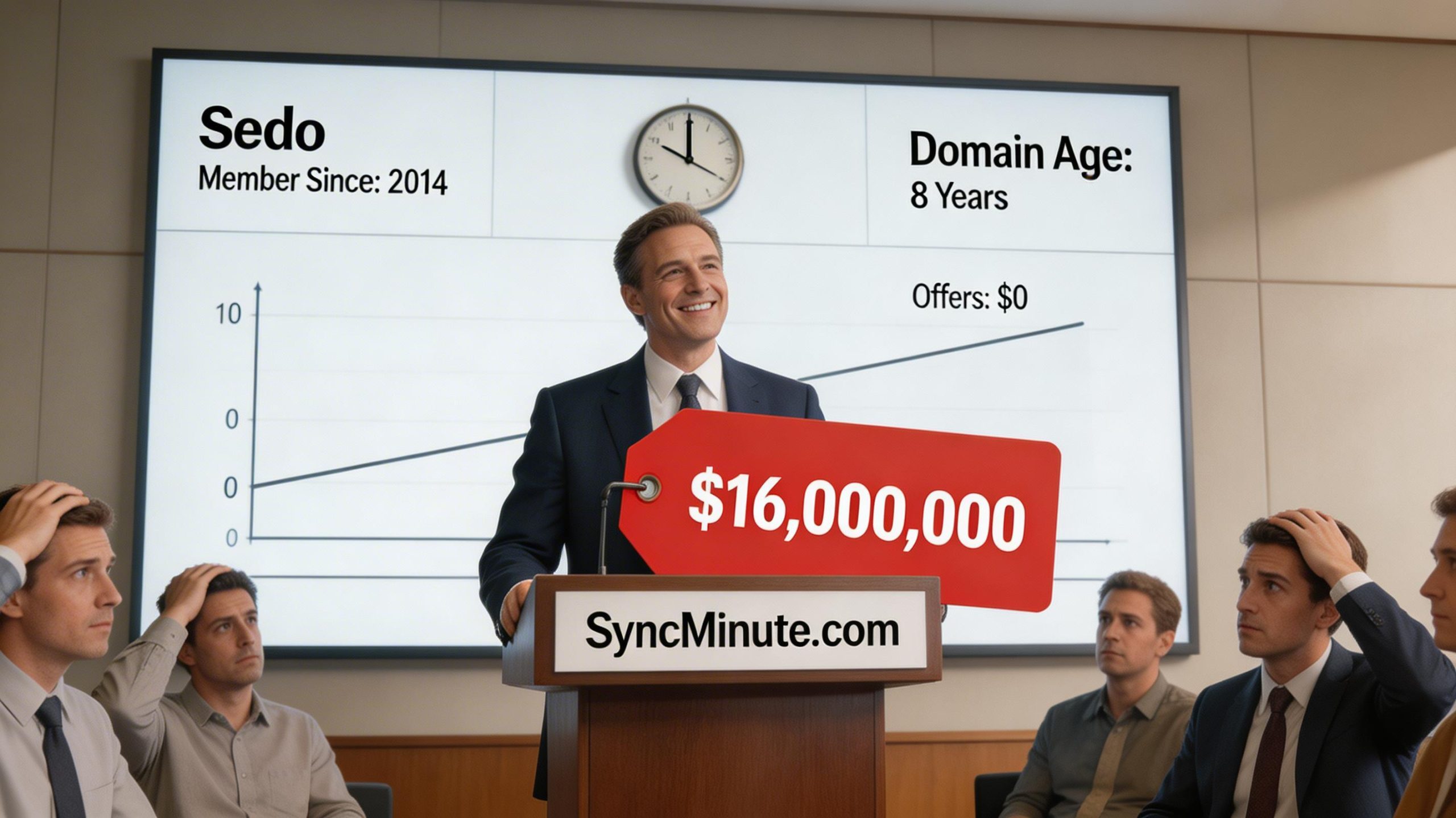
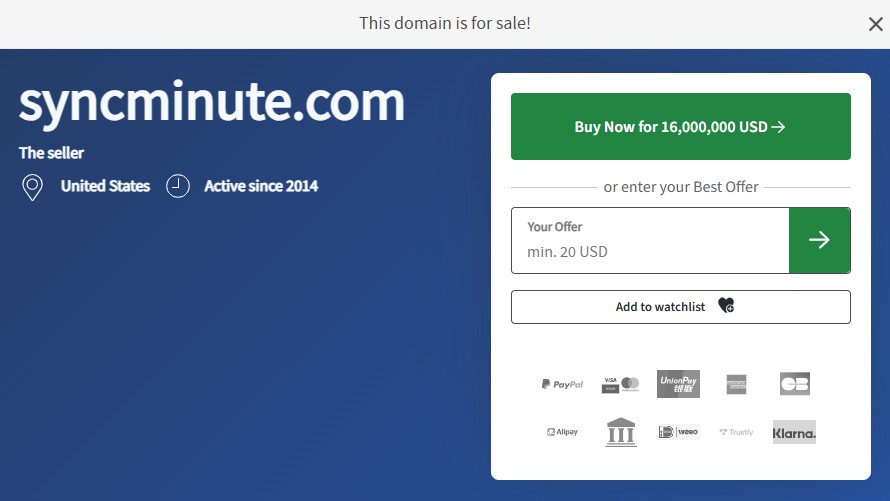
  • SyncMinute.com: The $16 Million Domain That Doesn’t Sync With Anything

    SyncMinute.com: The $16 Million Domain That Doesn’t Sync With Anything

    The Contender

    MetricDetails
    DomainSyncMinute.com
    Registration Date2018
    Domain Age~8 years
    Seller Sedo Since2014 (over a decade)
    PlatformSedo
    Asking Price$16,000,000 USD
    The PitchNone provided – just the listing
    The ProblemThe phrase makes no sense. No natural buyer. Price is pure fantasy.
    Sync-Minute

    Introduction: When Experience Doesn’t Equal Wisdom

    We’ve roasted newbies before. The “joined yesterday” crowd with $500,000 hand‑regs. The “started in 2025” sellers with random strings priced at €4.5 million. Those roasts are almost too easy.

    But SyncMinute.com is different.

    The seller has been on Sedo since 2014. That’s over a decade of experience. They’ve seen the market. They’ve watched sales happen. They’ve had time to learn what works and what doesn’t

    Yet here they are, listing SyncMinute.com for $16 million.

    The domain was registered in 2018. It’s not fresh – it’s been held for eight years. But eight years of holding doesn’t create value. What matters is what happened during those eight years. Did the domain:

    • Get developed into a website?
    • Accumulate traffic or backlinks?
    • Become a known brand?
    • Generate any revenue?

    Almost certainly not. It’s been sitting, undeveloped, for eight years. The seller has paid annual renewals (maybe $80–$100 total) and is now asking for $16 million – a 160,000x markup on a domain that has done nothing for almost a decade.

    Let’s break down why SyncMinute.com isn’t worth $16 million – and why the seller should know better.


    The Phrase Problem: What Is “Sync Minute”?

    Let’s start with the most basic question: what does “Sync Minute” mean?

    • Sync – short for synchronize. Bringing things into alignment. Data sync, device sync, calendar sync.
    • Minute – a unit of time (60 seconds). Or minute as in “small” (my‑noot), but that’s pronounced differently and rarely used in domains.

    Together, “Sync Minute” could be interpreted as:

    • A minute of synchronization (a one‑minute sync process?)
    • Synchronizing by the minute (real‑time sync?)
    • A product or service that syncs something in a minute?

    None of these are clear. None of them roll off the tongue. None of them evoke a specific industry or category.

    Compare to actual working phrases:

    • Sync.com – short, clear, valuable (but taken, and a single word)
    • MinuteSync.com – still awkward, but slightly better because it reads as “minute sync” (a sync that takes a minute)
    • SyncMinute.com – reads as “sync minute” – a minute of sync? It’s backwards.

    The phrase is not a natural compound. It’s not a common expression. It’s not a category‑defining term. It’s two words that someone put together because they sounded “techy,” but they don’t form a coherent concept.


    The 8‑Year Hold: Patience or Sunk Cost?

    The domain was registered in 2018. That’s eight years ago.

    In that time, the seller has:

    • Paid annual renewals (maybe $10–$15/year – call it $100 total)
    • Held the domain without development
    • Not built traffic, backlinks, or brand recognition
    • Not received any offers (presumably – otherwise it might have sold)

    Now they’re asking $16 million. That’s a 160,000x markup on their cost.

    Here’s the thing about holding domains: time alone doesn’t create value. A domain that sits undeveloped for eight years is not more valuable than a domain that was registered yesterday – unless it has accumulated traffic, backlinks, or some other asset during that time.

    SyncMinute.com has none of those. It’s a fresh‑feeling domain that happens to be eight years old. The age is a neutral factor at best.

    The seller might think they’re being “patient.” But patience without development is just stagnation. And stagnation isn’t a strategy – it’s a cost.


    The Seller’s Experience: Been on Sedo Since 2014

    This is the most puzzling part of the listing.

    The seller has been on Sedo for over a decade. They’ve had time to:

    • Watch thousands of domain sales
    • Understand pricing dynamics
    • Learn which TLDs and phrases have value
    • See what works and what doesn’t

    Yet they’re listing a nonsense phrase for $16 million. Either:

    • They’ve had success with other domains and are now testing the waters with a speculative listing (possible, but unlikely at this price)
    • They genuinely believe SyncMinute.com is worth $16 million (delusional)
    • They’re using the listing as a placeholder or a marketing stunt (ineffective)

    Whatever the reason, it’s a bad look. A decade of experience should teach you that SyncMinute.com is not a $16 million asset.


    The Price: $16,000,000 – What Does That Actually Buy?

    Let’s put $16 million in perspective.

    $16,000,000 buys:

    • A genuine one‑word .com in a competitive category (though the top tier – Voice.com at $30M – is higher)
    • A portfolio of hundreds of quality .com domains
    • A developed, revenue‑generating business
    • A private jet
    • A mansion in any city in the world

    What it doesn’t buy is SyncMinute.com.

    Even if we’re being generous, what’s the realistic value of SyncMinute.com?

    Factors to consider:

    • Nonsense phrase with no clear meaning
    • No traffic, no backlinks, no history of use
    • Eight years old, but undeveloped
    • No natural buyer pool
    • .com TLD is the only positive

    Realistic price range: $100 – $1,000

    At the high end, to a domain investor who sees potential in the “sync” angle and wants to take a flyer. At the low end, to someone who likes the sound of it for a small project.

    $16 million is not just optimistic – it’s 16,000 times the actual value.


    The No‑Pitch Problem

    The Sedo listing has no description. No pitch. No attempt to explain why SyncMinute.com is valuable. Just the domain name and the price.

    This is a common tactic among sellers who don’t have a real argument for why their domain is worth the asking price. They’re hoping a buyer will see the name and instantly recognize its supposed value.

    But when the name itself is weak, the silence is deafening. A $16 million listing without a description is like a luxury car dealership with no salespeople – you’re still looking at a product, but there’s no one to tell you why you should buy it.

    If the seller can’t be bothered to write a pitch, why should any buyer be bothered to inquire?


    The Defequer Analysis: Why SyncMinute.com Isn’t Worth $16 Million

    Factor 1: The Phrase – No Meaning, No Value

    “SyncMinute” is not a concept. It’s not a common phrase. It’s not a category. It’s two words that don’t belong together.

    Domains have value when they:

    • Describe a clear category or industry
    • Are commonly searched terms with commercial intent
    • Are short, memorable, and pronounceable
    • Evoke a specific emotion or idea

    SyncMinute.com does none of this. It’s a linguistic orphan – a phrase that exists only because someone typed it into a registration form.

    Factor 2: No Commercial Intent

    What would a business called “Sync Minute” do? Sync what? In a minute? Real‑time data synchronization? Calendar management? Time‑tracking software? The phrase is too vague to anchor a brand.

    A potential buyer would have to spend marketing dollars explaining what “Sync Minute” means – money that could be better spent on a domain that communicates its purpose instantly.

    Factor 3: The 8‑Year Hold – No Development, No Value

    Eight years is a long time. In that period, the seller could have:

    • Built a website on SyncMinute.com
    • Generated traffic and content
    • Created a brand with actual value
    • Sold the domain for a modest profit

    Instead, they held it. They paid renewals. They did nothing. And now they want $16 million for the privilege of doing nothing for another eight years.

    That’s not investing. That’s hoping.

    Factor 4: The Price – Disconnected From Market Reality

    $16 million is not a “make an offer” price. It’s not a “testing the waters” price. It’s a fantasy price.

    The domain market has seen eight‑figure sales – but those are for:

    • One‑word .coms (Voice.com, $30M)
    • Category‑defining terms (Insurance.com, $35.6M)
    • Domains with massive traffic and revenue potential

    SyncMinute.com is none of these. It’s a made‑up phrase with no history, no traffic, and no brand. It’s not in the same universe as real eight‑figure domains.


    The Delusion Index: 8.5/10

    FactorRatingExplanation
    Phrase Quality2/10Makes no sense. Two words that don’t belong together.
    Commercial Intent2/10No clear industry or use case.
    Domain Age5/10Eight years old, but undeveloped – neutral at best.
    Seller Experience3/10Been on Sedo since 2014 – should know better.
    Price Sanity1/10$16 million is 16,000 times the actual value.

    Overall Delusion Index: 8.5/10

    This is a high score because the seller has no excuse. A newbie making this mistake is one thing. Someone who’s been on Sedo for over a decade should have a better sense of market realities. The domain is weak, the price is absurd, and the experience makes the delusion more egregious.


    What SyncMinute.com Is Actually Worth

    Let’s do the math the seller should have done.

    Factors to consider:

    • Nonsense phrase with no clear meaning
    • No traffic, no backlinks, no history of use
    • Eight years old, but undeveloped
    • .com TLD (the only positive)

    Realistic price range: $100 – $1,000

    At the high end, to a domain investor who sees potential in the “sync” angle and wants to take a flyer. At the low end, to someone who likes the sound of it for a small project.

    $16 million is not just optimistic – it’s 16,000 times the actual value.


    The Defequer Verdict

    CategoryRating
    Phrase Quality⭐⭐☆☆☆ (2/5)
    Commercial Intent⭐⭐☆☆☆ (2/5)
    Domain Age⭐⭐⭐☆☆ (3/5 – aged but undeveloped)
    Price Sanity⭐☆☆☆☆ (1/5)
    Seller Experience⭐⭐☆☆☆ (2/5 – should know better)

    Final Word:

    “SyncMinute.com is a domain that doesn’t mean anything, listed for $16 million by a seller who has been on Sedo since 2014. Eight years of holding, zero development, zero traffic, zero value. The phrase ‘Sync Minute’ is not a concept, a category, or a brand. It’s two words that someone put together because they sounded ‘techy.’ The seller should know better. A decade of experience should teach you that nonsense phrases aren’t worth eight figures. But here we are.”


    What Should Actually Happen

    If the seller is reading this (and he should be):

    1. Drop the price to $1,000. See if there’s interest. If not, drop again.
    2. Develop the domain. If you believe in “Sync Minute,” build something. Create a product, a service, a blog. Add value. Then maybe, years later, you might sell for a meaningful price.
    3. Learn from your experience. You’ve been on Sedo since 2014. You’ve seen what sells. Apply that knowledge to your own listings.
    4. Let it go if it doesn’t sell. Eight years of holding is enough. The renewal fees add up. Cut your losses.

    For buyers: If you’re genuinely interested in SyncMinute.com, make an offer at $200–$500. The seller might be ready to deal after eight years of waiting.


    The Bottom Line

    SyncMinute.com joins the Defequer Hall of Shame as a case study in experienced seller delusion.

    A domain with no meaning. Eight years of holding with no development. A $16 million price tag. A seller who has been on Sedo since 2014 and should know better.

    The market isn’t broken. The domain is.

    Defequer Rating: 💩💩💩💩 (4/5 shits – the seller’s experience makes this delusion more disappointing.)

    Have a domain you’ve been holding for years with no buyers? Let us know!. We’ll tell you if it’s time to let go.

    Defequer.com – because someone had to flush.

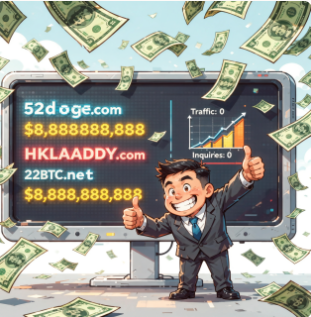
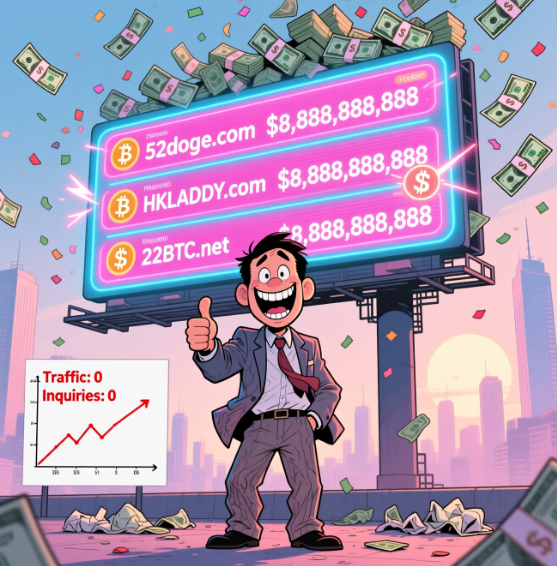
  • The $8.9 Billion Portfolio: 52doge.com, HKLADDY.com, and 22BTC.net

    The $8.9 Billion Portfolio: 52doge.com, HKLADDY.com, and 22BTC.net

    The Contenders

    Metric52doge.comHKLADDY.com22BTC.net
    Price$8,888,888,888$8,888,888,888$8,888,888,888
    Combined Total$26,666,666,664
    Platform4.cn4.cn4.cn
    Traffic (Monthly)000
    Inquiries000
    Page Views1,5559351,425
    Registrarhichinaunknownxin net
    The “Pitch”“我爱狗狗” (I love dogs)“香港丽人/香港女人” (HK beauty/woman)“爱爱btc/双数字+btc” (love love btc / double number + btc)

    Introduction: The Most Expensive Domains in Human History

    Let’s put this in perspective.

    The three domains listed on 4.cn – 52doge.com, HKLADDY.com, and 22BTC.net – have a combined asking price of over $26 billion dollars.

    That’s not a typo. Twenty‑six billion dollars.

    52doge 22btc hkladdy

    To understand how absurd this is, consider what $26 billion buys:

    • The entire domain industry’s annual aftermarket volume (estimated at ~$1‑2 billion) – you could buy it 13‑26 times over
    • Major professional sports teams (the New York Yankees sold for $3.2 billion; you could buy all 30 MLB teams and still have change)
    • A small country’s GDP (26 billion exceeds the GDP of half the nations on Earth)
    • Every single domain on NamePros, Sedo, and Afternic combined – and then some

    What does $26 billion actually buy from this seller? Three domains with:

    • Zero monthly traffic (the listings show 0 visitors)
    • Zero inquiries (询价次数: 0)
    • Zero backlinks (almost certainly)
    • Zero brand value
    • Zero logic

    The seller is asking $8,888,888,888 per domain – a number chosen for its visual appeal, not its connection to reality.

    This isn’t domain investing. It’s performance art with a price tag.


    The Platform: 4.cn – A Chinese Marketplace With a Fantasy Problem

    4.cn is a legitimate Chinese domain marketplace. It’s one of the largest in the region, handling thousands of transactions. It’s not a fly‑by‑night operation.

    But like any platform, it has listings that should never have been approved. These three are the worst of the worst.

    The listings include basic statistics that should embarrass any seller:

    • Website visits (last month): 0 – No one is typing these domains.
    • Page views (last month): 1,555, 935, 1,425 – People are clicking out of curiosity, not intent. They’re rubbernecking at a car crash.
    • Inquiries: 0 – Not a single serious buyer has asked about any of them.

    The seller has left brief descriptions:

    • 52doge.com: “我爱狗狗” (I love dogs) – a personal sentiment, not a sales pitch.
    • HKLADDY.com: “香港丽人/香港女人” (Hong Kong beauty / Hong Kong woman) – vague and culturally specific.
    • 22BTC.net: “爱爱btc/双数字+btc” (love love btc / double number + btc) – crypto buzzwords from 2021.

    None of these descriptions explain why anyone would pay $8.9 billion. Because there is no explanation.


    Domain 1: 52doge.com – “I Love Dogs” for $8.9 Billion

    The domain: 52doge.com

    The price: $8,888,888,888

    The pitch: “我爱狗狗” (I love dogs)

    Let’s break this down.

    What is “52doge”?

    • “52” is a number. In Chinese internet culture, “52” can sound like “wo ai” (I love) when spoken. It’s a leet‑speak abbreviation.
    • “Doge” is a meme – a Shiba Inu dog associated with cryptocurrency (Dogecoin).

    So “52doge” roughly translates to “I love doge” or “I love the Doge meme.”

    That’s not a brand. That’s a t‑shirt slogan. It’s not a business. It’s not a category. It’s not a high‑value keyword.

    Who would buy this?

    • A Dogecoin enthusiast with $8.9 billion? (There aren’t any.)
    • A crypto exchange? (They’d use their own brand, not a fan site.)
    • A meme archive? (They don’t have $8.9 billion.)

    The data: 0 monthly visitors. 0 inquiries. 1,555 page views – people laughing at the price.

    Realistic value: $50 – $500 (to a Dogecoin fan with spare change)


    Domain 2: HKLADDY.com – “Hong Kong Beauty” for $8.9 Billion

    The price: $8,888,888,888

    The pitch: “香港丽人/香港女人” (Hong Kong beauty / Hong Kong woman)

    What is “HKLADDY”?

    • “HK” stands for Hong Kong.
    • “LADDY” is not a word. It’s not “lady” (which would be HKLADY.com – still not valuable, but at least a real word). “LADDY” is a misspelling.

    The seller is trying to evoke “Hong Kong lady” – a beauty or woman from Hong Kong. But the misspelling kills it. No one types “laddy.” It’s a typo.

    Who would buy this?

    • A beauty brand in Hong Kong? (They’d use a real word, not a misspelling.)
    • A dating site? (They’d use a real word.)
    • A tourism company? (They’d use something descriptive, not a typo.)

    The data: 0 monthly visitors. 0 inquiries. 935 page views – people trying to understand why this exists.

    Realistic value: $0 – $100 (the misspelling makes it worthless)


    Domain 3: 22BTC.net – “Love Love Bitcoin” for $8.9 Billion

    The domain: 22BTC.net

    The price: $8,888,888,888

    The pitch: “爱爱btc/双数字+btc” (love love btc / double number + btc)

    What is “22BTC.net”?

    • “22” is a double number. In some contexts, “22” can sound like “love love” in Chinese internet slang (爱爱).
    • “BTC” stands for Bitcoin.
    • .net is the TLD – not .com, which would be slightly more valuable, but still not billions.

    So “22BTC.net” is a crypto‑themed domain with a number and a .net extension. It’s trying to capitalize on the 2021 crypto hype – three years too late.

    Who would buy this?

    • A crypto exchange? (They use .com or .io, not .net, and they don’t use numbers in their brand.)
    • A Bitcoin fan site? (They don’t have $8.9 billion.)
    • A domain investor? (Not at $8.9 billion. Not at $8,900.)

    The data: 0 monthly visitors. 0 inquiries. 1,425 page views – people marveling at the audacity.

    Realistic value: $100 – $500 (for a Bitcoin enthusiast who likes the number 22)


    The $8,888,888,888 Price: A Number Picked for Looks, Not Value

    The seller chose $8,888,888,888 for all three domains. That’s not a coincidence.

    In Chinese culture, the number 8 is considered lucky because it sounds like “发” (fa), meaning wealth or fortune. The more 8’s, the luckier – and the more expensive sellers think they can ask.

    But here’s the problem: luck doesn’t create value. A domain with eight 8’s in the price is not a domain with eight 8’s in the bank account. The seller is asking for a number that looks pretty, not one that reflects market reality.

    What $8,888,888,888 actually buys:

    • Every domain on the planet, multiple times over
    • A significant stake in Google or Apple
    • A small country’s entire economy
    • A fleet of private jets, yachts, and mansions

    What it doesn’t buy: 52doge.com, HKLADDY.com, or 22BTC.net.


    The Seller: Anonymous, Optimistic, Unreachable

    The listings include a QQ number (3188954172) – a Chinese instant messaging platform. No name, no company, no track record.

    The seller has provided zero evidence of why these domains are valuable. No traffic data (it’s 0). No backlink profiles. No comparable sales. No business plan. Just a price tag and a wish.

    The “descriptions” are laughably inadequate:

    • “I love dogs” for 52doge.com
    • “Hong Kong beauty” for HKLADDY.com (with a misspelling)
    • “Love love BTC” for 22BTC.net

    These aren’t sales pitches. They’re chat room nicknames.


    The Defequer Analysis: Why These Domains Are Worth Zero

    Factor 1: Zero Traffic, Zero Interest

    The listings themselves show 0 website visits in the last month. That means no one is typing these domains into browsers. No type‑in traffic. No organic discovery. No nothing.

    The page views (1,555, 935, 1,425) are from people rubbernecking at the price, not potential buyers. Zero inquiries confirm that not a single serious person has asked about any of them.

    Market feedback: The domains have no audience, no demand, and no value.

    Factor 2: The Domains Themselves Are Weak

    • 52doge.com – A meme reference from 2013. Dogecoin is still around, but “52doge” is not a brand. It’s a personal expression.
    • HKLADDY.com – A misspelling of “lady.” No one types “laddy.” No business wants a typo as their main domain.
    • 22BTC.net – A .net extension with a double number. .net is weaker than .com. Numbers are weaker than words. Crypto domains are out of fashion.

    Factor 3: The Price Is Disconnected From Reality

    $8.9 billion is not a “negotiable” price. It’s not a “make an offer” price. It’s a joke.

    Even if these domains were perfect – one‑word .coms with massive traffic – they wouldn’t sell for $8.9 billion. The highest domain sale in history is around $872 million for Cars.com (and that was a corporate acquisition, not a speculative listing). Most million‑dollar sales are in the low seven figures.

    $8.9 billion is 10 times the highest sale ever – for domains that are worthless.

    Factor 4: The 4.cn Platform Context

    4.cn is a real marketplace. It handles legitimate transactions. But it also allows any seller to list at any price. There’s no “reality check” button.

    The seller is taking advantage of that openness. They’ve listed three domains at prices that guarantee they will never sell, on a platform that has no incentive to tell them otherwise.

    The result: three listings that will sit untouched, accumulating page views from curious onlookers, until the seller either comes to their senses or lets them expire.


    The Delusion Index: 10/10 – The Highest Possible Score

    FactorRatingExplanation
    Price Sanity0/10$8.9 billion per domain – more than the entire domain aftermarket
    Domain Quality1/10Meme references, misspellings, weak TLDs
    Traffic/Data0/10Zero monthly visitors, zero inquiries
    Seller Realism0/10No track record, no sales pitch, just a QQ number
    Market Awareness0/10Thinks a Doge meme domain is worth billions

    Overall Delusion Index: 10/10

    This is the first time we’ve given a perfect score. These domains are not just overpriced – they’re priced at a level that has no precedent in human history. The seller is asking for more money than exists in the entire domain aftermarket. The delusion is complete.


    What These Domains Are Actually Worth

    Let’s do the math the seller should have done.

    52doge.com:

    • Meme reference, no commercial value
    • Zero traffic
    • Realistic value: $50 – $500

    HKLADDY.com:

    • Misspelling of “lady”
    • Zero traffic
    • Realistic value: $0 – $100

    22BTC.net:

    • Crypto term, .net TLD
    • Zero traffic
    • Realistic value: $100 – $500

    Combined realistic value: $150 – $1,100

    Combined asking price: $26,666,666,664

    That’s a 24 million times markup. The seller is asking for 24 million times what these domains are worth.


    The Defequer Verdict

    Category52doge.comHKLADDY.com22BTC.net
    Name Quality⭐☆☆☆☆ (1/5)⭐☆☆☆☆ (1/5)⭐⭐☆☆☆ (2/5)
    Traffic/Data⭐☆☆☆☆ (0/5)⭐☆☆☆☆ (0/5)⭐☆☆☆☆ (0/5)
    Price Sanity⭐☆☆☆☆ (0/5)⭐☆☆☆☆ (0/5)⭐☆☆☆☆ (0/5)
    Seller Realism⭐☆☆☆☆ (0/5)⭐☆☆☆☆ (0/5)⭐☆☆☆☆ (0/5)

    Final Word:

    “52doge.com, HKLADDY.com, and 22BTC.net are listed on 4.cn for $8,888,888,888 each. Combined price: over $26 billion. That’s more than the GDP of half the world’s countries. The domains have zero monthly traffic, zero inquiries, and zero chance of selling. ‘52doge’ is a meme reference from 2013. ‘HKLADDY’ is a misspelling of ‘lady.’ ‘22BTC.net’ is a .net domain with a number, trying to ride crypto hype that died three years ago. The seller chose the price for its lucky number of 8’s – not because it reflects any market reality. This isn’t domain investing. It’s a fantasy, typed into a listing form, waiting for a buyer who will never come.”


    What Should Actually Happen

    If the seller is reading this (and we hope they are):

    1. Delete all three listings. You’re not selling them for $8.9 billion. You’re not selling them for $8.9 million. You’re not selling them for $8,900.
    2. Let them expire. The renewal fees are more than the domains are worth. Cut your losses.
    3. Stop using “lucky numbers” as prices. 8’s are lucky, but they don’t create value. The market doesn’t care about your numerology.
    4. Learn what makes a domain valuable. Traffic, brandability, commercial intent, TLD strength. None of your domains have any of these.
    5. If you want to sell domains, start with real research. Look at NameBio. See what actually sells. Then register names that fit the data – not memes from 2013.

    For buyers: If you see these domains, ignore them. They’re not worth your time. The seller is not serious.


    The Bottom Line

    52doge.com, HKLADDY.com, and 22BTC.net join the Defequer Hall of Shame as the most delusional listings we have ever seen.

    Three domains. Zero traffic. Zero inquiries. $26 billion asking price. A seller who thinks a Doge meme is worth more than the GDP of a small country.

    This isn’t domain investing. It’s performance art with a price tag.

    Defequer Rating: 💩💩💩💩💩💩💩💩💩💩 (10/10 shits – the perfect score.)


    Have a domain priced at a billion dollars? Submit it here. We’ll tell you why it’s not worth it.

    Defequer.com – because someone had to flush.

  • SellsMan.com: The Domainer Who Blames the Market for His Own Bad Choices

    SellsMan.com: The Domainer Who Blames the Market for His Own Bad Choices

    The Contender

    MetricDetails
    SellerSellsMan.com (NamePros VIP Member)
    PortfolioSellsMan.com (website)
    The Complaint“Are domain sales dead this year? I’ve been actively trying to sell several domains… not a single bite.”
    The DomainsVaktsina.com, ContactLensess.com, My-insure.com, Artificial-intellect.com, Health-Cares.com, Blokchein.com, Cliccs.com, Odissei.com, and more
    The Pitch“Vaktsina.com is actually a five‑figure domain for the local market.”
    The RealityMisspellings, extra letters, hyphens, and made‑up words that no one wants.

    Introduction: When the Mirror Is the Last Place You Look

    There’s a certain type of domainer who, when faced with failure, looks everywhere but inward. The market is rigged. The sales reports are fake. The buyers are blind. Everyone else is wrong.

    SellsMan.com is that domainer.

    A VIP member on NamePros, he started a thread titled: “Are domain sales dead this year? My frustrating experience with failed outbound for Vaktsina.com (the transliterated version of vaccine.com).”

    His complaint: he reached out to “hundreds of vaccine russian manufacturers” (including AstraZeneca) and got no bites. He suspects that most reported high‑value sales are “money laundering or viral marketing.” He feels domaining is “a waste of time.”

    Then he shared his portfolio. And that’s where the real story begins.

    Let’s look at his domains. Let’s look at his approach. And let’s explain why the problem isn’t the market—it’s him.


    The Complaint: “Domain Sales Are Dead”

    SellsMan.com writes:

    “I’ve been actively trying to sell several domains by reaching out to companies that currently use inferior or longer versions. I offered them a premium .com upgrade for as low as $100, but had no takers.”

    He then pitched Vaktsina.com to Russian vaccine manufacturers. No bites. His conclusion: domaining is a waste of time, sales reports are fake, and the industry is a setup.

    The response from experienced members was swift and direct:

    “Outbound has never been easy. On top of that, you might be choosing the wrong domains.” – Brad (DataCube.com)

    “Your names aren’t premium. If they were, someone else would have acquired them before you. Improper spelling of words with extra ‘s’ is not impressive.” – biggie

    But SellsMan.com wasn’t listening. He doubled down:

    “Vaktsina.com is actually a five‑figure domain for the local market.”

    No. It isn’t.


    The Portfolio: A Graveyard of Bad Decisions

    Let’s take a tour of SellsMan.com’s portfolio. He’s organized them into “Elite,” “Premium,” “Bargain,” and “Sale” categories. He even includes a section titled “Most Expensive General Domains (For Comparison)” with sales like Cars.com ($872M) and Voice.com ($30M) – as if his domains belong in that conversation.

    They don’t.

    Here’s a sampling of what he’s actually selling:

    DomainProblem
    Vaktsina.comTransliterated Russian for “vaccine.” Not a natural word in English. No Russian manufacturer will pay five figures for a .com when they use .ru.
    ContactLensess.comContact Lenses with an extra “s.” A typo. Worthless.
    My-insure.comA hyphen. Hyphens kill value. No one types hyphens.
    Artificial-intellect.comHyphenated and 21 characters long. “Intellect” instead of “intelligence.” A disaster.
    Health-Cares.comHyphen + unnecessary plural. Cares? No.
    Blokchein.comMisspelling of “Blockchain.” A typo that will never sell.
    Cliccs.comClicks with an extra “c.” Why?
    Odissei.comMisspelling of “Odyssey.”
    Bodyst.comWhat is this? “Body” + “st”?
    iLavU.com“I love you” spelled like a 2005 text message. Not premium.
    Wallsts.com“Wall Street” with an extra ‘s’ and missing ‘e’?
    e-Pays.comHyphen + plural.
    Shejh.comRandom letters.
    Dvjg.comFour random consonants.

    And he calls these “Elite” and “Premium.”

    The only thing “elite” about this portfolio is the audacity to list them next to Cars.com and Voice.com.


    The Delusion: “Five‑Figure Domain for the Local Market”

    Let’s focus on Vaktsina.com, the domain that broke him.

    The claim: “Vaktsina.com is actually a five‑figure domain for the local market.”

    The reality:

    • “Vaktsina” is a transliteration of the Russian word for vaccine. It’s not a natural word in English or any other major language.
    • Russian vaccine manufacturers use .ru domains, not .com. The local market is on .ru.
    • Even if a Russian company wanted a .com, they’d want the English word “vaccine” or a brand name, not a transliteration that looks like a typo to anyone who doesn’t read Cyrillic.
    • No one is paying five figures for this. Not now. Not ever.

    SellsMan.com sent “hundreds” of outbound emails. He got no replies. That’s not bad luck—it’s market feedback. The market told him the domain has no value. He blamed the industry.


    The Outbound Problem: Spamming Isn’t Selling

    SellsMan.com’s outbound strategy appears to be: find companies, offer them a “premium upgrade” for $100, and expect them to jump.

    But here’s the thing: outbound only works when the domain is a genuine upgrade. If a company is using BestVaccineRussia.ru and you offer them Vaktsina.com, you’re not upgrading them. You’re offering them a worse name.

    He also mentions reaching out to AstraZeneca – a multinational pharmaceutical company still operating in Russia despite sanctions. Why would AstraZeneca buy Vaktsina.com? They have their own brand. They don’t need a transliterated .com. The fact that he thought this was a viable target shows a fundamental misunderstanding of how big companies operate.

    The experienced domainers in the thread tried to explain:

    “I am not sure why companies worth billions would need the example domain you gave, or how you would even be able to get in contact with decision makers.” – Brad

    SellsMan.com didn’t have an answer. He just repeated that Vaktsina.com is a five‑figure domain.


    The “Sales Reports Are Fake” Conspiracy

    When his outbound failed, SellsMan.com didn’t question his domains. He questioned the industry:

    “I’m starting to think most reported high-value sales (except maybe outliers like ai.com) are either money laundering or viral marketing. I suspect many sales reports are fake, designed to trick us into spending money on keeping our portfolios alive.”

    This is a classic coping mechanism. When you can’t sell your own domains, it’s easier to believe that everyone else is lying than to accept that your domains aren’t valuable.

    But here’s the truth: sales reports aren’t fake. NameBio tracks thousands of real transactions every day. Domainers on X (Twitter) and in private Discords share sales constantly. The market is alive and well – for people with good domains.

    The problem isn’t the industry. It’s the inventory.


    The Portfolio Website: Confidence Without Substance

    SellsMan.com has a professional‑looking portfolio site. It’s well‑designed, with categories, pricing tiers, and even a section comparing his domains to the biggest sales in history.

    But the design doesn’t make the domains better. You can put a clown in a tuxedo, but he’s still a clown.

    The “Elite” category includes:

    The “Premium” category includes:

    The “Bargain” and “Sale” categories include:

    He also lists TheIntellectualProperty.com (too long, unnecessary “The”) and Search-Engine-Optimizations.com (hyphenated, plural, a nightmare).

    Not a single domain in this portfolio would sell for more than low three figures, and most are worth $0.


    The Defequer Analysis: Why SellsMan.com Can’t Sell

    Factor 1: Misspellings and Extra Letters

    ContactLensess.com – two ‘s’s at the end? Cliccs – extra ‘c’? Wallsts – what is that? These aren’t typos you can recover from. They’re fundamental errors. No brand wants a domain that looks like a mistake.

    Factor 2: Hyphens Kill Value

    My-insure.com, Health-Cares.com, Artificial-intellect.com, e-Pays.com. Hyphens are domain poison. They’re hard to type, hard to remember, and scream “the .com I wanted was taken.” No premium brand uses hyphens.

    Factor 3: Transliterations Aren’t Valuable

    Vaktsina.com is the poster child. Just because a word exists in another script doesn’t mean the Latin spelling is a valuable domain. The local market uses local TLDs. The global market uses English words. Transliterations fall into a no‑man’s land.

    Factor 4: Made‑Up Words That Don’t Work

    Odissei, Boutics, Blokchein, Shejh, Dvjg, riill, Bodyst. These aren’t brandable – they’re random strings. A good brandable is short, memorable, and easy to say. These are none of the above.

    Factor 5: Blaming the Market Instead of Improving

    The most delusional part of SellsMan.com’s post is the refusal to accept feedback. Experienced domainers told him his names aren’t premium. He ignored them. He doubled down. He invented a conspiracy about fake sales reports rather than admit he might be wrong.

    That’s not a strategy. That’s denial.


    The Delusion Index: 9/10

    FactorRatingExplanation
    Domain Quality1/10Misspellings, hyphens, transliterations, random strings.
    Outbound Targeting1/10Cold‑emailing AstraZeneca for a transliterated .com is delusional.
    Market Awareness1/10Blames the industry, ignores feedback, invents conspiracies.
    Portfolio Presentation6/10The website looks professional, but it’s lipstick on a pig.
    Price Sanity1/10Calling Vaktsina.com “five‑figure” is fantasy.

    Overall Delusion Index: 9/10

    This is a high score because SellsMan.com has all the tools to succeed – a professional site, NamePros VIP status, years in the game – but he refuses to use the one tool that matters: self‑awareness. His domains are bad. His outbound is spam. His conspiracy theories are embarrassing. And he blames everyone but himself.


    The Defequer Verdict

    CategoryRating
    Portfolio Quality⭐☆☆☆☆ (1/5)
    Outbound Strategy⭐☆☆☆☆ (1/5)
    Receptiveness to Feedback⭐☆☆☆☆ (1/5)
    Market Understanding⭐☆☆☆☆ (1/5)
    Website Design⭐⭐⭐⭐☆ (4/5 – but it’s wasted on bad domains)

    Final Word:

    “SellsMan.com is a VIP NamePros member with a professional‑looking portfolio site and a lot of frustration. He’s convinced that domain sales are dead, that reported sales are fake, and that the industry is rigged against him. The truth is simpler: his domains are bad. ContactLensess.com has an extra ‘s.’ My-insure.com has a hyphen. Artificial-intellect.com is a 21‑character monstrosity. Vaktsina.com is a transliteration that no one wants. He spammed hundreds of companies, got no replies, and concluded the market is broken. The market isn’t broken. His domains are. Until he accepts that, he’ll keep paying renewal fees and blaming the industry.”


    What Should Actually Happen

    If SellsMan.com is reading this (and he probably will):

    1. Let 90% of your portfolio expire. Keep one or two that have a glimmer of potential. The rest are renewal‑fee traps.
    2. Stop outbound spam. Cold‑emailing AstraZeneca with Vaktsina.com is not a strategy. It’s a waste of time.
    3. Listen to the feedback you asked for. Brad and biggie told you the truth. You ignored them. That’s on you.
    4. Learn what makes a domain valuable. Short, pronounceable, .com, no hyphens, no misspellings, commercial intent. Your portfolio has none of these.
    5. Stop blaming the industry. Sales reports aren’t fake. You’re not succeeding because your domains aren’t good. That’s not a conspiracy – it’s a fact.

    For buyers: If you see a domain from SellsMan.com, check it carefully. Most are misspelled or hyphenated. Don’t pay more than $50 for any of them.


    The Bottom Line

    SellsMan.com’s portfolio joins the Defequer Hall of Shame as a case study in denial‑fueled domain investing.

    A professional website. A VIP forum badge. Years of experience. And a collection of domains that are misspelled, hyphenated, transliterated, or just nonsense. When the sales didn’t come, he blamed the industry, not himself.

    The market isn’t dead. His domains are.

    Defequer Rating: 💩💩💩💩💩 (5/5 shits – the combination of bad domains, conspiracy theories, and refusal to accept feedback earns top marks.)


    Have a portfolio full of misspellings and hyphens? Share it with us. We’ll tell you why it’s not working.

    Defequer.com – because someone had to flush.

  • PayPalMoneyPool.com: The $499 Domain That’s a Lawsuit Waiting to Happen

    PayPalMoneyPool.com: The $499 Domain That’s a Lawsuit Waiting to Happen

    The Contender

    MetricDetails
    DomainPayPalMoneyPool.com
    Registration DateMay 30, 2025
    ExpiresMay 30, 2026
    RegistrarGname
    Atom Appraisal$8,999 (7.7/10)
    Seller’s Price$499 (with a “24 hours only” urgency gimmick)
    The Pitch“25 TLDs registered. Root word STR for Pay: 8.57%. Root word STR for Pal: 6.19%. Keyword Synergy (Pay and Pal). Long (15 Letters).”
    The ProblemIt contains “PayPal,” a famous trademark. The domain is a UDRP case waiting to happen.

    Introduction: The Trademark Trap

    Paypal-Moneypool

    Every so often, a domain listing appears that’s not just overpriced—it’s legally dangerous. This is one of those.

    PayPalMoneyPool.com contains the word “PayPal” —a registered trademark of one of the largest financial technology companies in the world. PayPal Holdings, Inc. has a market capitalization of over $70 billion and a legal team that actively protects its brand.

    The seller, who registered this domain in May 2025 (less than a year ago), is trying to flip it for $499. They’ve dressed it up with:

    • An Atom AI appraisal of $8,999 (misleading)
    • Claims about “25 TLDs registered” (meaningless)
    • “Root word STR” percentages (pseudo‑data)
    • A “24 hours only” urgency gimmick

    None of that changes the fundamental problem: this domain infringes on a famous trademark. The seller doesn’t own “PayPal.” They can’t sell it. They can’t use it. They can only lose it—either through a UDRP, a lawsuit, or by letting it expire.

    Let’s break down why this domain is worth exactly $0—and why the seller’s “appraisal” is dangerously misleading.


    The Trademark Problem: You Can’t Sell What You Don’t Own

    Let’s start with the most basic fact: “PayPal” is a trademark.

    It’s not a generic term. It’s not a dictionary word. It’s a famous brand owned by PayPal Holdings, Inc. The company has spent billions building that brand over more than two decades.

    Adding “MoneyPool” to the end doesn’t make it yours. It doesn’t create a new, distinct brand. It just makes it a clearer infringement. The domain reads as a PayPal‑related service—exactly the kind of thing that triggers a UDRP complaint.

    What would happen if this domain were challenged?

    Under the UDRP, PayPal would need to prove three things:

    1. The domain is identical or confusingly similar to a trademark in which they have rights. “PayPalMoneyPool.com” contains the entire “PayPal” mark. That’s not just similar—it’s the mark plus a generic term. This is textbook confusing similarity.
    2. The registrant has no rights or legitimate interests in the domain. The seller doesn’t have a business called “PayPal Money Pool.” They’re not commonly known by that name. They’re not making a legitimate non‑commercial or fair use. They’re trying to sell it. That’s not a legitimate interest—it’s speculation on someone else’s trademark.
    3. The domain was registered and is being used in bad faith. Registering a domain that includes a famous trademark, with no connection to that trademark, and offering it for sale is textbook bad faith. The UDRP is filled with cases exactly like this.

    The outcome: The domain would be transferred to PayPal. The seller would lose the domain and pay legal fees. The “appraisal” would be irrelevant.


    The “Atom AI Appraisal” Problem: Garbage In, Garbage Out

    The seller prominently cites an Atom AI appraisal: $8,999 with a 7.7/10 rating.

    Here’s the problem with automated appraisals: they don’t check trademarks. They don’t understand legal risk. They look at length, keywords, TLD, and maybe some sales data—and they spit out a number.

    An AI doesn’t know that “PayPal” is a trademark. It just sees “PayPal” as a high‑value keyword. That’s not a market signal—it’s a warning sign.

    The seller is using this appraisal to justify their $499 price. They’re implying that the domain is worth nearly $9,000, so $499 is a bargain. In reality, the domain is worth $0. The appraisal is not just misleading—it’s dangerous. It gives sellers false confidence to list domains that will only get them into legal trouble.

    The rule: Never rely on an automated appraisal for a domain that includes a famous trademark. The AI doesn’t know the law. You should.


    The “25 TLDs Registered” Claim: A Red Flag, Not a Selling Point

    The seller boasts that the domain is “registered in 25 TLDs.” This is meant to suggest demand or value—like, “Look how many people want this name!”

    In reality, it means the seller (or someone else) spent money registering the same trademark‑infringing name across multiple extensions. That’s not a sign of value—it’s a multiplication of legal risk.

    If PayPal comes after one of these domains, they’ll come after all of them. Registering paypalmoneypool.net, .org, .xyz, etc., doesn’t make the .com more valuable. It just gives PayPal more reasons to file a single complaint covering all the infringing domains.

    The “25 TLDs” claim is also likely inflated. A quick check shows that many of those registrations are probably defensive or speculative, not evidence of market demand. But even if they were, it wouldn’t matter. You can’t create value by multiplying a bad idea.


    The “Root Word STR” Nonsense

    The seller includes two percentages:

    • “Root word STR for Pay: 8.57%”
    • “Root word STR for Pal: 6.19%”

    What does that mean? Almost certainly nothing.

    “STR” stands for “Sales‑Through Rate” in some contexts—the percentage of times a keyword appears in domain sales. But “Pay” and “Pal” aren’t independent keywords here. They’re part of a trademark. Any data about “Pay” or “Pal” in isolation is irrelevant when the combined term is a protected brand.

    This is the domain equivalent of saying: “The letters ‘A’ and ‘P’ appear frequently in dictionary words, so Apple.com must be valuable.” It’s pseudo‑data designed to sound impressive. It doesn’t change the legal reality.


    The “Keyword Synergy” Claim

    The seller also claims “Keyword Synergy (Pay and Pal).” This is the most revealing part of the listing. The seller knows that “PayPal” is the draw. They’re trying to frame it as a combination of two generic words—“Pay” and “Pal”—rather than a trademark.

    But “PayPal” isn’t generic. It’s a famous brand. The “synergy” is trademark infringement. The seller is hoping a buyer will see “Pay” and “Pal” and think “brandable.” But any buyer with half a brain—or a lawyer—will see “PayPal” and run.


    The Urgency Gimmick: “24 Hours Only”

    The listing includes: “Offer End only 24 Hours.” This is a classic sales tactic designed to create artificial urgency. The seller wants you to think you need to act fast before someone else snaps up this “deal.”

    But here’s the reality: no one else is going to snap up a trademark‑infringing domain. The “24 hours” is a countdown to nothing. The domain will still be there tomorrow, next week, and next month—until it expires or gets taken in a UDRP.

    If a seller has to create fake urgency, it’s because the domain can’t sell on its own merits. This one can’t.


    The Defequer Analysis: Why PayPalMoneyPool.com Is Worth $0

    Factor 1: Trademark Infringement – The Deal‑Breaker

    This is the only factor that matters. The domain contains a famous trademark. There’s no legitimate use that wouldn’t infringe on PayPal’s rights. The UDRP precedent is overwhelming:

    • Domains that incorporate famous trademarks are almost always transferred.
    • The fact that the registrant adds a generic term (“MoneyPool”) doesn’t save it.
    • Offering the domain for sale is itself evidence of bad faith.

    The domain has no value because it can’t be used or sold without legal consequences. The only “buyer” would be PayPal itself—and they wouldn’t pay $499. They’d file a UDRP and get it for free.

    Factor 2: The Age – Registered in 2025, Already a Target

    The domain was registered in May 2025. It’s less than a year old. It has no history, no traffic, no legitimate use. It’s a fresh hand‑reg of a trademark‑infringing name.

    This is actually worse than an aged domain. An aged domain might have a plausible history of legitimate use. This one has none. The registration date alone is evidence of bad faith.

    Factor 3: The Appraisal – Misleading and Dangerous

    The Atom AI appraisal of $8,999 is a classic case of an algorithm ignoring legal reality. It’s not just wrong—it’s dangerous. It gives sellers false confidence to list domains that will only get them into trouble.

    If you’re reading this and you own a domain that includes a famous trademark, do not rely on an automated appraisal. Consult a lawyer. Or just let the domain expire.

    Factor 4: The Seller’s “Research” – Cherry‑Picked Nonsense

    The seller has clearly done some research. They’ve looked up “STR” percentages. They’ve checked how many TLDs are registered. They’ve run an Atom appraisal.

    But they’ve ignored the one thing that matters: the law. All the data in the world doesn’t change the fact that “PayPal” is a trademark. The seller’s research is impressive in its detail and irrelevant in its conclusion.


    The Delusion Index: 9/10

    FactorRatingExplanation
    Trademark Safety0/10Contains “PayPal.” Guaranteed UDRP outcome.
    Domain Age1/10Registered 2025, no history, no legitimacy.
    Appraisal Reliance1/10Atom AI doesn’t check trademarks. The $8,999 number is fiction.
    Seller Awareness1/10Ignored legal risk, focused on irrelevant data.
    Urgency Gimmick2/10“24 hours only” is a transparent sales tactic.

    Overall Delusion Index: 9/10

    This is a high score because the domain is not just overpriced—it’s legally toxic. The seller has dressed it up with data and appraisals, but none of that changes the core problem. A domain that can’t be used without legal consequences is worth $0.


    What PayPalMoneyPool.com Is Actually Worth

    Let’s do the math the seller should have done.

    Factors to consider:

    • Contains a famous trademark
    • No legitimate use
    • Guaranteed UDRP outcome
    • Registered less than a year ago
    • No traffic, no history

    Realistic value: $0

    That’s not a typo. This domain has negative value because holding it exposes the registrant to legal costs. The seller is asking $499. A UDRP filing fee alone is $1,500. The math doesn’t work.


    The Defequer Verdict

    CategoryRating
    Trademark Safety⭐☆☆☆☆ (1/5 – actually zero)
    Domain Age⭐☆☆☆☆ (1/5)
    Appraisal Accuracy⭐☆☆☆☆ (1/5)
    Seller Research⭐⭐☆☆☆ (2/5 – detailed, but irrelevant)
    Price Sanity⭐☆☆☆☆ (1/5)

    Final Word:

    “PayPalMoneyPool.com contains a famous trademark. That’s not a selling point—it’s a death sentence. The seller has wrapped this domain in an Atom AI appraisal, “root word STR” percentages, and a claim about 25 TLDs registered. They’ve added a “24 hours only” urgency gimmick. They’re asking $499. None of it matters. PayPal’s legal team has handled hundreds of cases exactly like this. The domain will either expire or be transferred in a UDRP. The appraisal is fiction. The data is irrelevant. The domain is worthless.”


    What Should Actually Happen

    If the seller is reading this (and we hope he is):

    1. Let the domain expire. It’s set to expire in May 2026. Don’t renew it. Cut your losses.
    2. Don’t register domains that include famous trademarks. “PayPal” is not “Pay” + “Pal.” It’s a brand. The law is clear.
    3. Ignore automated appraisals for trademark‑sensitive domains. The AI doesn’t know the law. You need to.
    4. Stop using urgency gimmicks. “24 hours only” is a transparent sales tactic. It doesn’t make a bad domain good.
    5. Learn the lesson. You spent money registering this domain and probably others. That money is gone. Learn from it.

    For buyers: If you see this domain, run. Don’t touch it. Don’t make an offer. The only thing you’ll get is a UDRP complaint.


    The Bottom Line

    PayPalMoneyPool.com joins the Defequer Hall of Shame as a case study in trademark ignorance dressed up in data.

    An Atom AI appraisal. “Root word STR” percentages. A claim about 25 TLDs. A “24 hours only” urgency gimmick. And at the center of it all, a domain that includes one of the world’s most famous trademarks.

    The seller did their research—just not the research that matters. They looked at keywords and appraisals. They ignored the law. The result is a domain that’s worth $0, listed for $499, and guaranteed to attract legal trouble.

    Defequer Rating: 💩💩💩💩💩 (5/5 shits – the combination of trademark infringement, fake urgency, and misleading appraisal earns top marks.)

    Paypal-Moneypool

    Have a domain that includes a famous trademark? Share it with us. We’ll tell you why it’s a liability, not an asset.

    Defequer.com – because someone had to flush.

error: Content is protected !!