
Blog

  • Brad Mugford: The Quiet Professional Who Lets His Domains Speak for Themselves

    Brad Mugford: The Quiet Professional Who Lets His Domains Speak for Themselves

    The Winner

    MetricDetails
    SellerBrad Mugford (DataCube.com)
    Domain SoldImproveMyself.com
    Sale Price$7,500
    Sale DateMarch 20, 2026
    PlatformAfternic (inbound — buyer came to him)
    Portfolio PhilosophyNo outbound sales, ever. Buyers come to him.
    Notable HoldingDataCube.com (developed, not parked)

    Introduction: A Different Kind of Domainer

    If you’ve spent any time on Defequer, you’ve seen a parade of delusion: hand‑regs priced at $500,000, IDNs with accents no one can type, new gTLDs with $1.5 million price tags, and sellers who think an automated appraisal means they’ve struck gold.

    It’s easy to forget that there’s another side to domain investing—one built on patience, knowledge, and genuine value.

    Brad Mugford represents that side.

    In March 2026, Brad sold ImproveMyself.com for $7,500 through Afternic. The buyer came to him. He didn’t send a single email. He didn’t run a “48‑hour ultimatum” campaign. He didn’t cite an Atom appraisal or a cherry‑picked comp. He simply owned a quality domain, listed it at a reasonable price, and waited.

    This isn’t luck. It’s a philosophy built over decades, grounded in a deep understanding of what makes a domain valuable—and what doesn’t.

    Let’s celebrate a win the right way, and learn from someone who actually knows what he’s doing.


    Who Is Brad Mugford?

    Brad is best known as the owner of DataCube.com—but that domain isn’t just a parked page with a fantasy price. It’s a developed data‑centric business. He didn’t register it yesterday and hope for a miracle. He built something.

    His contributions to the domain community go far beyond his own portfolio:

    • ICANN Public Comment (2022): Brad submitted a thoughtful analysis of the UDRP process, arguing that it works well for clear‑cut trademark abuse but needs balance when dealing with generic, high‑value domains. He emphasized protecting registrant rights alongside trademark holder rights—a nuanced take from someone who actually understands the policy landscape.
    • NamePros AMA: His “Ask Me Anything” thread runs over 20 pages of detailed, humble answers. He’s been asked about everything from valuation to development to outbound sales. His consistent message: know what you’re holding, price it realistically, and let the market come to you.
    • No Outbound Sales: Brad has stated repeatedly that he never does outbound sales. He doesn’t cold‑email potential buyers. He doesn’t use brokers to hunt for leads. He lets his domains sit on marketplaces with fair prices, and when the right buyer appears, they find him.

    That last point is crucial. In an industry flooded with desperate sellers sending spam emails and creating false urgency, Brad’s approach is almost radical: if the domain has real value, the buyer will find it.


    The Sale: ImproveMyself.com at $7,500

    Let’s look at what sold.

    ImproveMyself.com is:

    • A two‑word .com
    • A clear, actionable phrase
    • Highly relevant to personal development, self‑help, coaching, and wellness
    • Brandable, memorable, and easy to communicate
    • Aged (since 2004)

    It’s the kind of domain that a coach, a course platform, a content creator, or a self‑improvement app would actually want. The buyer who came to Brad through Afternic saw the value, paid the asking price, and has already build a solid business on it.

    Now compare that to the domains we usually roast:

    Our RoastsImproveMyself.com
    Hand‑reg from last weekAged, with inherent value
    Fantasy price (10x‑100x reality)$7,500 — a fair, market‑aligned price
    No end‑user fitClear fit for personal development market
    Seller ignores adviceSeller is the one giving advice
    Automated appraisal as “proof”No appraisal needed; the market spoke

    Brad didn’t need an Atom estimate or a GoDaddy appraisal. He knew what he had, priced it sensibly, and waited for the right buyer. That’s not luck—it’s experience.


    Why ImproveMyself.com Worked

    Let’s break down why this domain was worth $7,500 and why it sold.

    Factor 1: The Phrase Has Genuine Commercial Value

    “Improve myself” is a common search term. It’s what people type when they’re looking for self‑help resources, coaching, courses, or tools. That’s buyer intent, not just curiosity.

    Domains with clear commercial intent—where someone would actually pay money to achieve the goal—are the ones that attract end‑user buyers. “ImproveMyself” fits that category perfectly.

    Factor 2: It’s Brandable Without Being Cutesy

    The domain is straightforward. It’s not a made‑up word that requires a marketing budget to explain. It’s not a generic keyword stack like “bestimproveyourselfnow.com.” It’s clean, honest, and immediately understandable.

    A coach or course creator can build a brand around “Improve Myself” without having to spend years teaching people what it means. That’s real value.

    Factor 3: The Price Was Right

    $7,500 is a serious number, but it’s not fantasy. It’s the kind of price that a serious business with a real budget can afford—and will pay when they find the right domain.

    Brad didn’t ask $500,000. He didn’t list it at $100,000 and hope for a lowball. He priced it within striking distance of actual market value, and a buyer stepped up.

    Factor 4: No Outbound Sales Pressure

    Because Brad doesn’t do outbound sales, the buyer who found ImproveMyself.com was genuinely interested. They weren’t talked into it by a pushy email. They weren’t subjected to “48‑hour” ultimatums. They found the domain, saw the price, and made the purchase.

    Inbound buyers are almost always better buyers. They’re not negotiating against a fabricated deadline. They’re acting on genuine need.

    Factor 5: Brad’s Reputation Matters

    When a buyer sees a domain listed by someone with a long track record, a developed portfolio, and a known reputation in the community, they trust that the transaction will be smooth. Brad’s name carries weight. He’s not an anonymous “started in 2025” account with one questionable listing. He’s the DataCube.com owner.

    Reputation doesn’t directly add to a domain’s price, but it removes friction. And in domain sales, removing friction is everything.


    The Contrast: What We Usually Roast vs. What Brad Does

    Let’s put Brad’s approach side‑by‑side with the sellers we feature in Defequer.

    FactorTypical RoastBrad Mugford
    Domain choiceTrend‑chasing, trademark risks, awkward TLDsClear, commercial, brandable .coms
    Registration dateLast week / last yearOften holds domains for years
    PricingFantasy (10x‑1000x reality)Market‑aligned, realistic
    Sales tacticOutbound spam, “48‑hour” ultimatumsNone. Inbound only.
    Appraisal relianceQuotes Atom/Estibot as “proof”Doesn’t need appraisals
    Response to feedbackIgnores experienced adviceGives experienced advice
    Portfolio100+ names, all fantasy‑pricedFocused, often developed
    Legal awareness“I know what I have”Writes ICANN comments on UDRP policy

    The difference isn’t luck. It’s discipline, experience, and respect for the market.


    What Brad’s ICANN Comment Teaches Us

    In 2022, Brad submitted a public comment to ICANN on the UDRP policy review. It’s worth reading in full, but here’s the core:

    “The UDRP process was designed for black & white cases of trademark abuse. Most disputes seem to fall under this group. As is, it works well for these types of clear‑cut cases. The problem occurs when you start dealing with more generic types of domains; domains with many potential uses that often have high value on the open market. The value of these domains has risen dramatically since the UDRP policy was first created and the policy needs to be balanced to recognize both trademark holders AND registrant rights.”

    This is not a comment from someone who registers “VolkswagenInsurance.com” and hopes for a payday. This is someone who understands that domain rights matter, that generic domains have legitimate value, and that policy must balance competing interests.

    It’s the mindset of a professional.


    Why Brad is a role model

    We spend a lot of time at Defequer roasting delusion. That’s our job. But it’s equally important to recognize what success looks like—so that people who are genuinely trying to learn have a model to follow.

    Brad Mugford is a model.

    He doesn’t chase trends. He doesn’t register domains based on news cycles. He doesn’t rely on automated appraisals. He doesn’t spam buyers. He doesn’t create fake urgency. He doesn’t price domains at 1,000 times their value and wait for a miracle.

    Instead, he:

    • Buys or holds domains with genuine commercial potential
    • Prices them realistically
    • Lists them on trusted marketplaces
    • Waits patiently
    • Builds something when it makes sense
    • Contributes thoughtfully to industry policy
    • Answers questions from the community for hours

    The sale of ImproveMyself.com for $7,500 is not a “one lucky break” story. It’s the result of a philosophy applied consistently over years.


    The Defequer Verdict

    CategoryRating
    Domain Quality⭐⭐⭐⭐☆ (4/5 — clear, commercial, brandable)
    Pricing Sanity⭐⭐⭐⭐⭐ (5/5 — realistic, market‑aligned)
    Sales Approach⭐⭐⭐⭐⭐ (5/5 — inbound, patient, professional)
    Industry Contribution⭐⭐⭐⭐⭐ (5/5 — ICANN comments, AMA, community engagement)
    Overall Example⭐⭐⭐⭐⭐ (5/5 — what domain investing should look like)

    Final Word:

    “Brad Mugford sold ImproveMyself.com for $7,500 in March 2026. The buyer came to him. He didn’t send a single outbound email. He didn’t cite an Atom appraisal or cherry‑pick a comp. He simply owned a quality domain, priced it realistically, and waited. This is what domain investing looks like when it’s done right. No hype. No desperation. No fantasy pricing. Just a professional who understands his assets, respects the market, and lets the work speak for itself. In an industry flooded with delusion, Brad Mugford is a reminder that patience, knowledge, and integrity still win.”


    What We Can All Learn

    Whether you’re a new domainer or a seasoned investor, Brad’s example offers lessons worth taking to heart:

    1. Buy domains with real commercial potential. Not every “brandable” is valuable. Not every news‑cycle term is an investment. Focus on phrases people actually search for with intent to buy.
    2. Price realistically. Use NameBio. Look at actual sales. Don’t multiply an automated appraisal by 10 and call it a day.
    3. Don’t do outbound spam. Cold emails with “48‑hour” deadlines don’t create buyers; they create blocklists. If a domain has value, the buyer will find it.
    4. Be patient. Some domains take years to sell. That’s fine. Renewal fees are the cost of doing business. If you can’t afford to wait, you’re not investing—you’re gambling.
    5. Build something if you can. A developed site with traffic and content is worth more than a parked page. DataCube.com is a business, not a bet.
    6. Engage with the community thoughtfully. Brad’s AMA is a masterclass in sharing knowledge without ego. When you help others, you build a reputation that lasts.
    7. Understand the rules. Read the UDRP. Understand trademark law. Know what you can and can’t do. Brad’s ICANN comment shows a level of engagement that most domainers never reach.

    Conclusion

    ImproveMyself.com isn’t the biggest sale of the year. It’s not a million‑dollar payday. But it’s a perfect example of how domain investing should work.

    A quality domain. A realistic price. An inbound buyer. A smooth transaction.

    Brad Mugford has been doing this for years, quietly, professionally, without hype. He’s contributed to policy, answered hundreds of questions, and built a business on DataCube.com.

    He’s the kind of domainer the industry needs more of.

    Defequer Approval: 🌟🌟🌟🌟🌟 (5/5 stars — a model for the industry.)


    Know a domainer who does it the right way? Let us know. We’re always happy to celebrate the professionals.

    Defequer.com – because someone had to flush the bad ones.
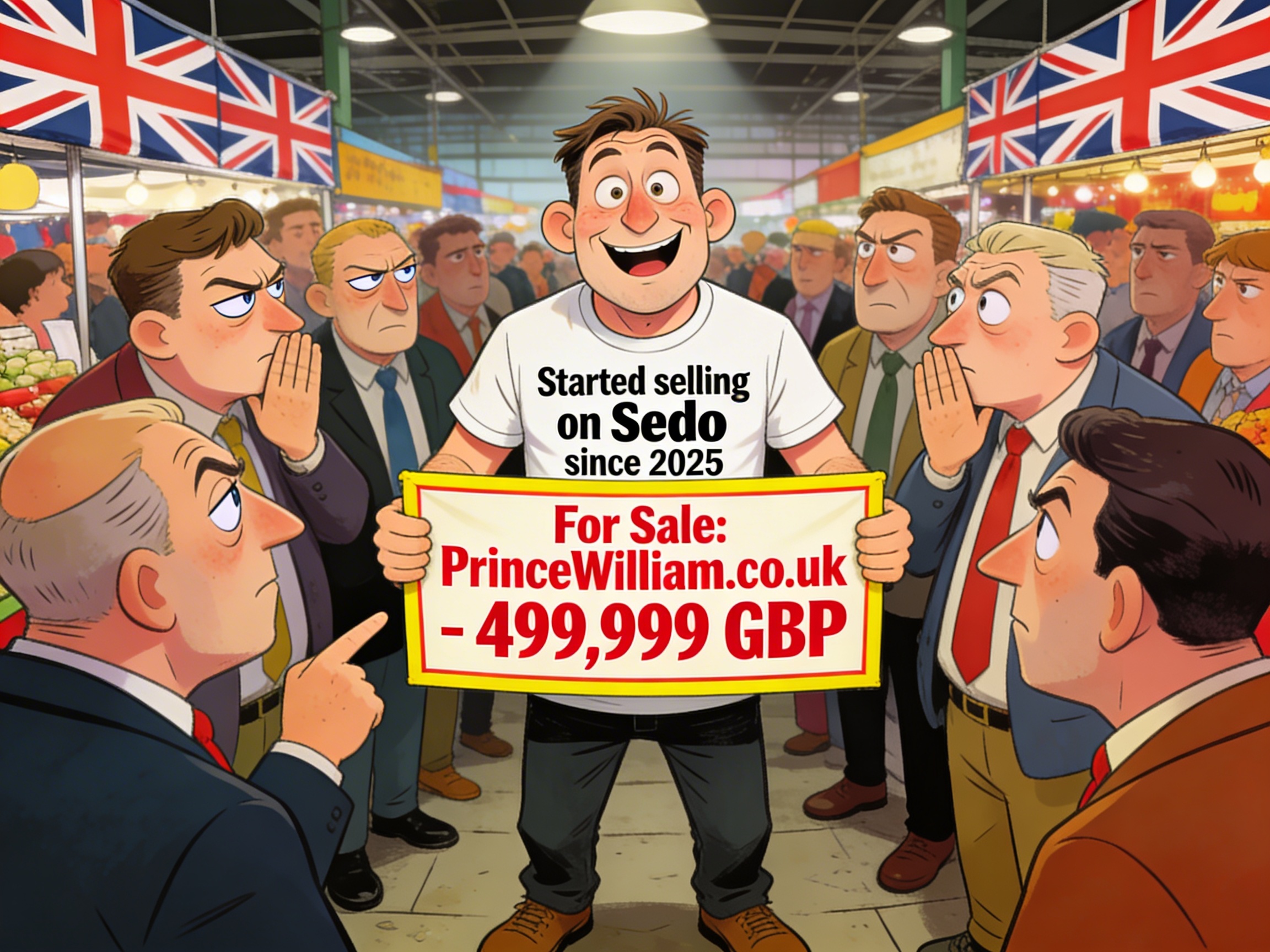
  • PrinceWilliam.co.uk: The £500,000 Royal Domain That Belongs to Someone Else

    PrinceWilliam.co.uk: The £500,000 Royal Domain That Belongs to Someone Else

    The Contender

    MetricDetails
    DomainPrinceWilliam.co.uk
    Registration DateFebruary 2026
    Registered UntilFebruary 2028 (two years pre‑paid)
    Seller LocationUSA
    Sedo Member Since2025
    PlatformSedo
    Asking Price£499,999 (approx. $645,000 USD)
    Auction Gimmick“Start an auction beginning at just $59” — seller pays to promote via auction format

    Introduction: A Royal Name With a Not‑So‑Royal Claim

    There’s a special category of domain delusion reserved for names that don’t just overvalue the domain—they ignore who actually owns the rights to it.

    PrinceWilliam.co.uk is a perfect example.

    The seller, based in the USA, registered this domain in February 2026. That’s this year. The domain is barely a month old. It references a living member of the British royal family—a name that is protected by trademark, personality rights, and centuries of tradition.

    And the seller wants £499,999 for it.

    Let’s set aside the pricing for a moment. The fundamental problem is that this domain has no legitimate claim to the name. Prince William is not a generic term. It’s a specific individual. The .co.uk extension is the United Kingdom’s country code. A US‑based seller registering a brand‑new domain that mirrors the name of a senior British royal is not “investing.” It’s a lawsuit waiting to happen.


    The Legal Reality: Royal Names Are Protected

    The British royal family actively protects their names and titles. The Royal Family’s official website is royal.uk. The Duke of Cambridge (Prince William) has his own official presence.

    What would happen if this domain were challenged?

    Under the UK’s dispute resolution policy for .uk domains (Nominet’s DRS), a complainant would need to show:

    • The domain is an Abusive Registration (registered primarily to sell it to the rights holder or a competitor, or to disrupt their business)
    • The registrant has no rights or legitimate interests in the name

    Here, the seller has no connection to Prince William, the royal family, or the UK. Registering the domain and immediately offering it for £500,000 is textbook “abusive registration.” The outcome would almost certainly be transfer to the rights holder.

    Even if the royal family didn’t pursue it immediately, any commercial use of the domain would be a trademark infringement. “Prince William” is a protected name.


    The “.co.uk” Problem: Why a US Seller Has No Business Here

    The seller is in the USA. He registered a .co.uk domain—the country code for the United Kingdom.

    There’s nothing illegal about non‑UK residents registering .co.uk domains. But it raises a glaring question: why would a US‑based seller register a UK‑specific domain referencing a British royal?

    The answer is obvious: he’s hoping that a UK‑based entity (maybe a fan site, a charity, or even the royal household) will pay a fortune for it. But that’s exactly the kind of speculation that Nominet’s DRS was designed to prevent.

    If a UK business or individual with a legitimate connection to “Prince William” wanted this domain, they would have a much stronger claim. A US speculator who registered it last week has none.


    The Registration Timeline: Fresh Domain, Stale Ambitions

    This domain was registered in February 2026. It’s barely a month old. At the time of this writing, it’s likely not even indexed properly by search engines.

    The seller paid for two years upfront (through February 2028), which suggests they think they’ll hold it for a while. But with no history, no traffic, and no legitimate claim, those two years will be a slow burn of annual fees and zero interest.

    What’s the seller’s strategy?

    • Register a royal name on a UK TLD
    • List it on Sedo at a fantasy price
    • Pay to promote it via an auction gimmick ($59 starting bid)
    • Hope someone bites before the legal notices arrive

    It’s not a strategy. It’s a prayer.


    The Sedo Auction Gimmick: $59 Start to Lure Fools

    Sedo allows sellers to start an auction with a low starting bid to generate interest. The seller here has chosen $59 as the opener—a tiny fraction of the £499,999 asking price.

    This is a common tactic:

    1. Low starting bid attracts clicks and early bids.
    2. Hidden reserve ensures the domain won’t sell unless a high bid appears.
    3. Seller hopes that competitive bidding will drive the price up.

    But there’s a problem: no one is bidding. The domain is a legal and commercial dead end. The auction is a ghost town. The seller is paying promotion fees to Sedo for a listing that will end with zero bids.


    The Seller’s Profile: New, American, and Optimistic

    The seller joined Sedo in 2025. That’s last year. They’re based in the USA. They have no apparent connection to the UK or the royal family.

    This is a classic “new domainer” move: grab a famous name, throw it on a marketplace, and wait for the millions to roll in. It never works.

    The only thing “new” about this listing is the registration date. The delusion, however, is timeless.


    The Defequer Analysis: Why PrinceWilliam.co.uk Is Worth Zero

    Factor 1: Trademark & Personality Rights – The Unwinnable Battle

    “Prince William” is not a generic term you can register and monetize freely. It’s a specific individual with legal protections.

    • Trademark: The Royal family holds numerous trademarks for royal titles and names. Even if “Prince William” isn’t explicitly registered in every class, using it commercially would infringe.
    • Personality rights: In the UK, the law protects against passing off and misuse of a well‑known person’s name.
    • Nominet DRS: The .uk dispute policy is specifically designed to stop people from registering domains that incorporate well‑known names or trademarks with no legitimate interest.

    If the seller tries to sell this domain, or worse, develop it, they will face legal action. The cost of defending a UDRP or DRS case is thousands of pounds—money they’ll never recoup from a domain that will be taken from them.

    Bottom line: This domain has negative value. Holding it is a liability.

    Factor 2: The “.co.uk” TLD – For the UK, Not for Speculation

    .co.uk is the United Kingdom’s country‑code domain. It’s intended for entities with a connection to the UK—businesses, organizations, individuals. A US‑based speculator with no UK presence is exactly the kind of registrant that the .uk registry (Nominet) looks at suspiciously.

    When a UK entity later applies for the same domain under the DRS, the fact that the current registrant is a foreign speculator with no legitimate interest weighs heavily against them.

    Factor 3: The Price – £499,999

    Let’s put that number in perspective.

    £500,000 is the kind of money that buys:

    • A genuine one‑word .com
    • A portfolio of 50+ quality domains
    • A house in London (not a mansion, but a house)
    • A lifetime of legal fees defending a domain you’ll lose anyway

    What it doesn’t buy: a brand‑new .co.uk domain with a royal name that belongs to someone else.

    Factor 4: The Auction Gimmick – Smoke and Mirrors

    Paying to promote a domain via Sedo’s “start an auction” feature is a waste of money when the domain itself is unsellable. The auction will end with zero bids. The seller will have wasted the promotion fee.

    But the gimmick does one thing: it makes the listing look “active” to casual browsers. It’s a trick, not a strategy.

    Factor 5: The Buyer – Who Would Actually Want This?

    Let’s imagine the potential buyers:

    Potential BuyerWhy It Won’t Happen
    Prince William / Royal HouseholdThey have official domains. They wouldn’t pay a speculator; they’d file a DRS and get it for free.
    A UK business with “Prince William” in the nameThey might have a legitimate interest, but they’d likely challenge the registration rather than buy it.
    A fan siteFans don’t have £500,000. Also, they’d be infringing.
    A domain investorNot at this price, not with this legal exposure. Any competent investor runs away.

    There are no buyers. The only person who “benefits” is the seller’s ego, which gets to say “I own princewilliam.co.uk.”


    The Delusion Index: 9.5/10

    FactorRatingExplanation
    Trademark Safety0/10A royal name with no legitimate claim—guaranteed to be challenged.
    TLD Appropriateness1/10.co.uk for a US speculator is a red flag.
    Domain Age1/10Registered February 2026—no history, no trust.
    Pricing Sanity0/10£500k for a brand‑new domain that’s legally toxic.
    Seller Experience1/10Joined Sedo in 2025, already in fantasy territory.
    Auction Gimmick1/10Paying to promote a doomed listing is throwing money away.

    Overall Delusion Index: 9.5/10

    This is among the highest we give. The only reason it’s not a 10 is that the domain technically exists. But in every meaningful sense—legal, commercial, practical—it’s worthless.


    What PrinceWilliam.co.uk Is Actually Worth

    Let’s do the math the seller should have done.

    Factors to consider:

    • Royal name with no legitimate claim
    • .co.uk TLD with no UK connection
    • Brand‑new registration
    • Guaranteed legal challenge if used or sold

    Realistic value: £0 (negative, actually, due to legal risk)

    If someone were foolish enough to buy it, they’d be buying a lawsuit. The domain is not an asset; it’s a liability.


    The Defequer Verdict

    CategoryRating
    Trademark Safety⭐☆☆☆☆ (1/5 – actually zero)
    TLD Appropriateness⭐☆☆☆☆ (1/5)
    Domain Age⭐☆☆☆☆ (1/5)
    Pricing Sanity⭐☆☆☆☆ (1/5)
    Seller Awareness⭐☆☆☆☆ (1/5)

    Final Word:

    “PrinceWilliam.co.uk is the kind of domain that gives the industry a bad name. A US seller, fresh to Sedo, registers a .co.uk domain named after a living British royal in February 2026 and slaps a half‑million‑pound price tag on it. The domain is barely a month old. It has no legitimate claim to the name. The seller has no connection to the UK. And the price is pure fantasy. If the seller tries to sell it, they’ll face legal action. If they try to develop it, they’ll face even more. The only thing this domain is worth is a lesson: registering famous names without rights isn’t investing—it’s a lawsuit waiting to happen.”


    What Should Actually Happen

    If the seller is reading this (and we hope he is):

    1. Delete the listing immediately. You’re not selling this domain—you’re advertising a UDRP case.
    2. Don’t renew it in 2028. Let it expire. Save yourself the money and the legal exposure.
    3. Consider transferring it to the rightful owner voluntarily. Sometimes goodwill is worth more than a losing battle.
    4. Learn the lesson. Registering domains that incorporate famous names, especially royalty, is a fast track to legal trouble.
    5. Consult a lawyer if you’ve already received any inquiries. You may have already attracted unwanted attention.

    For buyers: If you see this domain, run. Do not engage. The only outcome is legal fees and domain loss.


    The Bottom Line

    PrinceWilliam.co.uk joins the Defequer Hall of Shame as a textbook example of trademark‑ignorant speculation.

    A brand‑new .co.uk domain. A US seller. A royal name. A half‑million‑pound price. A pending legal disaster.

    This isn’t domain investing. It’s a liability with a landing page.

    Defequer Rating: 💩💩💩💩💩 (5/5 shits – the legal exposure and sheer audacity earn top marks.)

    Have a domain that uses a famous name without rights? Please share with us. We’ll tell you why it’s a liability.

    Defequer.com – because someone had to flush.

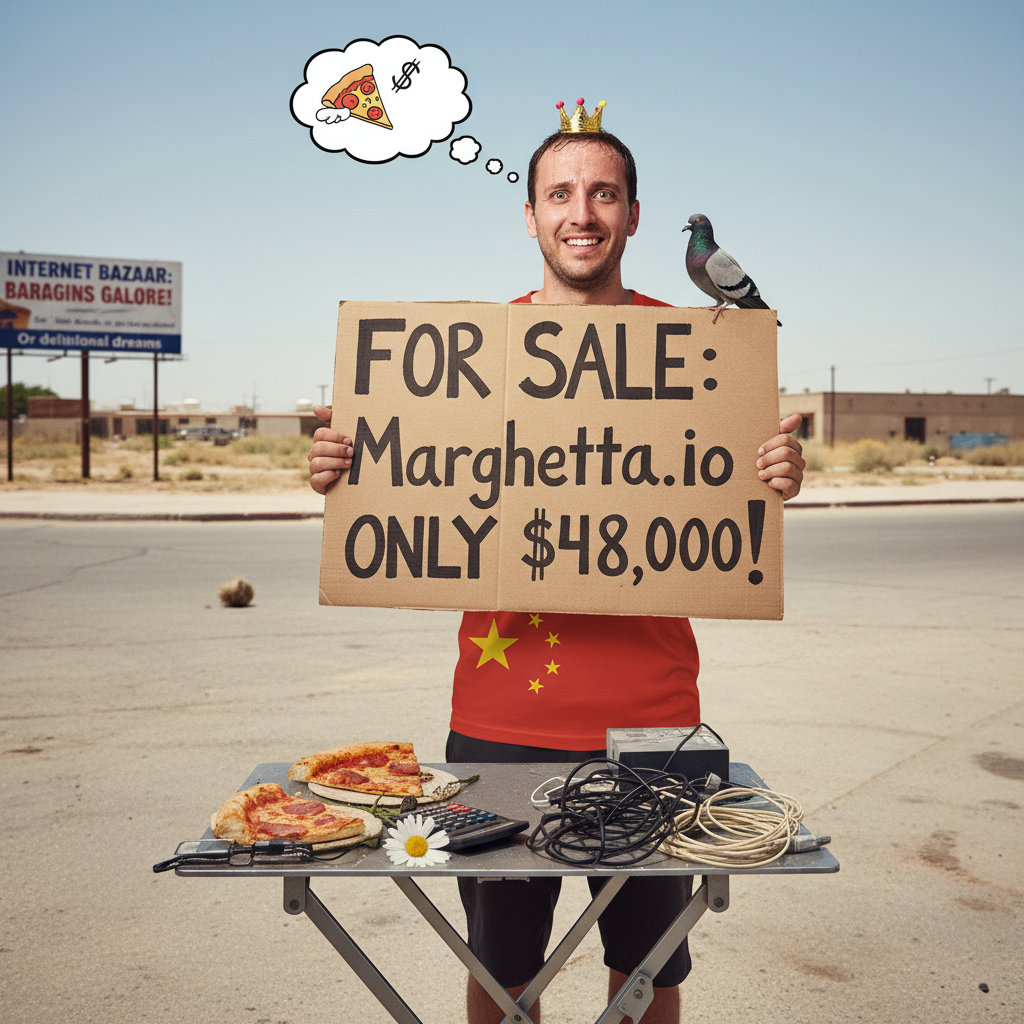
  • Margherita.io: The $48,000 Atom Appraisal That’s Worth About $48

    Margherita.io: The $48,000 Atom Appraisal That’s Worth About $48

    The Contender

    MetricDetails
    DomainMargherita.io
    SellerDaVinci Plus — account closed
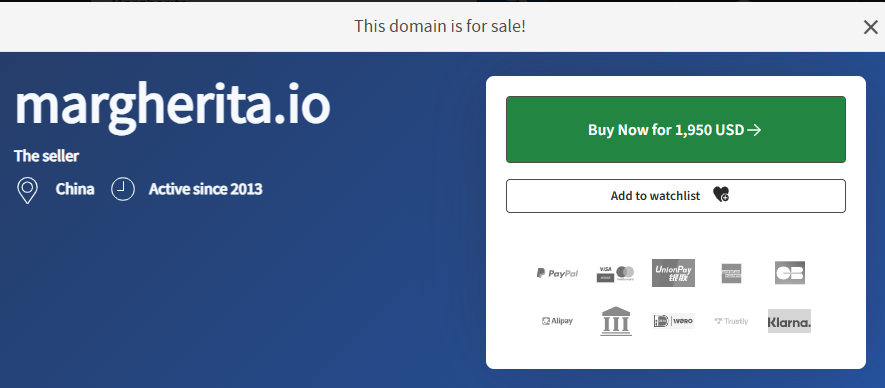
    PlatformsSedo ($1,950), Dynadot auction ($300 — removed?), Atom (appraised)
    The AppraisalAtom.com — $48,000 (automated)
    The Comps CitedLover.io sold for $16,600; Multiples.com sold for $19,666
    The Pitch“One word gem,” “64 extensions taken,” “famous Italian pizza”
    The RealityZero bids. Zero offers at asking. A seller who can’t decide on a price.

    Introduction: When Appraisals Replace Reality

    There’s a special kind of domain delusion that starts with an automated appraisal and ends with a seller genuinely believing they’re sitting on a six-figure asset.

    DaVinci Plus is living this delusion in real time.

    It began innocently enough. A new domainer registers Margherita.io. It’s a pizza name. It’s a flower name. It’s a woman’s name. It’s .io — the tech extension. The combination doesn’t make much sense, but that’s never stopped anyone before.

    Then he runs it through Atom’s automated appraisal tool. The number comes back: $48,000.

    And just like that, a fresh registration becomes a “premium asset.”

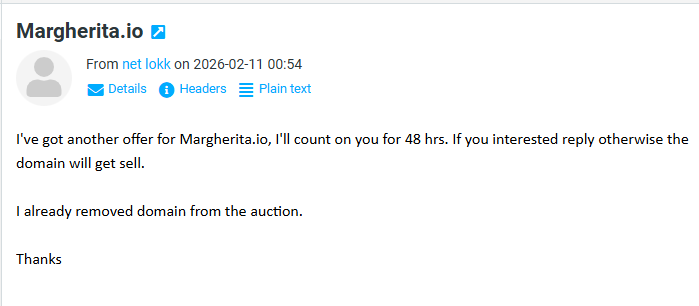
    He lists it on Sedo for $1,950. He puts it on Dynadot auction with a $300 starting bid. He emails potential buyers with urgency: “I’ve got another offer — 48 hours.” He posts on NamePros asking for advice, then ignores all of it.

    The result? Zero bids. Zero buyers. Zero interest.

    Let’s break down why Margherita.io is worth a fraction of what its owner believes — and why the behavior around it is a textbook case of appraisal-fueled delusion.


    The Appraisal Fantasy: Why Atom’s $48,000 Means Nothing

    Atom.com (formerly BrandBucket) provides automated appraisals. These algorithms look at:

    • Domain length
    • TLD
    • Keyword popularity
    • Comparable sales data

    What they don’t look at:

    • Actual end-user demand
    • Trademark conflicts
    • The specific market for .io domains tied to pizza
    • Whether anyone on earth would pay four figures for this name

    Automated appraisals are marketing tools, not valuation tools. They’re designed to make registrants feel good about their domains so they’ll keep paying renewal fees. GoDaddy does it. Estibot does it. Atom does it.

    The seller took that number — $48,000 — and built an entire fantasy around it.

    The reality check: NameBio shows thousands of .io sales. The vast majority are in the low hundreds. A tiny fraction break four figures. Almost none break five figures unless the domain has history, traffic, or a genuinely premium keyword.

    Margherita.io has none of these.


    The Comps Problem: Lover.io Sold for $16,600. So What?

    This is the seller’s favorite argument: “Lover.io sold for $16,600, so my pizza .io must be worth something.”

    Let’s look at what actually sold:

    Lover.io sold for $16,600 on GoDaddy expired auctions.

    Why?

    • It was previously a functioning website in a high-value niche
    • It had history, traffic, and backlinks
    • “Lover” is a broad, emotionally resonant keyword with commercial potential across dating, romance, gifts, and lifestyle
    • The .io extension made it a viable tech-play on a human concept

    Margherita.io has:

    • A specific pizza name
    • A flower name
    • A woman’s name
    • Zero history
    • Zero traffic
    • Zero connection to the .io tech ecosystem

    The comparison is nonsense. It’s like saying “a Ferrari sold for $300,000, so my used bicycle must be worth $10,000.”

    Multiples.com at $19,666 is even less relevant. That’s a .com. It’s a dictionary word. It’s not comparable to a .io pizza name in any way.

    The seller is cherry-picking high-value sales and pretending they’re comps for a domain that shares nothing with them.


    The TLD Problem: .io for Pizza Makes No Sense

    Let’s talk about .io.

    .io was originally the country-code TLD for the British Indian Ocean Territory. It became popular with tech startups because “IO” stands for input/output — a geeky tech reference. It’s now associated with:

    • Tech startups
    • SaaS companies
    • Developer tools
    • Cryptocurrency projects
    • Anything “digital” or “modern”

    What .io is not associated with:

    • Pizza
    • Italian restaurants
    • Flowers
    • Women’s names

    A pizzeria using .io is like a tech startup using .pizza — technically possible, thematically confusing. It sends the wrong signal to customers. It creates cognitive dissonance.

    The seller knows this. In the NamePros thread, he says: “Margherita is just a category of pizza and it’s niche to food industry, nothing to do with Tech and Ai.”

    Exactly. So why is it on .io? Why is he comparing it to Lover.io, a domain that succeeded precisely because it fit the .io vibe?

    The TLD mismatch is fatal. A pizza name on a tech extension appeals to almost no one.


    The Seller’s Behavior: A Case Study in Amateur Tactics

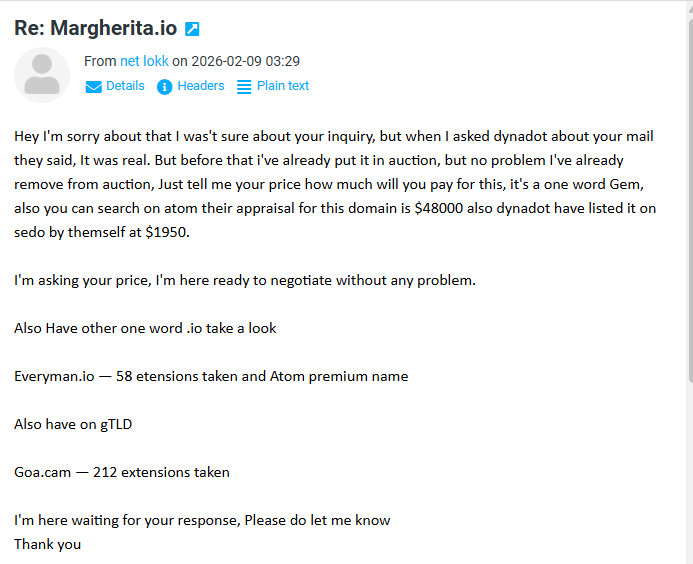
    Let’s look at the email the seller sent (as provided by one of our readers):

    “Hey I’m sorry about that I was’t sure about your inquiry, but when I asked dynadot about your mail they said, It was real. But before that i’ve already put it in auction, but no problem I’ve already remove from auction, Just tell me your price how much will you pay for this, it’s a one word Gem, also you can search on atom their appraisal for this domain is $48000 also dynadot have listed it on sedo by themself at $1950.”

    Let’s unpack this masterpiece of amateur salesmanship:

    “I’ve already put it in auction, but no problem I’ve already remove from auction” — The seller is creating confusion. Is it in auction? Is it removed? Is it on Sedo? The buyer can’t tell. That’s not a strategy; it’s chaos.

    “Just tell me your price how much will you pay for this” — This is the domain equivalent of “just make me an offer” without any anchor. It tells the buyer you have no idea what it’s worth and you’re hoping they’ll bid against themselves.

    “it’s a one word Gem” — “Gem” is seller-speak for “I have no data, but I like it.”

    “Atom their appraisal for this domain is $48000” — The seller genuinely believes this number is real. He’s not lying; he’s deluded.

    “dynadot have listed it on sedo by themself at $1950” — Dynadot didn’t list it. The seller did. This is a bizarre attempt to create distance from his own pricing.

    Then there’s the second email:

    “I’ve got another offer for Margherita.io, I’ll count on you for 48 hrs. If you interested reply otherwise the domain will get sell.”

    The classic manufactured urgency. “Another offer” — from whom? “48 hours” — why? “Will get sell” — the grammar alone tells you this is a copy-paste tactic.

    The result: Zero sales. Zero bids. Because buyers can smell desperation from a mile away.


    The Contradictory Listings: $1,950 on Sedo, $300 on Dynadot, $48,000 in His Head

    At the time of writing:

    • Sedo listing: $1,950
    • Dynadot auction: $300 starting bid (removed and relisted? unclear)
    • Atom appraisal: $48,000 (in his mind)

    These numbers don’t add up. If the domain is worth $48,000, why is it on auction for $300? If it’s worth $1,950, why did he remove it from auction?

    The seller doesn’t have a pricing strategy. He has a scattergun — hoping that listing in multiple places at multiple prices will magically attract a buyer.

    It won’t. It just makes him look confused.


    The NamePros Thread: Asking for Advice, Ignoring All of It

    In the Meet & Greet thread, DaVinci Plus posted:

    “I’ve a domain Margherita.io… where should i sell it, in which section, and how can i find the potential buyer for this pizza domain.”

    The community responded:

    • Experienced members explained that automated appraisals are worthless
    • Someone pointed out his previous account (arronmic) was closed
    • Others noted that Lover.io had history and traffic, making it irrelevant as a comp

    The seller’s response to all this? He doubled down on the Atom appraisal.

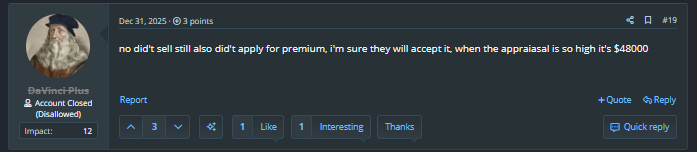
    “I’m sure they will accept it, when the appraiasal is so high it’s $48000.”

    He’s not asking for advice. He’s asking for validation. And when he doesn’t get it, he ignores the feedback and retreats further into fantasy.


    The NamePros Thread: Lover.io and the Comp Obsession

    In the sales thread, DaVinci Plus wrote:

    “Hello there, I’ve heard this section of the website somewhere that Lover.io sold for $16000, i suddenly register to sell my name Margherita.io… what could be the reasonable price to sell, I want to sell it $xxx, is this right to sell it for this price.”

    The community responded with clarity:

    • Nathan K: “Lover.io sold for $16,600… because it was previously a functioning website in a high-value niche.”
    • alop: Gently explained that the comp didn’t apply.

    The seller’s takeaway? Not that his domain is different, but that he should aim higher. He started asking about $500, then $1,950, then $48,000.

    He heard “$16,600” and thought “that could be me.” He didn’t hear “functioning website” or “high-value niche” because those didn’t fit the fantasy.


    The “64 Extensions” Fallacy

    In his email, the seller mentions: “64 extensions registered with this domain.”

    This is a common newbie talking point. It’s meant to suggest that because other people have registered Margherita in other TLDs, the .com must be valuable.

    Here’s the truth: Trademark holders and defensive registrants register domains across multiple TLDs to protect their brand. That doesn’t mean those domains have resale value. It means someone with a legitimate interest wanted to prevent cybersquatting.

    “64 extensions taken” is not a selling point. It’s a warning: if a trademark holder exists, they might come after your .io version.


    The “Everyman.io” and “Goa.cam” Portfolio

    In his email, the seller also pitches:

    “Also Have other one word .io take a look. Everyman.io — 58 extensions taken and Atom premium name. Also have on gTLD Goa.cam — 212 extensions taken.”

    Let’s briefly address these:

    • Everyman.io — A “premium” Atom name means Atom’s algorithm liked it. That’s all. No buyer has emerged.
    • Goa.cam — “212 extensions taken” means someone registered a lot of domains with “Goa” in them. That doesn’t make Goa.cam valuable.

    This is the same pattern: automated appraisals, extension counts, and zero sales.


    The Delusion Index: 9/10

    FactorRatingExplanation
    Appraisal Reliance1/10Atom’s $48k number is the foundation of his delusion.
    Comps Validity1/10Lover.io had history, traffic, and niche fit. This has none.
    TLD Match2/10.io for pizza is a category error.
    Pricing Consistency1/10$300 auction, $1,950 Sedo, $48k fantasy — pick a lane.
    Sales Tactics1/10“48-hour ultimatum” with no actual offer is amateur hour.
    Receptivity to Feedback1/10Asked for advice, ignored all of it.

    Overall Delusion Index: 9/10

    This earns a 9 because the seller has constructed an entire fantasy around an automated appraisal, ignoring every piece of market feedback, and is now running contradictory listings with self-created urgency — all for a domain that makes no sense in its chosen TLD.


    What Margherita.io Is Actually Worth

    Let’s do the math the seller should have done.

    Factors against it:

    • .io for a pizza/food name is a TLD mismatch
    • No history, no traffic, no backlinks
    • Automated appraisals are not market data
    • Lover.io comp is irrelevant
    • Pizza names have a tiny end-user market

    Factors in its favor:

    • “Margherita” is a real word with multiple meanings
    • It’s short (10 characters, but that’s not a major win)
    • A pizzeria might theoretically want it (for $50)

    Realistic price range: $50 – $300

    At the high end, to a domain investor who sees potential in the word and thinks they can flip it. At the low end, to a pizzeria owner who thinks .io is cool (unlikely).

    $48,000 is not just fantasy. It’s delusion maintained by ignoring every signal the market has sent.


    The Defequer Verdict

    CategoryRating
    Keyword Strength⭐⭐☆☆☆ (2/5 — it’s a real word, but niche)
    TLD Fit⭐☆☆☆☆ (1/5 — .io for pizza makes no sense)
    Appraisal Sanity⭐☆☆☆☆ (1/5)
    Sales Tactics⭐☆☆☆☆ (1/5)
    Receptivity to Truth⭐☆☆☆☆ (1/5)

    Final Word:

    *“Margherita.io is the perfect case study in appraisal-fueled delusion. A new domainer registers a pizza name on a tech extension, runs it through Atom’s algorithm, sees $48,000, and decides the market is wrong — not him. He lists it at $1,950 on Sedo, auctions it for $300 on Dynadot, and emails buyers with 48-hour ultimatums based on offers that don’t exist. All the while, experienced domainers on NamePros patiently explain that Lover.io sold for $16,600 because it had history, traffic, and niche fit — none of which Margherita.io has. The seller’s response? He doubles down on the appraisal. The result? Zero bids. Zero sales. Zero interest. And a $12 registration that’s headed for expiration, not fortune.”*


    What Should Actually Happen

    If the seller is reading this (and we hope he is):

    1. Delete the Atom appraisal from your memory. It’s not real. It never was.
    2. Pick one price. $300 auction, $1,950 Sedo, $48,000 fantasy — this chaos tells buyers you don’t know what you’re doing.
    3. Stop the “48-hour” ultimatums. You don’t have another offer. Buyers know it. You’re just embarrassing yourself.
    4. Listen to the NamePros feedback. You asked for advice. You got it. Ignoring it doesn’t make it wrong.
    5. Price it at $200. See if anyone bites. If not, let it expire and move on.

    For buyers: If you want Margherita.io, offer $50. The seller will eventually tire of renewals and the fantasy. Patience wins.


    The Bottom Line

    Margherita.io joins the Defequer Hall of Shame as a textbook case of appraisal delusion meets amateur sales tactics.

    A $48,000 Atom number. A $16,600 comp that doesn’t apply. A $1,950 Sedo listing. A $300 auction. Zero bids. Zero buyers. And a seller who genuinely believes the market is wrong.

    The appraisal said $48,000. The market said $0.

    Trust the market.

    Defequer Rating: 💩💩💩💩💩 (5/5 shits — the combination of appraisal fantasy, comp cherry-picking, contradictory listings, and “48-hour” ultimatums makes this a perfect storm of delusion.)


    Have a domain propped up by an automated appraisal? Submit it by email. We’ll tell you what it’s really worth.

    Defequer.com – because someone had to flush.


    Post-Roast Note to DaVinci Plus

    Look, I’m not trying to be cruel. I’m trying to be helpful in the only way that works after you’ve ignored everyone else.

    You asked NamePros for advice. Experienced domainers gave it. You ignored them because it didn’t match the $48,000 in your head.

    You ran contradictory listings. You sent “48-hour” ultimatums. You cited Lover.io without understanding why it sold.

    The market has answered: zero bids, zero sales.

    You can keep paying renewals and waiting for a buyer who will never come. Or you can learn the lesson, drop the price to something realistic, and move on.

    Your choice. But the fantasy ends when the renewal notices start arriving.

    We’ll be here. Watching. Waiting for you to listen.

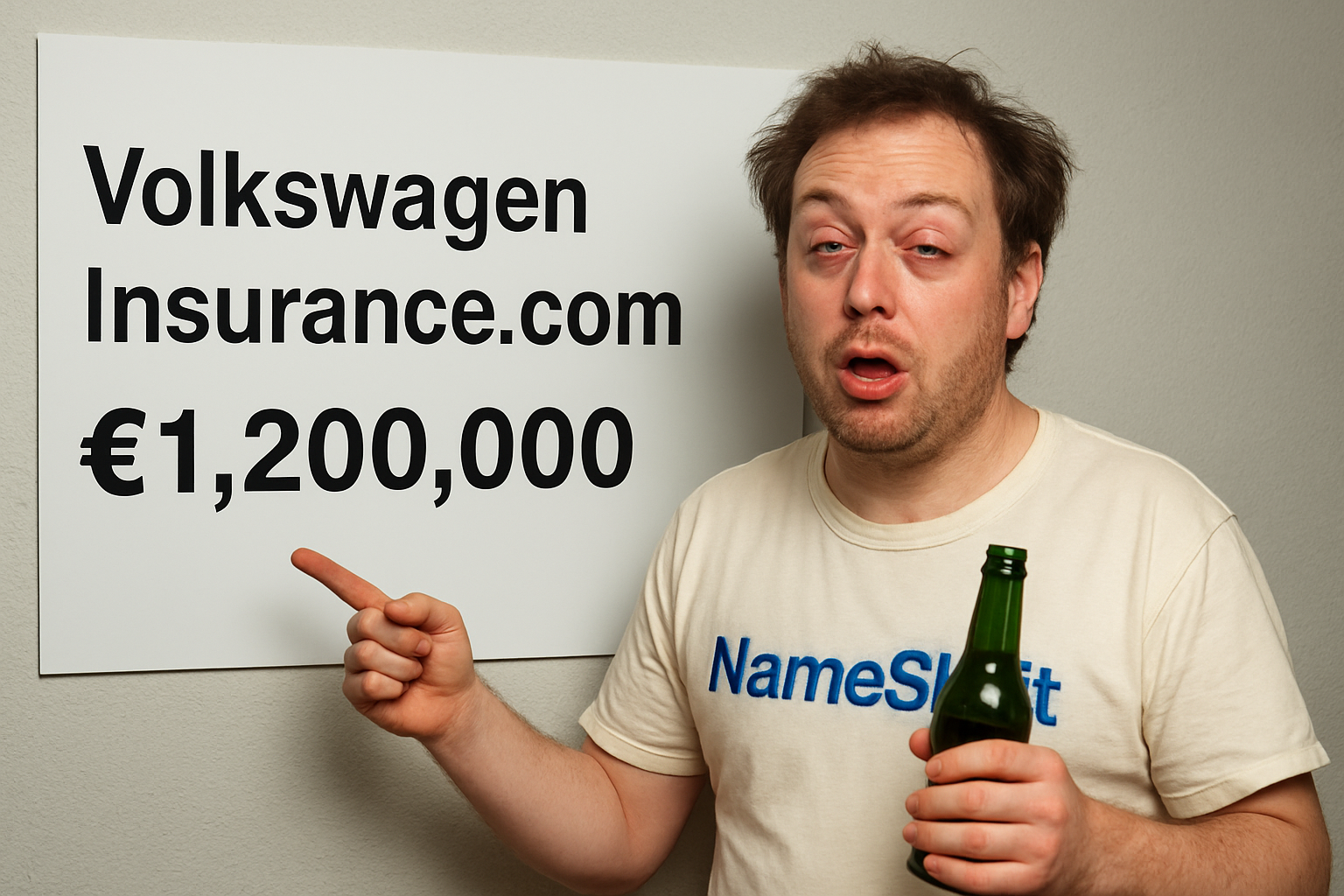
  • VolkswagenInsurance.com: The €1.2 Million Lawsuit Waiting to Happen

    VolkswagenInsurance.com: The €1.2 Million Lawsuit Waiting to Happen

    The Contender

    MetricDetails
    DomainVolkswagenInsurance.com
    Registration Date2024
    Current RegistrationPaid through 2028
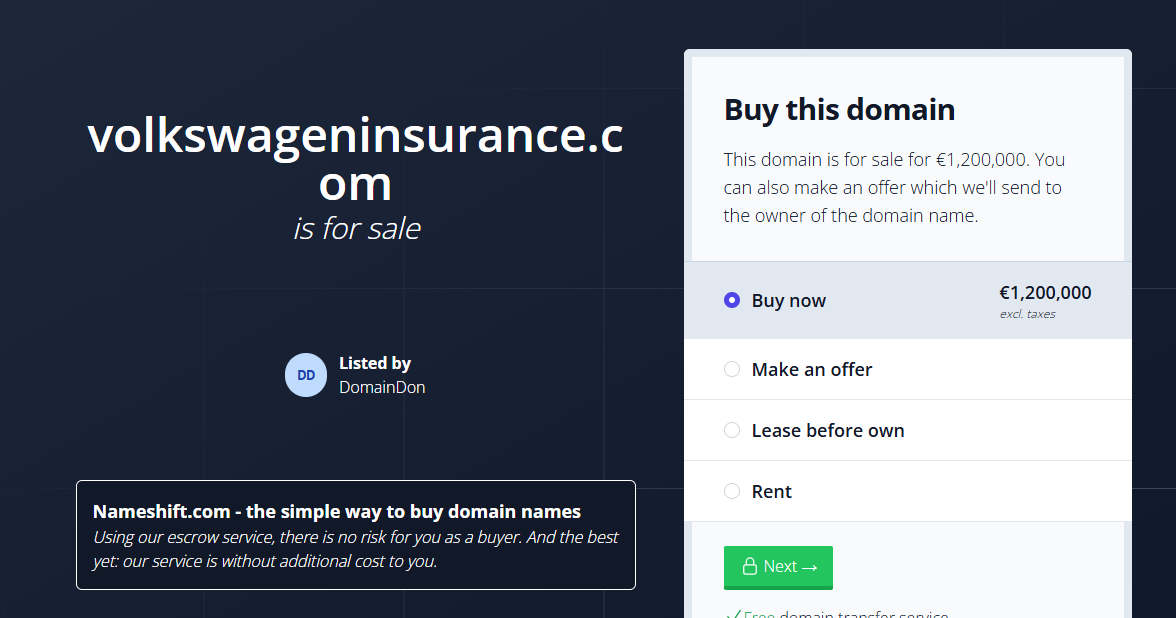
    PlatformNameshift.com Marketplace
    Asking Price€1,200,000
    SellerUnspecified
    The Pattern[Famous Trademark] + [Generic Industry Term]

    Introduction: When Domain Investing Meets Trademark Law

    There’s a special category of domain delusion reserved for names that aren’t just overpriced—they’re legally dangerous.

    VolkswagenInsurance.com is a perfect example.

    At first glance, it might seem clever. Volkswagen is a massive automaker. Insurance is a massive industry. Put them together and you get… a domain that Volkswagen’s legal team will absolutely, positively, without question come after.

    This isn’t speculation. This isn’t “maybe they won’t notice.” This is inevitable.

    Volkswagen Group has already demonstrated exactly how they handle domains like this. In April 2025, they filed a federal lawsuit against over 40 domain names that incorporated their trademarks, including VWINSURANCE.COM, VOLKSWAGENRETAILFINANCE.COM, and AUDIRETAILFINANCE.COM .

    That lawsuit is active right now. In a U.S. District Court. With Volkswagen’s lawyers actively pursuing these domains.

    And someone, somewhere, thinks it’s a good idea to list VolkswagenInsurance.com for €1.2 million in 2026.

    Let’s talk about why this domain isn’t just overpriced—it’s toxic.


    The Legal Reality: What Volkswagen Has Already Done

    On April 30, 2025, Volkswagen Group of America filed a complaint in the U.S. District Court for the Eastern District of Virginia .

    The defendants: Over 40 domain names, including:

    • VWINSURANCE.COM
    • VOLKSWAGENRETAILFINANCE.COM
    • VOLKSWAGENPARTS.COM
    • VOLKSWAGEN.NYC
    • VWPARTSHAUS.COM
    • VWRETAILFINANCE.COM

    The legal basis: Trademark infringement under the Lanham Act (15 U.S.C. § 1125).

    This isn’t a theoretical risk. This is active litigation. Volkswagen’s lawyers are currently pursuing domain names that follow the exact same pattern as VolkswagenInsurance.com .

    The lawsuit was filed less than a year ago. It’s ongoing. The message from Volkswagen couldn’t be clearer: if your domain includes our trademark, we will come after it.


    The Precedent: Volvo v. volvoinsurance.com

    This isn’t even Volkswagen’s first rodeo—or the first time an automaker has pursued an “insurance” domain.

    In 2002, a WIPO panel decided the case of Volvo Trademark Holding AB v. e-motordealer Ltd. , concerning the domain volvoinsurance.com .

    The facts:

    • Volvo had trademark registrations for VOLVO dating back to 1955
    • Volvo even had a registered trademark in Class 36 (insurance) since 1995
    • The respondent registered volvoinsurance.com in November 2001
    • The respondent claimed they wanted to offer competitive insurance quotes to Volvo drivers

    The outcome: The panel ordered the domain transferred to Volvo .

    The panel found that by “incorporating Complainant’s popular mark with the generic term ‘insurance’—one of Complainant’s offered services—at the end of the Domain Name, the likelihood of confusion is rather aggravated than dispelled” .

    That’s not a close call. That’s a rout.

    And that was 2002. Trademark law has only gotten stronger since then.


    The Volkswagen Lawsuit: A Pattern of Enforcement

    The 2025 Volkswagen lawsuit shows that automakers are more aggressive than ever about protecting their trademarks online.

    Look at the list of domains they’re pursuing:

    • VWINSURANCE.COM – the short version of Volkswagen + insurance
    • VOLKSWAGENRETAILFINANCE.COM – full trademark + financial services
    • VWRETAILFINANCE.COM – initials + financial services
    • VOLKSWAGENPARTS.COM – full trademark + parts
    • And dozens more 

    The pattern is unmistakable: Volkswagen does not tolerate domains that combine their trademarks with commercial terms.

    VolkswagenInsurance.com is the exact same pattern as VWINSURANCE.COM and VOLKSWAGENRETAILFINANCE.COM—both of which are currently being sued.

    Whoever owns this domain is not sitting on a €1.2 million asset. They’re sitting on a legal liability that’s already been identified by Volkswagen’s lawyers as a target.


    The Defequer Analysis: Why This Domain Is Worthless

    Factor 1: The Trademark Problem – It’s Not If, It’s When

    This is the single most important factor in evaluating VolkswagenInsurance.com.

    The legal framework:

    Under the Uniform Domain-Name Dispute-Resolution Policy (UDRP), a trademark holder can successfully challenge a domain if they prove three things :

    1. The domain is identical or confusingly similar to their trademark
    2. The registrant has no rights or legitimate interests in the domain
    3. The domain was registered and is being used in bad faith

    How does VolkswagenInsurance.com fare on these criteria?

    Criterion 1: The domain incorporates the famous VOLKSWAGEN trademark in its entirety and adds the generic term “insurance.” This is textbook confusing similarity. In fact, it’s more confusing because insurance is a service Volkswagen actually offers through Volkswagen Financial Services .

    Criterion 2: What legitimate interest could the registrant claim? They’re not commonly known as “Volkswagen Insurance.” They’re not making a non-commercial fair use. They’re trying to sell it for €1.2 million. That’s not a legitimate interest—it’s speculation on someone else’s trademark.

    Criterion 3: Bad faith? Registering a domain that includes a famous trademark, with no connection to that trademark, and trying to sell it for seven figures is about as clear an example of bad faith as exists.

    The result: This domain doesn’t just risk a UDRP—it guarantees one. And the outcome is foreordained: transfer to Volkswagen.

    Factor 2: The Timing Problem – Registered in 2024, Already Targeted

    This domain was registered in 2024. That’s after decades of established case law on trademark-infringing domains. That’s after the 2002 Volvo decision. That’s after countless other UDRP cases.

    And critically, it’s after Volkswagen filed their massive lawsuit in April 2025 .

    Whoever registered this domain in 2024 thought they were being clever. By 2025, Volkswagen’s lawyers were already suing over almost identical names. By 2026, this domain is sitting on Nameshift at €1.2 million, waiting for a buyer who will never come—because anyone with legal counsel will run the other direction.

    Factor 3: The Price Problem – €1.2 Million for a Legal Liability

    Let’s talk about that price.

    €1.2 million is not a small number. In the domain world, that’s serious money. That’s the kind of price you pay for:

    • A true one-word .com (Voice.com sold for $30M, so €1.2M is in the conversation for lesser words)
    • A highly commercial keyword with massive search volume
    • A domain with history, traffic, and established value 

    VolkswagenInsurance.com has none of these. It has:

    • A famous trademark that guarantees legal action
    • A 2024 registration date (no history)
    • Zero traffic (presumably)
    • Zero commercial value independent of the trademark

    What it’s actually worth: Negative dollars. Because holding it exposes you to legal fees, UDRP costs, and potential liability.

    Factor 4: The Buyer Problem – Who Would Actually Buy This?

    Let’s imagine the potential buyers for VolkswagenInsurance.com.

    Potential BuyerWhy It Won’t Happen
    Volkswagen themselvesThey already have vw.com, volkswagen.com, and their financial services domains. They don’t need this. And even if they wanted it, they’d get it for free through a UDRP.
    An insurance companyThey’d be insane to brand themselves with someone else’s trademark. Volkswagen would sue them immediately.
    A domain investorNot at this price—and not with this legal exposure. Any competent investor runs away.
    A brokerThey’d never take this listing. Too much legal risk.

    The brutal truth: There are zero buyers for this domain at any price above zero. Because anyone who buys it is buying a lawsuit.


    The Domain Valuation Framework: What Makes a Domain Valuable?

    Let’s step back and look at what actually creates domain value, based on established industry principles .

    The Core Factors

    FactorWhat It MeansVolkswagenInsurance.com
    TLD.com is king—most recognized and trusted It’s a .com, so that’s one point in its favor
    LengthShorter is better; one-word domains are unicorns 20+ characters—a disaster for memorability
    KeywordsHigh-value commercial terms drive value “Insurance” is good, but attached to a trademark
    BrandabilityDistinctive, memorable, easy to say Impossible to separate from Volkswagen’s brand
    History/AgeOlder domains with clean histories add trust Registered in 2024—brand new, no history
    Legal SafetyNo trademark conflicts Catastrophic failure

    The “Commercial Match” Principle

    Domain valuation experts emphasize that a domain’s true value depends on its commercial match . A domain that perfectly matches a high-value industry can command significant premiums.

    But that principle assumes legal ownership of the terms involved. VolkswagenInsurance.com doesn’t have a commercial match—it has a trademark conflict. And that’s not a premium feature. It’s a deal-killer.


    The Delusion Index: 9.8/10

    FactorRatingExplanation
    Trademark Safety0/10Active litigation over identical patterns. Guaranteed to be challenged.
    Commercial Relevance2/10“Insurance” is valuable, but attached to a trademark you don’t own.
    Domain Age1/10Registered in 2024—no history, no trust.
    Memorability2/1020+ characters, impossible to say easily.
    Price Sanity0/10€1.2M for a domain that will be taken away for free.
    Seller Awareness0/10Either unaware of the lawsuits or hoping buyers are.

    Overall Delusion Index: 9.8/10

    This is about as high as we go without reserving 10/10 for literally impossible domains. The combination of:

    • Active, ongoing litigation over almost identical names
    • Clear legal precedent from 2002
    • A 2024 registration date (after all this history)
    • A €1.2 million price tag
    • Paid renewals through 2028 (four years of fees on a doomed asset)

    …is breathtaking in its audacity.


    The Nameshift Factor

    Nameshift is the marketplace hosting this listing. We don’t know much about them, but we know this: any competent domain marketplace should have flagged this domain as a legal risk.

    Whether they did and the seller ignored them, or whether they simply accepted the listing without due diligence, the result is the same: a domain that shouldn’t be for sale is being marketed as a “premium asset.”

    It’s not. It’s a liability with a landing page.


    What This Domain Is Actually Worth

    Let’s do the math that the seller should have done.

    Direct value: $0

    Because:

    • It will be challenged under UDRP
    • The challenge will succeed
    • The domain will be transferred to Volkswagen
    • The seller will lose the domain and pay legal fees

    Negative value: -$X,XXX

    Because defending a UDRP costs money. Even if the seller folds immediately, there are costs involved. The domain is not an asset—it’s a drain.

    €1.2 million is not just fantasy pricing. It’s actively misleading anyone who might consider buying it.


    The Defequer Verdict

    CategoryRating
    Trademark Safety⭐☆☆☆☆ (1/5 – actually 0, but the scale doesn’t go that low)
    Commercial Relevance⭐⭐☆☆☆ (2/5 – insurance is valuable, but not like this)
    Domain Age⭐☆☆☆☆ (1/5)
    Memorability⭐☆☆☆☆ (1/5)
    Price Sanity⭐☆☆☆☆ (1/5)
    Seller Awareness⭐☆☆☆☆ (1/5)

    “VolkswagenInsurance.com isn’t a domain investment—it’s a legal target with a €1.2 million price tag. Registered in 2024, after decades of UDRP precedent and an active federal lawsuit over almost identical names, this domain is a monument to either ignorance or arrogance. Volkswagen has already sued over VWINSURANCE.COM. They’ve sued over VOLKSWAGENRETAILFINANCE.COM. They have a 2002 WIPO decision establishing that volvoinsurance.com must be transferred. The pattern is clear, the law is settled, and the outcome is inevitable. The only mystery is why someone paid to renew this through 2028—four years of fees on a domain that will never see the end of its registration term.”


    What Should Actually Happen

    If the seller is reading this (and we hope he is):

    1. Delete the listing immediately. You’re not selling this domain—you’re advertising a lawsuit.
    2. Don’t renew it in 2028. Let it expire. Save yourself the money and the legal exposure.
    3. Consider transferring it to Volkswagen proactively. Sometimes goodwill is worth more than a fight you’ll lose anyway.
    4. Learn the lesson. Never register domains that incorporate famous trademarks. It’s not “clever.” It’s not “investing.” It’s trademark infringement waiting to happen.
    5. Consult a lawyer if you’ve already received any inquiries. You may have already attracted attention you don’t want.

    For buyers: If you see this domain, run. Do not pass go. Do not collect €1.2 million in damages when Volkswagen sues you.


    VolkswagenInsurance.com joins the Defequer Hall of Shame as a case study in trademark delusion.

    A famous automaker. A generic industry term. A 2024 registration. Active litigation over identical names. A €1.2 million price tag.

    This isn’t a domain. It’s a lawsuit waiting to happen, priced for a buyer who doesn’t exist and marketed to an audience that should know better.

    Defequer Rating: 💩💩💩💩💩 (5/5 shits – the legal exposure pushes this into the highest tier of delusion.)


    Post-Roast Note to the Seller

    Look, we’re not trying to be cruel. We’re trying to be helpful in the only way that might get through.

    You registered a domain in 2024 that includes one of the world’s most valuable trademarks. In April 2025, Volkswagen filed a lawsuit over dozens of domains following the exact same pattern. That lawsuit is ongoing right now.

    Your domain is not worth €1.2 million. It’s not worth €12. It’s a legal liability that will cost you money to hold and more money to defend.

    Let it go. Write it off. Learn the lesson.

    Or don’t. Keep it. Pay renewals through 2028. Wait for the cease-and-desist letter that’s almost certainly coming.

    Your choice.

    We’ll be here. Watching. Taking notes. And maybe linking to the UDRP decision when it comes.

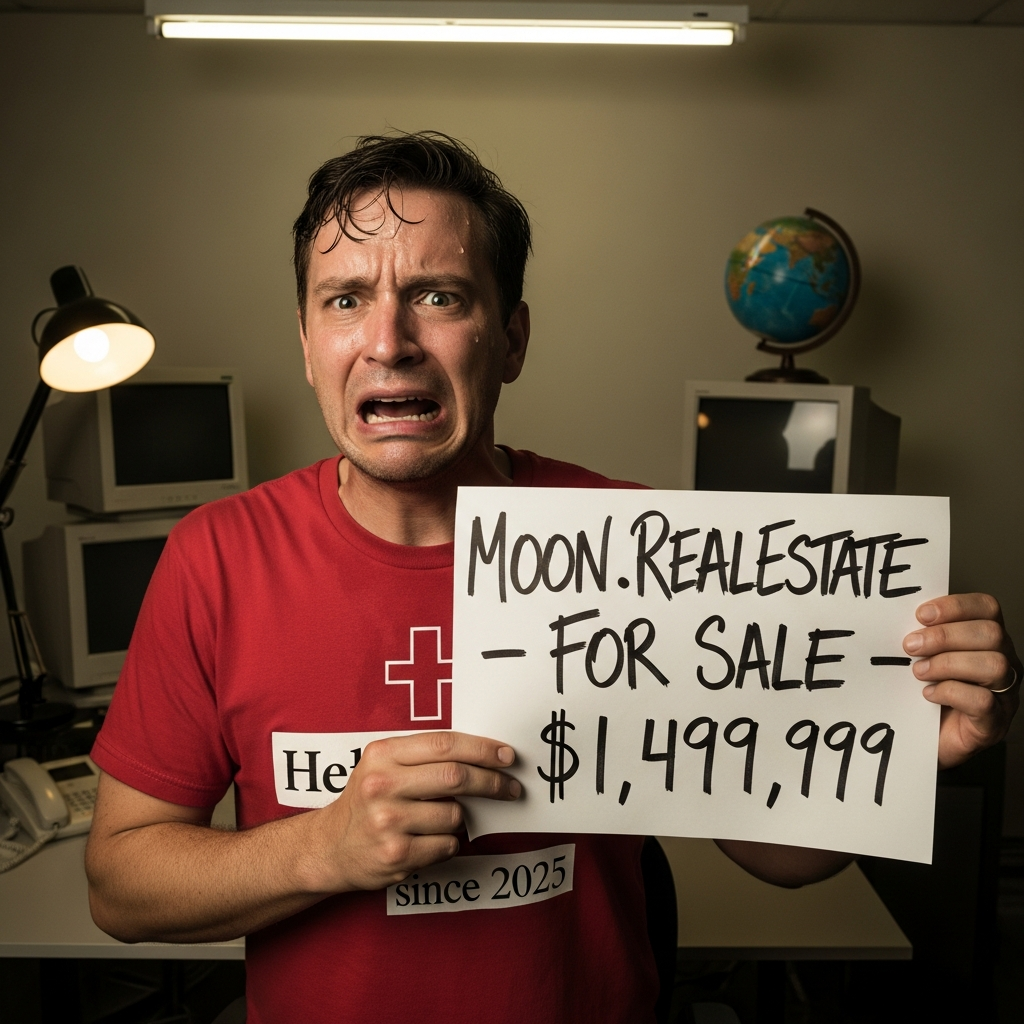
  • Moon.RealEstate: The $1.5 Million Domain on a TLD Nobody Asked For

    Moon.RealEstate: The $1.5 Million Domain on a TLD Nobody Asked For

    The Contender

    MetricDetails
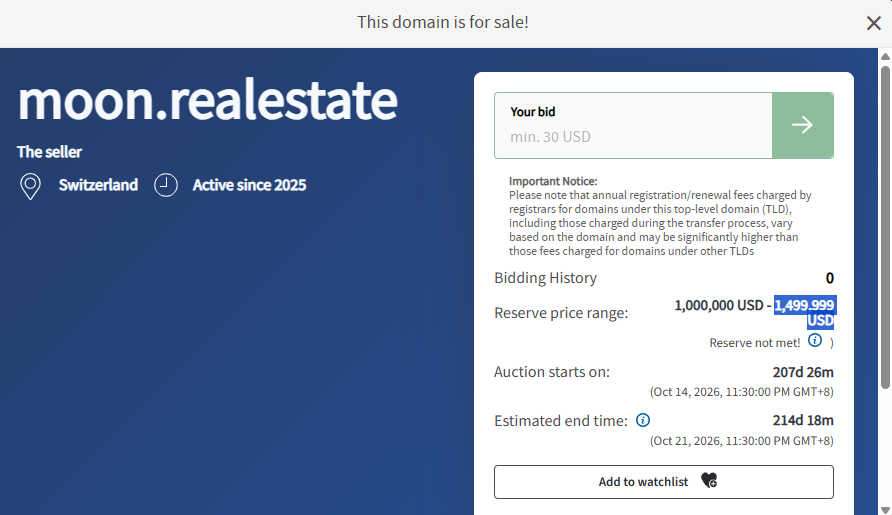
    Domainmoon.realestate
    TLD.realestate (new gTLD launched in 2014)
    Asking Price$1,499,999 USD (reserve price)
    Seller LocationSwitzerland
    Sedo Member Since2025
    PlatformSedo

    Introduction: When a Great Word Meets a Questionable Extension

    Let’s start with what this domain actually is.

    Moon is a fantastic word. It’s short. It’s memorable. It has universal appeal. In the right extension, it would be worth serious money.

    .realestate is… not the right extension.

    It’s one of hundreds of new gTLDs launched in 2014, part of ICANN’s massive expansion of the domain space. The idea was to give businesses more options than crowded .com space.

    The reality has been different. New gTLDs have struggled to gain trust, market share, or resale value. A tiny fraction of domains are registered in them. An even tinier fraction sell for significant money.

    And yet, someone who joined Sedo in 2025 thinks that combining “moon” with “.realestate” creates a $1.5 million asset.

    Let’s talk about why this is one of the more creative fantasy pricings we’ve seen—creative in the sense that it’s completely disconnected from any market reality.


    The Defequer Analysis: Why Moon.RealEstate Isn’t Worth $1.5 Million

    Factor 1: The TLD Problem – What Is .RealEstate Actually Worth?

    Let’s be direct: .realestate is a new gTLD with almost no market presence.

    What we know about new gTLDs generally:

    • They account for a tiny fraction of all registered domains
    • They have virtually no resale market compared to .com
    • End-users don’t instinctively trust them
    • Most are associated with spam or cheap registrations
    • The vast majority of new gTLD sales are in the low hundreds of dollars, not the millions

    What we know about .realestate specifically:

    • It’s a long TLD (10 characters after the dot)
    • It’s descriptive but not distinctive
    • It’s rarely used by actual real estate companies
    • Most real estate businesses still use .com, their country code, or their own brand

    A quick scan of the market shows that .realestate domains are available for registration at standard rates. The ones that have sold? Almost none at prices that would make you sit up and take notice.

    The TLD itself is the problem. No amount of “moon” in front of it changes that.

    Factor 2: The Extension Paradox – Why .Com Still Rules

    There’s a reason .com remains the gold standard after all these years. It has:

    • Trust: Users instinctively trust .com. It’s been around since the beginning.
    • Memorability: Everyone knows what .com means. No one has to explain it.
    • Type-in traffic: People still type .com out of habit.
    • Resale market: .com is where the money is. NameBio is filled with .com sales. New gTLDs? Barely register.

    Compare:

    TLDTrustMemorabilityResale MarketType-in Traffic
    .comHighHighMassiveSignificant
    .realestateLowLowNegligibleNone

    When you put “moon” in front of .realestate, you’re not creating a premium asset. You’re taking a great word and attaching it to a TLD that most people have never heard of and would never type.

    Factor 3: The Commercial Reality – Who Would Buy Moon.RealEstate?

    Let’s imagine the potential buyers for this domain.

    A real estate company specializing in lunar properties?
    That’s the obvious pitch. “Moon real estate” as in, selling land on the moon. It’s a gimmick that’s been around for decades. People sell “moon acres” as novelty gifts.

    But here’s the problem: those companies don’t spend $1.5 million on domains. They spend $12 on a domain and $500 on marketing. The novelty gift market is not a high-end domain buyer.

    A luxury real estate company?

    “Moon” as a branding concept for high-end properties? Possible. But they’d want .com. Or they’d want something shorter. Or they’d want a TLD that actually conveys luxury.

    “.realestate” does not convey luxury. It conveys “I couldn’t get the .com.”

    A real estate tech startup?

    Maybe. Startups love creative domains. But they also love .io, .co, and .com. .realestate is not on their radar.

    And no startup with any sense is spending $1.5 million on a domain when that money could fund a year of development, marketing, and staff.

    The brutal truth: There is no natural buyer for this domain at any significant price. The combination of a great word and a bad TLD creates something that’s neither fish nor fowl—too expensive for novelty, too niche for serious real estate, too unknown for mainstream use.

    Factor 4: The Seller Factor – Joined Sedo in 2025

    This seller joined Sedo in 2025. That’s last year.

    There’s a pattern we’ve seen across hundreds of roasts: new sellers have the most unrealistic prices.

    It makes sense when you think about it:

    • They’ve read about million-dollar .com sales but not about the 99.9% of domains that sell for nothing
    • They’ve run their domains through automated appraisals that flatter their egos
    • They haven’t experienced the reality of renewing a domain for years with zero offers
    • They’re still in the “I know what I have” phase before the market teaches them otherwise

    This seller is in that phase. They’ve found a combination they think is clever—”moon” plus “real estate”—and they’ve convinced themselves it’s worth $1.5 million.

    The market will teach them otherwise. It just might take a few years of renewal notices.

    Factor 5: The Price – $1,499,999

    Let’s talk about that specific number.

    $1.5 million is a serious price. In the domain world, that’s the territory of:

    • Ultra-premium one-word .coms
    • Highly commercial keywords with massive search volume
    • Domains with history, traffic, and established value

    Moon.realestate is none of these. It’s a new gTLD with zero history, zero traffic, and zero established value.

    What would $1.5 million actually buy in domains?

    • A portfolio of 100+ quality .com domains
    • A truly premium one-word .com in a less competitive niche
    • Several developed websites with actual revenue
    • A house in most countries

    What $1.5 million does not buy:

    The price is not just optimistic. It’s disconnected from reality.

    Factor 6: The “Moon” Factor – Great Word, Wrong Home

    “Moon” is genuinely good. It’s short. It’s memorable. It has universal appeal. In the right TLD, it’s a six-figure domain easily.

    But TLD matters. A great word in a bad TLD is like a Ferrari with a flat tire—it looks impressive until you try to use it.

    Consider the alternatives:

    DomainEstimated ValueWhy
    Moon.comMillionsOne-word .com, ultra-premium
    Moon.co$10,000-$50,000Short, appealing, .co is acceptable
    Moon.io$5,000-$20,000Tech startups love .io
    Moon.xyz$500-$2,000.xyz is trendy but limited
    Moon.realestate$200-$1,000TLD kills it

    The .realestate TLD drags “moon” down. Way down.


    The Delusion Index: 9/10

    FactorRatingExplanation
    TLD Quality1/10.realestate has no market, no trust, no sales history.
    Keyword Strength8/10“Moon” is genuinely great. This is the only reason the score isn’t higher.
    Commercial Relevance2/10Who specifically needs this combination? Almost no one.
    Seller Experience1/10Joined 2025, no track record, fantasy pricing.
    Price Sanity0/10$1.5M for a new gTLD domain is pure fantasy.
    TLD+Word Match3/10“Moon real estate” is a concept, but not a commercial category.

    Overall Delusion Index: 9/10

    This earns a 9 because the word “moon” is genuinely strong. If this were moon.com, we’d be having a different conversation. But it’s not. And the TLD kills it so completely that the price becomes absurd.


    The New gTLD Reality Check

    Let’s take a step back and look at the new gTLD market as a whole.

    When ICANN launched hundreds of new TLDs in 2014, the promise was that they would create new opportunities for branding, new spaces for innovation, and new value for domain investors.

    What actually happened:

    • Most new gTLDs were hoovered up by speculators, not end-users
    • Registrations were driven by discounts and promotions, not genuine demand
    • Renewal rates are abysmal—most domains are dropped after the first year
    • Resale market is almost nonexistent
    • End-users continue to prefer .com, country codes, and a handful of trusted alternatives

    .realestate falls into the category of new gTLDs that never gained traction. It’s too long, too niche, and too unknown to compete with .com or even .io.

    The seller who registered moon.realestate probably thought they were being clever—combining a great word with a niche TLD to create something unique. What they actually created was a domain that no one wants and no one trusts.


    What This Domain Is Actually Worth

    Let’s do the math that the seller should have done.

    Factors to consider:

    • Great word (“moon”)
    • Weak TLD (.realestate)
    • No history or traffic
    • No established end-user market
    • New gTLD with negligible resale value

    Realistic price range: $200 – $1,000

    That’s not a typo. In the current market for new gTLD domains, moon.realestate might attract:

    • A novelty “moon land” seller looking for a domain: $200-$500
    • A domain investor who sees potential in the word: $500-$1,000
    • At auction, with multiple interested parties: maybe $2,000 on a very good day

    $1.5 million is not just optimistic. It’s 1,500 times the actual value.


    The Defequer Verdict

    CategoryRating
    Keyword Strength⭐⭐⭐⭐☆ (4/5 – “moon” is excellent)
    TLD Quality⭐☆☆☆☆ (1/5 – .realestate is a dud)
    Commercial Relevance⭐☆☆☆☆ (1/5)
    Seller Experience⭐☆☆☆☆ (1/5)
    Price Sanity⭐☆☆☆☆ (1/5)
    Combined Value⭐⭐☆☆☆ (2/5 – great word wasted on bad TLD)

    Final Word:

    “Moon.realestate is what happens when a great word meets a questionable TLD and a seller who joined Sedo yesterday. ‘Moon’ is excellent. It’s short, memorable, and universally appealing. But .realestate is the anchor that drags it to the bottom. A new gTLD with no market presence, no trust, and no resale value. The combination doesn’t create a premium asset—it creates a curiosity. And curiosities don’t sell for $1.5 million. They sell for a few hundred dollars to someone with a novelty business idea, or they expire. The seller, who started in 2025, clearly hasn’t learned this lesson yet. They will. It just might take a few years of renewal notices.”


    What Should Actually Happen

    If the seller is reading this (and we hope he is):

    1. Drop the price by 99.9%. List it at $1,500 and see what happens. Even that might be optimistic, but at least it’s in the conversation.
    2. Research new gTLD sales. Look at what .realestate domains actually sell for. The results will sober you up quickly.
    3. Consider the TLD problem. No matter how good the word, .realestate is not a premium TLD. It never will be. Price accordingly.
    4. Learn the market before pricing. You joined Sedo in 2025. You’re new. That’s fine. But learn before you list at seven figures.
    5. Ask yourself: Who would actually buy this? If you can’t answer that question with a specific type of buyer at a specific price, you’re guessing. And guessing at $1.5 million is not investing.

    For buyers: If you’re genuinely interested in moon.realestate, make an offer at $200-$500. The seller might be ready to deal after reading this roast. And if they’re not, wait. It’s not selling at $1.5 million.


    The Bottom Line

    Moon.realestate joins the Defequer Hall of Shame as a case study in great word, wrong TLD, fantasy price.

    A seller who joined Sedo in 2025. A TLD with no market. A word that deserves better. A price that exists in a separate reality.

    This isn’t domain investing. It’s wishful thinking with a registration fee and a landing page.

    Defequer Rating: 💩💩💩💩 (4/5 shits – the word “moon” saves it from a 5, but everything else is a disaster.)


    Post-Roast Note to the Seller

    Look, we’re not trying to be cruel. We’re trying to be helpful in the only way that works: honesty.

    You found “moon.” That’s genuinely good. You’re not wrong to see value in that word.

    But you attached it to .realestate—a TLD that has never produced a significant sale, that no one trusts, and that actively harms the value of whatever word is in front of it.

    A great word on a bad TLD is not a premium asset. It’s a compromise. And compromises don’t sell for $1.5 million.

    Drop the price. Or keep it. Your choice. But the market will teach you the same lesson either way—it just might take a few years and a few renewal fees.

  • 1Testament.com: The $5.1 Million Domain That’s Been Waiting Since 2008

    1Testament.com: The $5.1 Million Domain That’s Been Waiting Since 2008

    The Contender

    MetricDetails
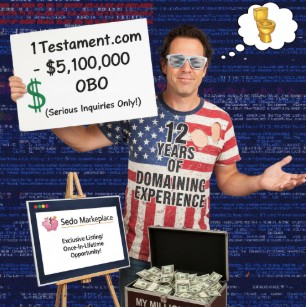
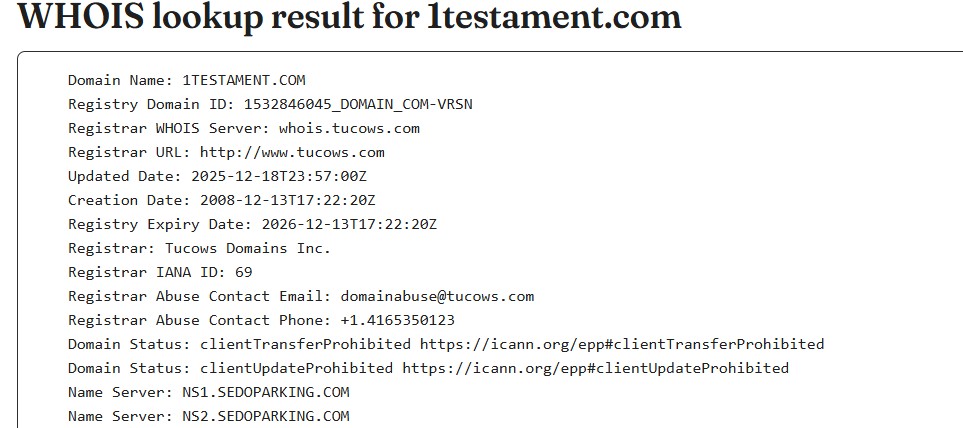
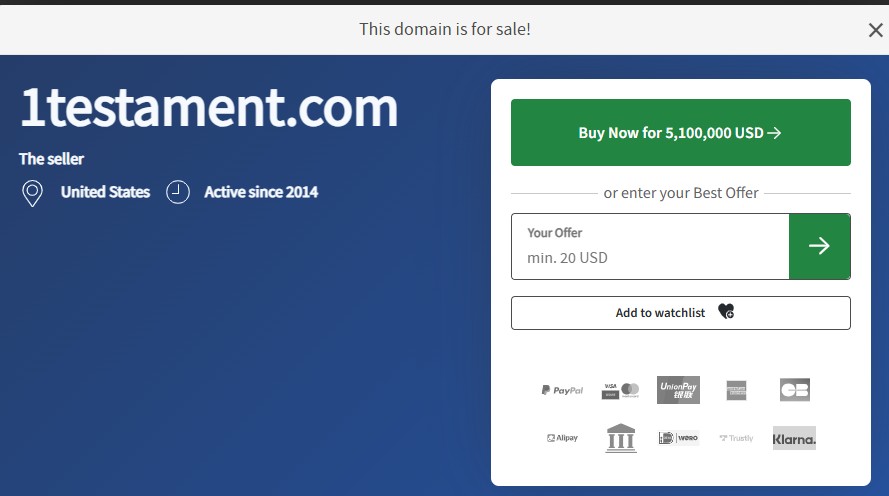
    Domain1Testament.com
    Registration Date2008
    Domain Age18 years
    Seller LocationUSA
    Sedo Member Since2014
    PlatformSedo
    Asking Price$5,100,000 USD
    Time on MarketAt least 12 years (since joining Sedo)

    Introduction: The Longest Game of “Make an Offer” in History

    Let’s start with some context.

    This domain was registered in 2008. That’s the year Barack Obama was first elected. The iPhone was one year old. Bitcoin didn’t exist. The global financial crisis was in full swing.

    Someone saw the future and registered 1Testament.com.

    Sixteen years later, that domain is still here. The seller joined Sedo in 2014—that’s 12 years ago. For over a decade, this domain has been sitting on the marketplace, waiting for a buyer at $5.1 million.

    No takers.

    At what point does “patient investing” become “refusing to accept reality”? At what point does a domain stop being an asset and start being a monument to stubbornness?

    For 1Testament.com, that point was probably around year three. Maybe year five. Definitely by year ten.

    And yet, here we are in 2026, and the listing is still up.


    The Defequer Analysis: Why 1Testament.com Isn’t Worth $5.1 Million

    Factor 1: The Number Problem – Why “1” Doesn’t Add Value

    Let’s start with the most obvious issue: the number 1.

    In domain investing, numbers can add value in specific contexts:

    • 123.com – short, memorable, valuable
    • 1-800-flowers.com – part of a brand
    • 24hourfitness.com – meaningful descriptor

    But “1” at the beginning of a word? Almost never.

    The problem with leading numbers:

    • They make domains harder to say aloud (“One Testament” or “First Testament”?)
    • They make domains harder to remember (did you type the number or the word?)
    • They look like typos of the word version (Testament.com is clearly better)
    • They scream “the .com I really wanted was taken”

    Consider the alternatives:

    • Testament.com – registered since 1997, highly valuable
    • TheTestament.com – available? No Way! It was already picked up in 2009
    • MyTestament.com – also better
    • NewTestament.com – taken, obviously

    1Testament.com is what you register when you can’t get the good version. It’s a consolation prize, not a premium asset.

    Factor 2: The Religious Angle – Sacred Terms, Commercial Prices

    “Testament” is a loaded word. It means:

    • A covenant or agreement (biblical context)
    • A will (legal context)
    • Evidence or proof (general usage)

    The primary association is religious—specifically, the Old and New Testaments of the Bible.

    This creates several problems:

    Problem 1: Religious organizations don’t spend $5 million on domains. They’re nonprofits. They have better uses for their money.

    Problem 2: Commercial use of religious terms is tricky. A business called “1Testament” would face skepticism from religious audiences and potential backlash for commodifying sacred concepts.

    Problem 3: The “1” makes it worse. “First Testament” is a real term (another name for the Old Testament). “1Testament” is just awkward.

    Who would actually buy this?

    • A religious publisher? Unlikely at this price.
    • A legal services company? Maybe, but they’d want LastWill.com or something clearer.
    • A tech startup? Why would they name themselves after a biblical term with a number in front?
    • A domain investor? Not at $5.1 million.

    The intersection of “people who want this exact domain” and “people who have $5.1 million” is vanishingly small. Possibly zero.

    Factor 3: The 18-Year Hold – What Has Happened in That Time?

    This domain has been registered since 2008. That’s 18 years of:

    • Annual renewals (at least $180 total, probably more)
    • Zero development (presumably)
    • Zero sales (obviously)
    • Zero traffic building
    • Zero brand building

    In 18 years, the seller could have:

    • Developed a website
    • Built an audience
    • Created a brand
    • Generated revenue
    • Sold the domain for actual money

    Instead, they’ve held it, waiting for a $5.1 million payday that has never come.

    The opportunity cost is staggering. Even if the domain were worth $50,000, the 18-year hold would have been a terrible investment compared to almost any other use of that time and money.

    Factor 4: The 11-Year Sedo Listing – What the Market Has Said

    The seller joined Sedo in 2014. That means this domain has been publicly listed for over a decade.

    Think about what that means:

    • Thousands of potential buyers have seen it
    • Countless domain investors have scrolled past it
    • Brokers have ignored it
    • Offers, if any, have been rejected
    • The market has spoken, repeatedly and consistently: this price is wrong

    In 12 years on a major marketplace, if this domain were worth even a fraction of the asking price, it would have generated interest. It would have received offers. It would have sold.

    Instead, it sits. Year after year. A digital monument to unrealistic expectations.

    Factor 5: The Price – $5,100,000

    Let’s talk about that specific number.

    $5.1 million is not a random figure. It’s just over $5 million, with an extra $100,000 tacked on to make it look deliberate.

    • A truly premium one-word .com (Voice.com sold for $30M, so $5M gets you in the conversation)
    • A portfolio of dozens of quality domains
    • A developed business with actual revenue
    • A house in most US cities
    • A lifetime of renewals on thousands of domains

    What does $5.1 million not buy?

    1Testament.com

    There is no universe where this domain is worth $5.1 million. Not in 2008 when it was registered. Not in 2014 when it was listed. Not in 2026, after 18 years of zero traction.

    Factor 6: The “Sedo Since 2014” Context

    Sedo is one of the largest domain marketplaces in the world. They’ve facilitated billions of dollars in sales. Their platform is where serious buyers go to find serious domains.

    If 1Testament.com were worth $5.1 million, Sedo’s brokers would have been all over it. They would have featured it. They would have promoted it. They would have found a buyer.

    Instead, it’s just another listing in a sea of millions. Unfeatured. Unpromoted. Unwanted.

    The platform itself is telling you something: this domain isn’t special.


    The Delusion Index: 9.5/10

    FactorRatingExplanation
    Number Problem1/10Leading “1” kills value and memorability.
    Religious Relevance3/10“Testament” has meaning, but not commercial value at this scale.
    Domain Age7/1018 years is a positive, but wasted on this name.
    Market Feedback1/1011 years on Sedo with no sale = the market has spoken.
    Price Sanity0/10$5.1M for a domain with a number prefix is pure fantasy.
    Seller Patience10/10Gotta respect the stubbornness, if nothing else.

    Overall Delusion Index: 9.5/10

    We reserve 10/10 for domains that are literally impossible (like selling Google.com). This one earns a 9.5 for:

    • The 18-year hold with zero results
    • The 11-year Sedo listing with no sale
    • The number prefix that kills any premium value
    • The price that exists in a separate reality
    • The sheer persistence in the face of overwhelming evidence

    The “Testament” Market – What’s Actually Valuable

    Let’s look at the broader market for religious or biblical domains.

    What has value:

    • Bible.com – obviously
    • Scripture.com – yes
    • Gospel.com – very likely
    • Faith.com – yes

    What has less value:

    • Specific book names (Genesis.com, Exodus.com) – taken, but limited commercial appeal
    • Compound terms (BibleStudy.com) – moderate value
    • Variations with numbers – essentially worthless

    1Testament.com falls into the “variations with numbers” category. It’s what you register when you can’t get the real thing, and you’re hoping someone will settle.

    They won’t.


    The 18-Year Hold: A Case Study in Opportunity Cost

    Let’s do the math on what 18 years of holding this domain has cost.

    Direct costs:

    • Registration/renewal fees: ~$10/year × 18 = $180 (minimum)
    • Sedo listing fees? Maybe not, but some platforms charge

    Opportunity costs:

    • The $12 registration fee could have bought a better domain
    • The time spent managing this listing could have been spent on something productive
    • The mental energy of “waiting for the big sale” could have been directed elsewhere

    The biggest cost:

    The seller has spent 18 years believing this domain is worth $5.1 million. That’s 18 years of not adjusting to market reality. 18 years of ignoring feedback. 18 years of watching the world change while their domain sits still.

    That’s not investing. That’s stubbornness as a lifestyle.


    The Defequer Verdict

    CategoryRating
    Domain Quality⭐⭐☆☆☆ (2/5 – the number kills it)
    Commercial Relevance⭐☆☆☆☆ (1/5)
    Market Awareness⭐☆☆☆☆ (1/5)
    Price Sanity⭐☆☆☆☆ (1/5)
    Seller Persistence⭐⭐⭐⭐⭐ (5/5 – have to admire the commitment)
    Likelihood of Sale0.01% (and only if someone wins the lottery and makes a terrible decision)

    Final Word:

    “1Testament.com is the domain equivalent of a man who has been waiting at a bus stop for 18 years, convinced that a private jet will eventually pick him up. Registered in 2008. Listed on Sedo since 2014. Asking $5.1 million. Zero buyers. The number prefix alone should have told the seller this wasn’t a premium asset. The 11 years of market silence should have confirmed it. But here we are in 2026, and the listing is still up, a monument to the kind of hope that refuses to die even when all evidence says it should. This isn’t patience. It’s delusion, polished and maintained for nearly two decades.”


    What Should Actually Happen

    If the seller is reading this (and we hope he is):

    1. Accept the market feedback. Eleven years on Sedo with no sale is not bad luck. It’s data.
    2. Drop the price by 99%. List it at $51,000 and see what happens. Even that might be optimistic, but at least it’s in the conversation.
    3. Consider the number problem. “1” at the beginning of a domain is almost always a negative. Accept that and price accordingly.
    4. Look at comparable sales. Find domains with religious themes that have actually sold. See what they went for. Adjust your expectations.
    5. Reflect on the 18-year hold. Was this really the best use of your time and money? Could you have done something more productive with those resources?

    For buyers: If you genuinely want this domain, make an offer at $100. The seller might be ready to deal after 18 years of waiting. And if they’re not, let them wait another 18. Your patience will outlast theirs.


    The Bottom Line

    1Testament.com joins the Defequer Hall of Shame as a case study in long-term delusion.

    Eighteen years of holding. Eleven years on Sedo. $5.1 million asking price. Zero sales.

    The domain has a number prefix that kills its premium potential. The religious angle limits its commercial appeal. The market has had over a decade to prove its value and has consistently said “no thanks.”

    At some point, “patient investing” becomes “refusing to accept reality.” 1Testament.com passed that point years ago and kept going.

    Defequer Rating: 💩💩💩💩💩 (5/5 shits – the combination of longevity, price, and market indifference earns top marks in the delusion Olympics.)


    Post-Roast Note to the Seller

    Look, we’re not trying to be cruel. We’re trying to be helpful in the only way that still might reach you after 18 years.

    You’ve held this domain since 2008. You’ve listed it on Sedo since 2014. In all that time, no one has paid anywhere close to your asking price.

    That’s not a coincidence. That’s data.

    The market has been telling you for over a decade that this price is wrong. You haven’t listened. But it’s not too late.

    Drop the price. Sell it for whatever you can get. Use the proceeds to buy something better. Or just let it go and free up the mental space.

    Eighteen years is long enough.

    We’ll be here. Watching. Hoping you finally hear what the market is saying.

  • The John Nguyen Collection: Seven Domains, One Delusion, $213,450 in Fantasy Pricing

    The John Nguyen Collection: Seven Domains, One Delusion, $213,450 in Fantasy Pricing

    The Contender: A Portfolio Built on Hope

    MetricDetails
    SellerJohn Nguyen
    PlatformAfternic
    Total Asking Price$213,450 (across these seven domains)
    Portfolio ThemeGeneric keywords, questionable TLDs, and prices that defy reality

    Previous record of the same seller


    Introduction: When One Delusion Isn’t Enough

    We’ve roasted individual domains before. The $500,000 hand-reg. The $100,000 religious transliteration. The $3,235 brandable that nobody can pronounce.

    But sometimes, a seller comes along who doesn’t stop at one fantasy. They build an entire portfolio of them—a collection of domains so consistently overpriced, so thoroughly disconnected from market reality, that they deserve a special kind of attention.

    Meet John Nguyen.

    John has assembled a delightful assortment of seven domains (and probably more, but these are the ones we could verify) with a combined asking price of $213,450.

    What do you get for that kind of money? Let’s find out.


    The Portfolio: A Domain-by-Domain Takedown

    1. 2mesothelioma.com – $12,500

    MetricDetails
    Domain2mesothelioma.com
    Price$12,500
    CategoryMedical/Health
    The ProblemEverything

    Let’s start with the number “2” at the beginning. Why is it there? Is it:

    • “To mesothelioma” (as in, the preposition)?
    • “Two mesothelioma” (as in, the quantity)?
    • A failed attempt at “to mesothelioma” that got registered before someone realized the typo?

    This is what we call a structural disaster in domain branding. The “2” serves no purpose except to confuse. It doesn’t make the domain shorter. It doesn’t make it more memorable. It just makes it look like someone registered the wrong version of “ToMesothelioma.com” and decided to keep it anyway.

    The medical context makes this worse. Mesothelioma is a serious, life-threatening cancer caused by asbestos exposure. Patients and their families search for information, support, and legal help. They deserve clarity and compassion, not a domain that looks like a typo.

    Realistic value: $0 – $100. The “2” kills any potential.

    Verdict: A domain that manages to be both confusing and insensitive, priced like it’s a premium medical asset. It’s not. It’s garbage.


    2. 360crypto.xyz – $9,950

    MetricDetails
    Domain360crypto.xyz
    Price$9,950
    TLD.xyz
    The ProblemThe TLD, the trend-chasing, the everything

    Ah, the .xyz special. A domain extension that was heavily discounted for years, then rebranded as “the new .com” for crypto bros, and now mostly serves as a warning label for speculative excess.

    360crypto.xyz combines:

    • A trendy prefix (“360,” suggesting completeness or virtual reality)
    • A trendy keyword (“crypto,” because it’s still 2021 in someone’s mind)
    • A controversial TLD that most mainstream users don’t trust

    The result is a domain that screams “I registered this during the crypto boom and now I’m hoping a bagholder appears.”

    The .xyz problem: Most internet users don’t trust .xyz. It’s associated with spam, cheap registrations, and get-rich-quick schemes. A legitimate crypto business would choose .com, .io, or .co. .xyz says “amateur.”

    Realistic value: $100 – $500, and that’s generous.

    Verdict: A trend-chasing domain registered two years too late, priced like it’s still 2021.


    3. AccountingDigest.com – $49,500

    MetricDetails
    DomainAccountingDigest.com
    Price$49,500
    CategoryProfessional/Industry
    The ProblemThe price, mostly

    This one is actually… not terrible? “Accounting Digest” sounds like a trade publication, a newsletter, or a content site for accounting professionals. It’s descriptive, professional, and has a clear target audience.

    So why is it in this roast?

    Because $49,500 is wildly optimistic.

    Let’s do the math:

    • A trade publication would need significant traffic and revenue to justify this price
    • A newsletter would need thousands of subscribers
    • A content site would need established authority

    This domain has none of that. It’s just the name. No history, no traffic, no built-in audience.

    Comparable sales: Industry-specific “Digest” domains trade in the low-to-mid four figures, not the high five figures. “MarketingDigest.com” might sell for $5,000-10,000 to the right buyer. $49,500 is fantasy territory.

    Realistic value: $3,000 – $8,000

    Verdict: A decent domain ruined by a price that guarantees it will never sell.


    4. AdoptMyChild.com – $19,500

    MetricDetails
    DomainAdoptMyChild.com
    Price$19,500
    CategorySocial/Family
    The ProblemThe emotional weight

    This one makes us uncomfortable, and not just because of the price.

    Adoption is not a commercial transaction. It’s a life-changing process involving real children, real families, and real emotions. Turning “Adopt My Child” into a domain name feels… wrong.

    Who would buy this?

    • An adoption agency? They’d use their own brand name.
    • A support group? They’d use a .org or a more sensitive name.
    • A marketplace? The very concept is ethically fraught.

    The phrase “adopt my child” is something a birth parent might say in moments of profound difficulty. It’s not a brand. It’s not a business. It’s a human experience that shouldn’t be commodified.

    Realistic value: This domain shouldn’t be sold. It should be donated to a legitimate adoption charity or allowed to expire.

    Verdict: A domain that feels exploitative, priced like it’s a commercial asset. It’s not. It’s a word combination that should never have been registered for resale.


    5. Airjet.xyz – $17,500

    MetricDetails
    DomainAirjet.xyz
    Price$17,500
    TLD.xyz
    The ProblemThe TLD, the genericness, the price

    “Airjet” is a decent word combination. It suggests aviation, speed, modernity. If it were Airjet.com, it might have some value.

    But it’s not. It’s Airjet.xyz.

    Remember what we said about .xyz? It applies here too. A private aviation company isn’t going to brand itself on .xyz. A jet charter service isn’t going to trust .xyz. A aerospace startup might consider it, but they’d probably prefer .io or .co.

    The price: $17,500 for a .xyz domain with a generic word combination is pure fantasy. .xyz domains with good keywords trade for hundreds, not thousands, unless they’re truly exceptional.

    Realistic value: $200 – $800

    Verdict: A decent word wasted on a questionable TLD and a delusional price.


    6. BakeForFun.com – $29,500

    MetricDetails
    DomainBakeForFun.com
    Price$29,500
    CategoryHobby/Lifestyle
    The ProblemThe phrase, the price, the everything

    “Bake for fun” is what people say when they’re explaining why they spent Sunday making sourdough instead of doing something productive. It’s a casual phrase, not a brand.

    Who would buy this?

    • A baking blog? They’d choose something shorter or more personal.
    • A recipe site? They’d want “recipes” or “baking” in the name.
    • A baking supply store? They’d want “supplies” or “store” in the domain.

    This domain is caught in no-man’s land: too generic to be brandable, too casual to be commercial.

    The price: $29,500 for a domain that describes a weekend activity. That’s about 30,000 cupcakes’ worth of revenue. No baking blog is generating that kind of money.

    Realistic value: $500 – $1,500

    Verdict: A domain that sounds like a retirement hobby, priced like a business acquisition.


    7. BestDealCar.com – $75,000

    MetricDetails
    DomainBestDealCar.com
    Price$75,000
    CategoryAutomotive
    The ProblemThe “best” trap

    “Best” is one of the most overused words in domain investing. It’s also one of the least valuable.

    Why “best” kills value:

    • It’s subjective. What’s “best” to one person isn’t to another.
    • It’s overused. Every category has a “BestX” domain.
    • It’s hard to trademark. You can’t own “best.”
    • It sounds spammy. “Best Deal Car” feels like a used car lot’s radio ad, not a premium brand.

    The automotive context: Car sales is a massive industry. But the valuable domains are short, brandable, or highly specific. “Cars.com” sold for millions. “BestDealCar.com” is just another generic phrase in a sea of generic phrases.

    The price: $75,000 would require a buyer with a massive marketing budget and a strange attachment to the word “best.” That buyer doesn’t exist.

    Realistic value: $2,000 – $5,000

    Verdict: The most expensive domain in the portfolio, and arguably the most generic. A perfect capstone to a collection of overpriced fantasies.


    The Portfolio Pattern: What We Learn From John Nguyen

    Looking at these seven domains together, a clear pattern emerges.

    Strategy 1: Generic Keywords at Premium Prices

    Every domain in this portfolio follows the same formula:

    • Take a common keyword or phrase
    • Add a generic modifier (“best,” “360,” “2”)
    • Register it in .com or a cheap TLD
    • Price it at 10-100x market value

    This is what we call the “spray and pray” strategy: register hundreds of domains, price them all at fantasy levels, and hope that one or two hit with an end-user who doesn’t know any better.

    The problem? Buyers aren’t stupid. They can spot fantasy pricing from a mile away. And with tools like NameBio and Estibot, they can quickly determine what a domain is actually worth.

    Strategy 2: Trend-Chasing Without Timing

    360crypto.xyz is the clearest example. Crypto peaked in 2021. Registering a crypto domain in 2023 or 2024 and pricing it at $9,950 is like buying Beanie Babies in 1999 and expecting retirement money.

    Trend-chasing only works if you’re ahead of the trend. John Nguyen is consistently behind it.

    Strategy 3: The TLD Gamble

    Two of the seven domains use .xyz, a TLD with questionable reputation and minimal resale value. This suggests a seller who doesn’t understand that TLD matters—a lot.

    Premium .com domains can command premium prices. .xyz domains cannot, no matter how good the keyword. Putting “Airjet” in .xyz doesn’t make it valuable; it makes it handicapped.

    Strategy 4: Emotional Exploitation

    AdoptMyChild.com crosses a line. Using adoption—a sensitive, emotional process involving real children—as a domain speculation play is ethically dubious. It’s not just overpriced; it’s inappropriate.

    We don’t roast domains to be cruel. We roast them to correct market dysfunction. But this one deserves special mention because it commodifies something that shouldn’t be commodified.


    The Math: What This Portfolio Is Actually Worth

    Let’s do what John Nguyen should have done before setting these prices.

    DomainAsking PriceRealistic ValueRatio
    2mesothelioma.com$12,500$50250x
    360crypto.xyz$9,950$30033x
    AccountingDigest.com$49,500$5,00010x
    AdoptMyChild.com$19,500$0 (donate it)Infinite
    Airjet.xyz$17,500$50035x
    BakeForFun.com$29,500$1,00029.5x
    BestDealCar.com$75,000$3,50021x
    TOTAL$213,450~$10,35020x average

    That’s right: the realistic value of these seven domains combined is about $10,000. John Nguyen is asking 20 times that amount.

    At this ratio, John would need to sell one domain per year for 20 years just to match the revenue of pricing them correctly and selling them all in a reasonable timeframe.

    But they won’t sell at these prices. They’ll sit, accumulate renewal fees, and eventually expire—at which point someone else will register them for $12 and the cycle begins again.


    The Delusion Index: Portfolio Edition

    DomainDelusion ScoreReasoning
    2mesothelioma.com9/10The “2” kills it, and the medical context makes it worse.
    360crypto.xyz8/10Trend-chasing on a questionable TLD.
    AccountingDigest.com6/10Actually decent, but priced 10x too high.
    AdoptMyChild.com10/10Ethically problematic and commercially worthless.
    Airjet.xyz7/10Good word, wrong TLD, delusional price.
    BakeForFun.com7/10Casual phrase, commercial pricing.
    BestDealCar.com8/10The “best” trap at $75,000.
    PORTFOLIO AVERAGE7.9/10A masterclass in overpricing.

    The Defequer Verdict: The John Nguyen Collection

    CategoryRating
    Domain Quality (Average)⭐⭐☆☆☆ (2/5)
    Pricing Sanity (Average)⭐☆☆☆☆ (1/5)
    TLD Awareness⭐☆☆☆☆ (1/5)
    Ethical Consideration⭐☆☆☆☆ (1/5 – for AdoptMyChild.com)
    Likelihood of Any Sale5% (and only if someone negotiates hard)

    Final Word:

    *”John Nguyen has assembled a portfolio that perfectly captures everything wrong with speculative domain investing: generic keywords, questionable TLDs, fantasy pricing, and the occasional ethical lapse. At $213,450 combined, these domains are priced for a world that doesn’t exist. In the real world, they’re worth about $10,000—and that’s being generous to AccountingDigest.com. The rest are renewal-fee traps waiting to expire.”*


    What Should Actually Happen

    If John Nguyen is reading this (and we hope he is):

    1. Drop every price by 90-95%. Start with realistic numbers and see what happens. You might be surprised.
    2. Let AdoptMyChild.com expire or donate it. Seriously. This isn’t a domain to profit from.
    3. Drop the .xyz domains entirely. They’re not worth the renewal fees. Focus on .com.
    4. Research comparable sales. Before pricing another domain, spend an hour on NameBio. See what similar names actually sell for.
    5. Consider a different strategy. Domain investing isn’t about registering everything and hoping. It’s about selective acquisition, realistic pricing, and patience.

    For buyers: If you see a John Nguyen domain you like, wait. It’s not selling at these prices. Make an offer at 5-10% of asking and see what happens. The worst they can say is no.


    The Bottom Line

    The John Nguyen portfolio joins the Defequer Hall of Shame as a case study in portfolio-wide delusion.

    Seven domains. $213,450 in fantasy pricing. Maybe $10,000 in actual value.

    This isn’t domain investing. It’s hope as a strategy, with a side of questionable ethics and a complete disregard for market reality.

    Defequer Rating: 💩💩💩💩💩 (5/5 shits – a portfolio so consistently overpriced it achieves a kind of terrible perfection.)

  • USAWinsWW3.com: The $100,000 Domain That’s Betting on World War III

    USAWinsWW3.com: The $100,000 Domain That’s Betting on World War III

    The Contender

    MetricDetails
    DomainUSAWinsWW3.com
    Registration DateJuly 11, 2025
    Age at ListingLess than 9 months
    PlatformPorkbun Marketplace
    Asking Price$100,000
    SellerUnspecified
    The PitchNone provided—just the price and the domain itself

    Introduction: When Current Events Meet Fantasy Pricing

    porkbun-usawinsww3

    There’s a special category of domain delusion reserved for people who watch the news and think “I should register that.”

    Geopolitical tension? Register a domain. Natural disaster? Register a domain. Celebrity scandal? Register a domain. The reasoning is always the same: “This is trending now, so someone will want the domain later.”

    It never works.

    USAWinsWW3.com was registered on July 11, 2025. That was during a period of heightened geopolitical rhetoric, when discussions of global conflict were circulating in certain corners of the internet and media.

    Someone saw those discussions and thought: “If World War III happens and America wins, someone will want this domain. I’ll be ready. I’ll be rich.”

    Eight months later, here we are. No World War III. No buyer. Just a $100,000 listing on Porkbun and a registration date that’s starting to look very stale.

    Let’s talk about why this domain isn’t worth $100,000—or $1,000, or probably even $100.


    The Defequer Analysis: Why USAWinsWW3.com Is Worthless

    Factor 1: The “Current Events” Trap

    Registering domains based on news cycles is one of the oldest and most reliably unsuccessful strategies in domaining.

    The problem is timing:

    When a news event happens, thousands of other people have the same idea. They all register variations of the same keywords. The market is flooded with essentially identical domains, all competing for attention.

    Then the news cycle moves on. The event fades from public consciousness. And suddenly you’re left with a domain that references something people have already forgotten, with no commercial value and no audience.

    USAWinsWW3.com is a perfect example. It references:

    • A specific geopolitical outcome (USA wins)
    • A specific event (WW3)
    • A specific framing (nationalistic victory narrative)

    All of these are time-bound. Today, it’s a hypothetical. In five years, if WW3 hasn’t happened, it’s irrelevant. If WW3 has happened, the last thing anyone will be thinking about is buying domain names related to it.

    There’s no scenario where this domain becomes valuable.

    Factor 2: Length and Memorability – The “Can You Type This?” Test

    Let’s look at the domain itself.

    USAWinsWW3.com is:

    • 12 characters (excluding TLD)
    • Three distinct elements: “USA,” “Wins,” “WW3”
    • An acronym (“WW3”) that not everyone will immediately recognize
    • A political statement that will alienate half your potential audience

    Say it out loud: “U-S-A Wins W-W-3 dot com.” That’s 7 syllables. That’s a tongue twister. That’s not a domain you can communicate verbally without confusion.

    Try telling someone over the phone:

    “Visit us at USA Wins WW3 dot com.”
    “Wait, is that U-S-A wins W-W-3? Or is it Usa wins world war three?”
    “It’s U-S-A wins W-W-3.”
    “So three Ws? U-S-A-Wins-W-W-3?”
    “Yes. No. Actually it’s USAWinsWW3 all together.”
    “I’m just going to Google it.”

    This is what we call a marketing disaster. A domain that can’t be easily communicated is a domain that will never build traffic through word of mouth.

    Factor 3: Commercial Relevance – Who Would Actually Buy This?

    This is the million-dollar question (or in this case, the $100,000 question).

    Who is the end user for USAWinsWW3.com?

    Potential BuyerWhy It Won’t Happen
    A political organizationThey’d use their own brand or a .org. This is too specific and too inflammatory.
    A news outletThey’d never brand themselves with a victory narrative. Objectivity is their currency.
    A merchandise sellerMaybe, if they wanted to sell “USA Wins WW3” t-shirts. But they’d use a storefront platform, not a custom domain.
    A patriotic brandPossible, but they’d want something broader and less tied to a specific conflict.
    A historianAcademics don’t spend $100,000 on domains.

    The brutal truth: there is no natural buyer for this domain. It’s too specific to be broadly appealing, too political to be commercially safe, and too tied to a hypothetical event to have lasting value.

    Factor 4: The “Registered 2025” Problem

    This domain is less than nine months old. It has:

    • No history
    • No backlinks
    • No traffic
    • No established presence
    • No way to verify any potential value

    In domain investing, age matters. A 20-year-old domain with clean history has some inherent trust. A 9-month-old domain has nothing. It’s just a hand registration with a price tag.

    The seller is asking $100,000 for a domain they almost certainly registered for $12. That’s a 8,333x markup with zero value added. No development, no traffic building, no marketing—just registration and hope.

    Factor 5: The Political Landmine

    Let’s address the elephant in the room: this domain is politically charged.

    “USA Wins WW3” is not a neutral statement. It’s a specific narrative that:

    • Assumes America’s involvement
    • Assumes a particular outcome
    • Frames global conflict in nationalistic terms

    Half the country (and 95% of the world) might find this offensive, distasteful, or simply ridiculous. Any brand that adopted this domain would immediately alienate a huge portion of their potential audience.

    Commercial viability requires broad appeal. Domains that polarize have limited value because they limit your market. A liberal-leaning company won’t touch this. An international company won’t touch this. A company that wants to grow won’t touch this.

    The only potential buyers are those who specifically want to cater to the “USA Wins WW3” demographic—and that demographic is both small and unlikely to have $100,000 for a domain.

    Factor 6: The Search Intent Problem

    What would someone searching for “USA Wins WW3” actually want?

    • News about geopolitical developments
    • Opinion pieces about American military superiority
    • Merchandise related to the concept
    • Forum discussions about hypothetical scenarios

    None of these are commercial transactions. None of them lead to a business opportunity. None of them justify a $100,000 domain investment.

    Domains with real value are tied to keywords that have buyer intent—people looking to purchase something. “Car insurance.” “Hotel deals.” “Online courses.” USAWinsWW3.com has zero buyer intent. It’s a phrase people might search for out of curiosity, not with a credit card in hand.


    The Delusion Index: 9/10

    FactorRatingExplanation
    Commercial Relevance0/10No business would brand itself with this phrase.
    Memorability3/10It’s memorable in a “can’t believe someone registered this” way.
    Search Intent1/10Zero commercial search volume.
    Age/History1/10Registered in 2025, no history, no value.
    Political Sensitivity2/10Alienates half the market, offends the rest.
    Pricing Sanity0/10$100,000 for a 9-month-old hand-reg with no buyers.

    Overall Delusion Index: 9/10

    We reserve 10/10 for domains that are literally impossible (like selling Google.com). This one earns a 9 for the sheer audacity of pricing a politically charged, 9-month-old hand-reg at six figures, with zero evidence of market demand.


    The “Registered During a News Cycle” Pattern

    USAWinsWW3.com follows a pattern we’ve seen countless times:

    1. Something happens in the news (geopolitical tension, natural disaster, celebrity event)
    2. Thousands of domainers rush to register related names
    3. They list them at fantasy prices, convinced they’ve struck gold
    4. The news cycle moves on
    5. The domains sit unsold, year after year
    6. Eventually they expire, and someone else registers them for $12 (if ever)

    This domain was registered in July 2025. That was during a period of heightened discussion about global conflicts. The registrant saw an opportunity.

    Eight months later, that opportunity looks like a sunk cost with a $100,000 price tag attached.


    What This Domain Is Actually Worth

    Let’s get real for a moment.

    Factors to consider:

    • 9 months old
    • Political/controversial phrase
    • No commercial keywords
    • No history or traffic
    • No natural buyer pool

    Realistic price range: $0 – $100

    That’s not a typo. In the wholesale market, this domain might attract a $50 offer from someone who collects political domains. At retail, to the absolute right buyer (a merchandise seller with a specific niche), maybe $200 – $300.

    $100,000 is not just optimistic. It’s delusional.


    The Porkbun Factor

    Porkbun is a legitimate registrar with a marketplace feature. They allow users to list domains for sale directly through their platform.

    Unlike Sedo or Afternic, Porkbun’s marketplace doesn’t have the same visibility or buyer traffic. Domains listed there tend to sit unless they’re exceptionally good or exceptionally cheap.

    USAWinsWW3.com is neither.

    The listing exists in a quiet corner of the internet, waiting for a buyer who will never come. It’s the digital equivalent of a “For Sale” sign in a ghost town.


    The Defequer Verdict

    CategoryRating
    Commercial Relevance⭐☆☆☆☆ (1/5)
    Memorability⭐⭐☆☆☆ (2/5 – memorable for the wrong reasons)
    Age/History⭐☆☆☆☆ (1/5)
    Political Sensitivity⭐☆☆☆☆ (1/5)
    Pricing Sanity⭐☆☆☆☆ (1/5)
    Likelihood of Sale0.5% (and only to a complete fool)

    Final Word:

    “USAWinsWW3.com isn’t a domain investment—it’s a time capsule from July 2025, when someone saw geopolitical tensions and thought ‘I should register that.’ Eight months later, the tension has shifted, the news cycle has moved on, and the domain sits on Porkbun at $100,000, waiting for a buyer who will never come. It’s too political for commercial use, too specific for broad appeal, and too recent to have any history or value. The only thing it’s worth is a lesson: registering domains based on news cycles is a fool’s errand.”


    What Should Actually Happen

    If the seller is reading this (and we hope he is):

    1. Drop the price to $100. See if anyone bites. (They won’t, but at least you’ll learn something.)
    2. Let it expire. July 2026 is approaching. The $12 renewal fee is not worth it for a domain that has generated zero interest.
    3. Learn the lesson. News-cycle domains almost never sell. The market doesn’t work that way.
    4. Next time, ask yourself: Who would actually buy this? What business would use it? If you can’t answer those questions, don’t register it.
    5. Reflect on the political angle. Using hypothetical global conflicts as domain fodder isn’t a great look. Consider whether this is the reputation you want.

    For buyers: If you’re genuinely interested in this name (for some reason), wait. It’s not selling at this price. It will either drop in price dramatically or expire. Patience is your friend.


    The Bottom Line

    USAWinsWW3.com joins the Defequer Hall of Shame as a textbook example of news-cycle speculation meets fantasy pricing.

    A 9-month-old hand-reg. A politically charged phrase. Zero commercial potential. A $100,000 price tag that exists in a vacuum, disconnected from any market reality.

    This isn’t domain investing. It’s hope—the hope that current events will somehow translate into future value, that a buyer will appear from nowhere, that a $12 registration will magically become a six-figure asset.

    It won’t.

    Defequer Rating: 💩💩💩💩💩 (5/5 shits – the combination of recency, political charge, and fantasy pricing earns top marks in the delusion Olympics.)


    Have a news-cycle domain priced like a premium asset? Submit it to us. We’ll tell you why it’s not worth it.

    Defequer.com – because someone had to flush.


    Post-Roast Note to the Seller

    Look, we’re not trying to be cruel. We’re trying to be helpful in the only way that works: honesty.

    You registered a domain during a news cycle. You thought you were being clever. You weren’t—thousands of others had the same idea, and their domains are just as worthless as yours.

    The $100,000 price tag isn’t doing you any favors. It’s not attracting buyers (because there are none). It’s not building interest (because there is none). It’s just making you look like you don’t understand the market.

    Drop the price. Let it expire. Learn the lesson.

    Or don’t. Keep it at $100,000. Pay renewals for the next decade. Watch it sit there, untouched, a monument to a moment in time that no one cares about anymore.

    Your choice.

    We’ll be here. Watching. Taking notes.

  • Rhea.com: The $1,500,000 “Incredible Brand Asset” That Atom.com Is Hyping Like It’s the Next Google

    Rhea.com: The $1,500,000 “Incredible Brand Asset” That Atom.com Is Hyping Like It’s the Next Google

    Rhea.com promises to be one of the most valuable brand assets on the market today—if you buy it for $1.5 million. Atom.com calls it essential for serious builders and warns it will vanish forever once sold. But strip away the glossy pitch and payment plans, and you're left with a solid but unremarkable single-word .com that's nowhere near justifying six-figure dreams. Our deep roast exposes the fantasy.
    We roast Rhea.com, listed for a jaw-dropping $1,500,000 on Atom.com as an “incredible brand asset.” Discover why this pretty Greek name falls flat in real market value despite the ultra-premium hype in our no-BS rhea.com review.

    In the ultra-premium corners of the domain world, where sellers love to drape ordinary names in phrases like “one of the most valuable brand assets on the market today,” Rhea.com stands as the latest exhibit in delusional pricing. Listed on Atom.com for a cool $1,500,000—with interest-free installments of $57,500 over 24 months and a complimentary high-resolution vector logo tossed in as a bonus—this domain gets the full red-carpet treatment. The sales page urges buyers to “secure Rhea.com if you’re serious about building an incredible brand” and warns, “Don’t wait. Once this name sells, it will be off the market forever.” It’s classic fear-of-missing-out marketing wrapped in luxury vibes, complete with audio pronunciation, a “Check Brand Alignment” tool, and categorization under fashion, beauty, lifestyle, health, wellness, luxury, style, glamour, design, and elegance.

    Atom positions it in their Ultra Premium Marketplace, promising purchase protection, 24-hour transfers, and no hidden tricks. On the surface, it sounds tempting—a clean, single-word .com with mythological roots (Rhea, the Greek Titan mother of the gods) and ties to Saturn’s moon. But when you dig into the actual quality versus the asking price, the hype collapses faster than a poorly coded landing page. This isn’t a visionary brand asset; it’s a nice name inflated to lottery-ticket levels by a seller banking on emotional buyers who skip due diligence. Today’s roast cuts straight through the glamour to show why Rhea.com, while decent, belongs nowhere near the million-dollar club.


    The Contender in the Spotlight

    The listing keeps it short and seductive. No long-winded NamePros thread or forum crossposts—just a polished Atom page that lets the domain do the talking (or so they claim). The core pitch repeats the provided description verbatim: Rhea.com is framed as an irreplaceable asset for anyone serious about branding. Extras include the logo design to get you started and flexible payments to lower the barrier (though $57,500 monthly is hardly pocket change). Buyer interest tools are front and center: hear it pronounced, check alignment with your vision, add to shortlist. No specific history or past sales are mentioned, and the page explicitly notes that no trademarks or business registration come with it—buyers must handle that separately (with Atom offering extra services, of course).

    The tone is pure urgency: act now or lose it forever. This scarcity play works well for true unicorns like Voice.com or Sex.com, but here it feels forced. Rhea is a lovely word—elegant, feminine, memorable—but it’s not in the same league as truly iconic single-word domains that command seven figures. The listing treats it like one anyway.


    The Backstory: A Mythological Name Meets Modern Hype

    Rhea carries real cultural weight. In Greek mythology, she’s the mother of Zeus, Poseidon, and Hades—the Titan who protected her children from Cronus. It’s also the name of Saturn’s largest moon and a fairly common female given name in various cultures. That gives the domain some built-in story potential, which the Atom page hints at with its “Hear the story behind Rhea.com” button. Beyond that, details are thin. No mention of prior development, traffic history, or how long the seller has held it. The focus stays squarely on future branding glory rather than proven value.

    The payment plan and included logo are nice touches that soften the sticker shock, but they don’t change the fundamentals. This is Atom’s ultra-premium section, where listings often target end-users with deep pockets—fashion houses, wellness brands, luxury services. The categorization pushes hard on lifestyle and glamour, hoping buyers imagine Rhea as the next Chanel or Goop-level empire. It’s a clever angle, but clever marketing can’t manufacture the kind of instant recognition that justifies $1.5 million.


    Breaking Down the Domain Quality: Elegant, But Not Elite

    Rhea.com scores well on basics. It’s short (five letters plus .com), easy to spell, easy to pronounce (ree-uh), and brandable across multiple industries. The mythological resonance adds depth for storytelling—think wellness retreats, jewelry lines, or space-tech ventures. Trademark risks exist (Rhea is used in various businesses), but nothing catastrophic for a generic word. SEO potential is decent for related searches like “Rhea” in fashion or health contexts.

    Yet the cracks show quickly. Single-word .coms can be powerful, but only when the word itself carries massive commercial weight or rarity. Rhea is pleasant but not magnetic like Apple, Oracle, or even newer hits like Stripe. It doesn’t scream “luxury” or “innovation” on its own; it needs heavy marketing to carry that weight. In today’s market, buyers pay seven figures for names that already feel iconic or have proven resale comps. Rhea.com feels more like a strong mid-six-figure candidate at best—solid for a boutique brand, forgettable as a million-dollar anchor.

    The included logo and payment plan don’t fix the core issue: the name lacks the instant “wow” factor that turns heads in boardrooms. It’s versatile, sure, but versatility at this price point is expected, not exceptional.


    The Delusion Factor: Turning a Nice Name Into a Fantasy Fortune

    The real overreach lies in the language. Calling it “one of the most valuable brand assets on the market today” is classic ultra-premium puffery. The “don’t wait, it will be gone forever” line is standard FOMO, but it ignores that plenty of similar single-word domains sit unsold for years at far lower prices. The $1,500,000 tag places it alongside true legends, ignoring that Rhea simply doesn’t have the same cultural or commercial cachet. Add the interest-free installments and free logo, and it starts feeling like a timeshare presentation—lots of shiny incentives to distract from the inflated base price.


    Realistic Valuation: Grounded in Actual Market Patterns

    Without relying on made-up comps, observable trends for single-word .coms show wide variance. Strong, everyday words in hot niches can reach six figures when end-users bite, but mythological or less common terms like Rhea typically trade in the low-to-mid six-figure range at most when they move—and many never reach that. A realistic retail price for Rhea.com sits closer to $50,000–$150,000 for the right buyer who loves the story and has branding budget. Wholesale? Probably $15,000–$40,000. The $1,500,000 ask turns a good domain into unsold inventory, forcing renewals and opportunity cost while waiting for a unicorn buyer who may never appear.


    Lessons for Domainers: Premium Doesn’t Mean Priceless

    This listing is a textbook reminder that brandability alone doesn’t equal seven-figure value. Test names with real audiences, run brand checks, and price based on comps and demand—not mythology or marketing copy. Sellers who price realistically (like the Ghostly.co example we praised) move assets and build reputation. Overreach like this just feeds the renewal cycle and gives the rest of us more material.


    The Defequer Verdict

    CategoryRating
    Name Quality⭐⭐⭐⭐☆ (4/5)
    Appraisal Sanity⭐☆☆☆☆ (1/5)
    Actual Market Value⭐⭐⭐☆☆ (3/5)
    Likelihood of $1,500,000 Sale0.00%

    Defequer Rating: 💩💩💩💩💩 (5/5 shits—pure fantasy pricing on a name that’s elegant but nowhere near legendary.)

    Rhea.com isn’t trash. It’s actually a pretty solid domain that could serve a smart brand well at a realistic price. But at $1.5 million with this level of hype? It’s just another example of premium-page theater. Drop the price dramatically, develop it yourself, or accept that it’s a nice name, not a priceless asset. The market has spoken louder than the sales copy—time to listen.

  • Villa.company: The $1.5 Million .Company Domain That Forgot What “Company” Means

    Villa.company: The $1.5 Million .Company Domain That Forgot What “Company” Means

    The Contender

    MetricDetails
    DomainVilla.company
    PlatformAtom.com
    Buy It Now Price$1,499,888 USD
    Installment Plan$38,995 total over 48 months (approx. $812/month)
    TLD.company (a “new gTLD” launched in 2014)
    SellerUnspecified (listed on Atom marketplace)

    Introduction: When a Dictionary Word Meets a Questionable TLD

    Let’s start with what this domain actually is.

    Villa is a nice word. It evokes images of Mediterranean getaways, luxury estates, wine country retreats. It’s a word with genuine commercial potential in travel, real estate, and hospitality.

    .company is a TLD. It was introduced in 2014 as part of the new gTLD program, designed to give businesses an alternative to .com. It means… well, “company.” A villa company. A company that does villa things.

    Put them together and you get Villa.company—a domain that, on its absolute best day, might be worth a few thousand dollars to a very specific buyer.

    The seller wants $1,499,888.

    That’s not a typo. Nearly one and a half million dollars for a domain in a TLD that has never produced a seven-figure sale and almost certainly never will.

    Let’s break down why this is one of the most absurd listings we’ve ever encountered.


    The Two Prices: A Study in Delusion

    Before we dive into the domain itself, let’s appreciate the pricing strategy.

    Option A: Pay $1,499,888 upfront.

    Option B: Pay $38,995 over 48 months.

    Do you see the problem?

    The installment plan total is $38,995. That’s 2.6% of the upfront price.

    This isn’t a payment plan—it’s a completely different price masquerading as a financing option.

    If the domain were truly worth $1.5 million, the installment plan would reflect that with interest. Instead, the seller is offering a 97.4% discount for paying over time. This tells us everything we need to know:

    • The seller knows $1.5 million is a fantasy
    • They’ve set a “real” price of ~$39,000 through the installment option
    • But they’ve left the fantasy price up to create the illusion of value
    • And $39,000 is still wildly overpriced for this domain

    It’s like a car dealership listing a used Honda Civic for $1 million, but offering a “special financing plan” of $20,000 over 48 months. The math doesn’t math, and it’s not supposed to—it’s supposed to confuse you into thinking you’re getting a deal.


    The Defequer Analysis: Why Villa.company Is Worth Pennies, Not Millions

    Factor 1: The TLD Problem – Why .Company Is Not .Com

    This is the single most important factor in this valuation, and it’s the one the seller is hoping you’ll ignore.

    .company is a new gTLD. It was launched in 2014 alongside hundreds of others like .xyz, .club, .online, and .site. These TLDs were supposed to revolutionize the domain industry by offering alternatives to crowded .com space.

    Instead, they’ve become graveyards of speculation.

    The data:

    • New gTLDs account for a tiny fraction of all registered domains
    • They have virtually no resale market
    • End-users don’t trust them
    • They’re associated with spam and cheap registrations
    • Most have renewal fees higher than their market value

    The .company problem specifically:

    • It’s long (7 characters before the dot)
    • It’s descriptive but not distinctive
    • It’s rarely used by actual businesses
    • It has no premium sales history to speak of

    A quick search of NameBio shows zero significant sales for .company domains. Not one. The entire TLD is a wasteland of unsold inventory and expired registrations.

    Compare to .com:

    If this were Villa.com, we’d be having a different conversation. Villa.com is a genuinely valuable asset—a dictionary word with commercial appeal. It might sell for six or even seven figures to the right buyer.

    But it’s not Villa.com. It’s Villa.company. And that tiny difference is the difference between a premium asset and a curiosity.

    Factor 2: The “Villa” Factor – A Nice Word, But Not That Nice

    “Villa” is a good word. It has:

    • Clear meaning
    • Positive associations
    • Commercial applications

    But it’s not a high-value commercial keyword like:

    • Insurance
    • Loans
    • Hotels
    • Cars
    • Travel

    These are words that entire industries are built around. “Villa” is a niche within a niche—specifically, the high-end vacation rental market.

    Who might want Villa.company?

    • A villa rental agency in Spain or Italy
    • A luxury travel company specializing in villas
    • A real estate firm focused on villa properties
    • A hospitality brand

    None of these buyers have $1.5 million budgets for domain names. They might have $5,000 or $10,000 for the right domain. But $1.5 million? That’s delusional.

    Factor 3: The End-User Reality Check

    Let’s imagine a real-world buyer for Villa.company.

    They’re a company that rents luxury villas in Tuscany. They currently operate under “TuscanVillaRentals.com” and are looking to rebrand. They have a marketing budget. They understand the value of a good domain.

    Would they pay $1.5 million for Villa.company?

    Absolutely not. Here’s why:

    Reason A: They could buy VillaRentals.com for a fraction of that price. Or Villas.com (if they had millions). Or VillaTuscany.com for a few thousand. There are dozens of alternatives that are better than .company at lower prices.

    Reason B: The .company TLD actively harms their brand. It makes them look like they couldn’t afford the .com. It signals “new gTLD” which, to many consumers, signals “sketchy.”

    Reason C: Their customers will type “villavillasomething.com” out of habit. They’ll never remember the .company extension. They’ll search Google instead, defeating the purpose of having a memorable domain.

    Reason D: They can get a perfectly good .com for their actual business name for $12. Why would they pay $1.5 million for a worse option?

    Factor 4: Comparable Sales – What Do .Company Domains Actually Sell For?

    We promised not to cite unverified comparables, so let’s talk about the general market for new gTLDs.

    NameBio data shows:

    • The vast majority of .company sales are mostly in the $xxx range
    • The highest new gTLD sales (like .io and .co) are for TLDs that have built trust over time
    • .company has no significant sales history

    What a realistic buyer might pay:

    • To a villa rental company with a specific need: $2,000 – $5,000
    • To a domain investor: $100 – $500
    • At auction, with multiple interested parties: maybe a thousand?

    $1.5 million is not just optimistic. It’s not even in the same universe as realistic.


    The Delusion Index: 9.5/10

    FactorRatingExplanation
    TLD Quality1/10.company has no market, no trust, no sales history.
    Keyword Strength6/10“Villa” is nice, but not a high-value commercial term.
    End-User Demand2/10Who specifically needs this exact combination?
    Price Sanity (Upfront)0/10$1.5M for a .company domain is pure fantasy.
    Price Sanity (Installment)1/10$39k is still 40-80x the actual value.
    Seller Honesty1/10The two-price strategy is deliberately misleading.

    Overall Delusion Index: 9.5/10

    We reserve 10/10 for domains that are literally impossible (like selling Google.com). This one earns a 9.5 for:

    • The complete disconnect between TLD and price
    • The deliberately misleading two-price strategy
    • The utter absence of market reality
    • The sheer audacity of asking $1.5 million for something worth $500

    The Atom Platform Context

    Atom.com (formerly BrandBucket) is a legitimate marketplace for domain names. They’ve been around for years and have facilitated thousands of transactions.

    But Atom is also a platform where anyone can list any domain at any price. There’s no vetting for fantasy pricing. There’s no “reality check” before hitting submit.

    This seller is taking full advantage of that openness. They’ve listed a .company domain at a price that guarantees it will never sell, on a platform that has no incentive to tell them otherwise.

    The “Payment Plan” feature is particularly troubling here. Atom promotes payment plans as a way to make domains accessible. But when the installment price is 97% lower than the upfront price, it’s not accessibility—it’s deception.


    What Villa.company Is Actually Worth

    Let’s get real for a moment.

    Factors in its favor:

    • “Villa” is a nice word
    • It has some commercial potential in travel/real estate

    Factors against it:

    • .company TLD with zero market credibility
    • No history or traffic
    • No established end-user demand
    • Better alternatives exist at lower prices

    Realistic price range: $500 – $3,000

    At the very high end, if a villa company with too much money and poor advice falls in love with it. At the low end, if the seller gets tired of renewals and accepts an offer.

    $1,499,888 is not just wrong—it’s insulting to the concept of valuation.


    The Defequer Verdict

    CategoryRating
    TLD Quality⭐☆☆☆☆ (1/5)
    Keyword Strength⭐⭐⭐☆☆ (3/5 – “Villa” is decent)
    Commercial Relevance⭐⭐☆☆☆ (2/5)
    Price Sanity (Upfront)⭐☆☆☆☆ (1/5)
    Price Sanity (Installment)⭐☆☆☆☆ (1/5)
    Seller Transparency⭐☆☆☆☆ (1/5)

    Final Word:

    “Villa.company isn’t a premium domain—it’s a math problem dressed up as a digital asset. The seller wants $1.5 million upfront or $39,000 over time, a spread so vast it’s practically an admission that the ‘real’ price is the installment one. And $39,000 is still 40 times what this domain is worth. The .company TLD kills any potential value before you even get to the word. No one trusts it. No one remembers it. No one types it. And no one—absolutely no one—is paying $1.5 million for the privilege.”


    What Should Actually Happen

    If the seller is reading this (and we hope he is):

    1. Pick one price. The two-price strategy is transparent and insulting. If the domain is worth $39k, list it at $39k. If it’s worth $1.5M, explain why. (Spoiler: you can’t.)
    2. Drop the price by 95%. List it at $1,995 and see what happens. If there’s interest, you’ll learn something. If not, you’ll learn something else.
    3. Acknowledge the TLD problem. .company domains don’t sell at premium prices. That’s not opinion—it’s data. Adjust accordingly.
    4. Research actual .company sales. Look at NameBio. See what’s actually happening in this TLD. The results will sober you up quickly.
    5. Consider a different strategy. If you genuinely believe in this domain, develop it. Build a villa rental site. Add value. Then maybe, years later, you might recoup your investment.

    For buyers: If you genuinely want Villa.company, make an offer at $500-$1,000. The seller might be ready to deal after reading this roast. And if they’re not, wait. It’s not selling at these prices.


    The Bottom Line

    Villa.company joins the Defequer Hall of Shame as a textbook example of new gTLD fantasy pricing meets misleading marketing tactics.

    A decent word. A worthless TLD. A price that’s 3,000x the actual value. A payment plan that’s a completely different price. And a seller hoping you won’t notice any of it.

    Defequer Rating: 💩💩💩💩💩 (5/5 shits – the two-price strategy pushes this into legendary delusion territory.)

error: Content is protected !!