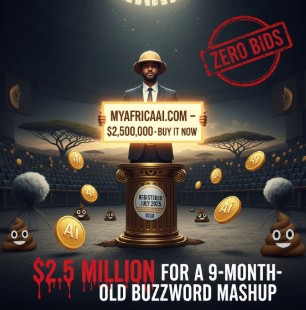
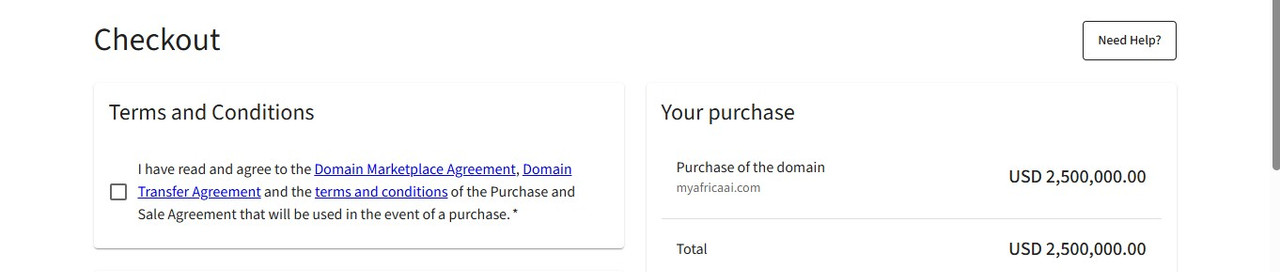
The AI hype train continues to produce some truly creative pricing strategies. Today’s exhibit: MyAfricaAI.com — registered on 28 July 2025 and now listed on Sedo with a firm BUY IT NOW price of $2,500,000.
No “make offer” option. No room for negotiation. Just a clean seven-figure demand for a domain that is barely nine months old. The listing sits in Sedo’s premium section, looking ambitious and continental, while the market continues to offer its consistent, thoughtful response: absolute silence.
This isn’t visionary pricing. This is “Africa + AI” keyword optimism taken to its most expensive conclusion
The Contender in the Spotlight
MyAfricaAI.com is currently listed as a fixed-price BUY IT NOW on Sedo for exactly $2,500,000. The seller has positioned it as a premium AI + Africa play — presumably for continental tech hubs, AI development platforms, investment funds, or pan-African innovation projects. There is no detailed description, no use-case story, no traffic data, and no development history — just the domain name and the massive price tag.
The listing promises the usual Sedo buyer protections and secure transfer, but at this price level those features feel more like polite formalities than actual selling points. Nine months after registration, the domain has attracted exactly zero visible interest or bids.
The Backstory: July 2025 Registration Meets Immediate Multi-Million Dreams
The domain was registered on 28 July 2025 — right in the middle of the ongoing global AI investment wave, with Africa increasingly positioned as the next frontier for tech growth. The seller apparently saw the combination of “My” (personal/ownership feel) + “Africa” + “AI” and decided this was destined to become a seven-figure brand asset.
Instead of developing the name, building a landing page, or testing the market at realistic levels, they went straight for the nuclear option: a $2.5 million BUY IT NOW price on Sedo. This is the domain version of seeing a trending topic and immediately pricing your notebook scribble as fine art.
Breaking Down the Domain Quality: Keyword Overload, Zero Brand Magic
Let’s examine the name with zero continental fanfare:
MyAfricaAi is 10 characters long (excluding the extension). It’s a triple-keyword mashup: “My” + “Africa” + “AI.”
The name is extremely descriptive and generic. It sounds exactly like what it is — a placeholder for an “Africa-focused AI” project. There is almost zero unique brand personality or emotional appeal.
“MyAfrica” feels possessive and slightly awkward. Adding “AI” at the end turns it into a buzzword sandwich that tries to ride two hot trends at once (Africa rising + AI boom).
In the AI/Africa/tech space, strong brands tend to be short, memorable, and culturally resonant (think “Andela”, “Flutterwave”, “InstaDeep”, or even newer plays like “Africarare” or “PanAfricanAI”). MyAfricaAI.com feels like a conference session title or a grant proposal name, not a premium brand.
Nine months of age is the only mildly positive factor. Everything else is textbook buzzword stuffing.
The Delusion Factor: Nine Months Old and Already Worth $2.5 Million
The real satire here is the speed of the ambition. Registered in July 2025, listed in 2026 for $2,500,000 with no development, no traction, and no proven demand. The seller is treating a fresh hand-registration as if it’s already a mature, continent-scale AI platform with built-in equity.
This level of optimism ignores basic market realities: even strong geo + tech combination domains rarely command seven figures unless they are exceptionally short, brandable, or have real traction and cultural resonance. The complete lack of interest on Sedo is the market’s polite way of saying “nice try, but no.”
Realistic Valuation: What the Silence Is Telling Us
The AI boom and Africa’s growing tech scene are both very real, but combining hot keywords does not automatically create a premium brand. Strong names in this space need to be short, memorable, culturally resonant, and emotionally compelling — not a descriptive mashup that sounds like a project title. If you’re going to chase geo + AI trends, at least register something that doesn’t feel like it was generated by a keyword combiner tool.
The Defequer Verdict
Category
Rating
Name Quality
⭐☆☆☆☆ (1/5)
Appraisal Sanity
⭐☆☆☆☆ (1/5)
Actual Market Value
⭐☆☆☆☆ (1/5)
Likelihood of $2.5M Sale
0.00%
Defequer Rating: 💩💩💩💩💩 (5/5 shits — registering a triple-keyword AI + Africa mashup in July 2025 and listing it for $2.5 million nine months later is peak buzzword delusion.)
MyAfricaAI.com isn’t the worst name we’ve seen, but at $2,500,000 it’s comedy gold. The market has spoken with its silence. Drop the price dramatically or prepare for another quiet year watching the renewal notices roll in.
Got more seven-figure geo-AI dreams, fresh buzzword mashups, or any other over-hyped Sedo listings you want roasted? Don’t hesitate to let us know. We’re always flushing the fluff — one overpriced continental dream at a time.
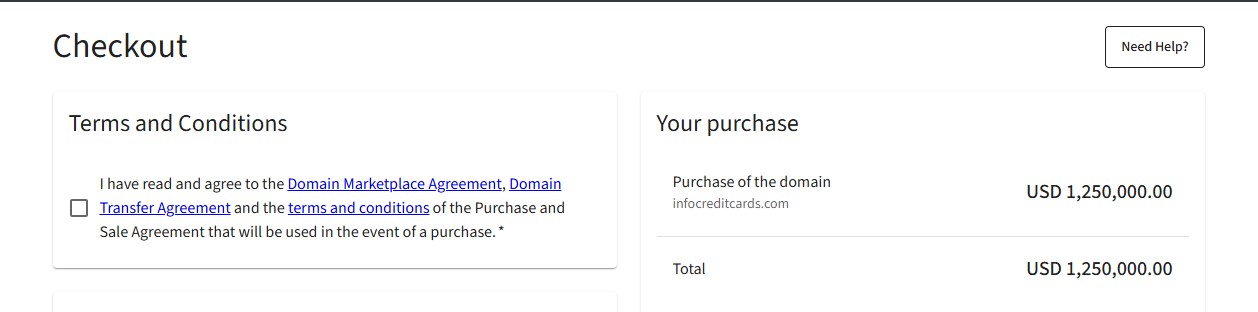
Some domainers see a hot niche like credit cards and immediately think “keyword stuffing + .com = instant millions.” Enter InfoCreditCards.com — registered on 25 February 2024 and now proudly listed on Sedo with a firm BUY IT NOW price of $1,250,000.
No negotiation. No “make offer” button. Just a clean seven-figure demand for a domain that is barely two years old. The listing sits in Sedo’s premium section, looking expensive and corporate, while the market continues to offer its thoughtful, consistent response: absolute silence.
This isn’t strategic pricing. This is keyword-stuffed optimism taken to its logical extreme.
The Contender in the Spotlight
InfoCreditCards.com is currently listed as a fixed-price BUY IT NOW on Sedo for exactly $1,250,000. The seller has positioned it as a premium financial information portal, presumably for credit card comparison sites, reviews, or fintech tools. There is no detailed description, no traffic data, no development history — just the domain name and the massive price tag.
The listing promises the usual Sedo buyer protections and secure transfer, but at this price level those features feel more like polite formalities than actual selling points. Two years after registration, the domain has attracted exactly zero visible interest or bids.
The Backstory: Registered in Early 2024, Monetized with Maximum Ambition in 2026
The domain was created on 25 February 2024 — right in the middle of ongoing fintech and credit card comparison hype. The seller apparently saw the steady demand for credit card information sites and decided that cramming “Info” + “CreditCards” together would create instant premium value.
Instead of developing the domain, building content, or testing the market at realistic levels, they went straight for the nuclear option: a $1.25 million BUY IT NOW price on Sedo. This is the domain version of buying a generic domain name and immediately pricing it like it’s already a successful business.
Breaking Down the Domain Quality: Keyword Stuffing at Its Finest
Let’s examine the name with zero fintech sparkle:
InfoCreditCards is 15 characters long (excluding the extension). It’s a triple-keyword mashup: “Info” + “Credit” + “Cards.”
The name is extremely descriptive and generic. It sounds exactly like what it is — a placeholder for a credit card information website. There is zero brand personality or emotional appeal.
n the highly competitive credit card/fintech space, successful brands are short, memorable, and aspirational (think “Credit Karma”, “NerdWallet”, “WalletHub”, or even “CardRates”). InfoCreditCards.com feels like a 2015 directory site that never took off.
It’s long, clunky to type, and instantly forgettable. The word “Info” adds nothing unique — it just makes the name longer and more corporate-sounding.
Two years of age is the only mildly positive factor. Everything else is textbook generic keyword stuffing.
The Delusion Factor: Two Years Old and Already Worth $1.25 Million
The real satire here is the speed at which the delusion escalated. Registered in February 2024, listed in 2026 for $1,250,000 with no visible development or traction. The seller is treating a fresh, descriptive registration as if it’s already a mature, revenue-generating asset.
This level of optimism ignores basic market realities: credit card comparison sites succeed because of strong branding, user experience, and content — not because they own a long, generic domain name. The complete lack of interest on Sedo is the market’s polite way of saying “thanks, but we’ll pass.”
Realistic Valuation: What the Silence Is Telling Us
In today’s aftermarket, even decent financial keyword .coms rarely break low six figures unless they have proven traffic, revenue, or exceptional brandability. A two-year-old descriptive mashup like InfoCreditCards.com realistically sits in the $200 range at best — and that’s on a very good day with the right buyer who needs a comparison site domain.
$1,250,000 is not ambition. It’s pure fantasy pricing that guarantees the domain will continue to sit unsold while renewal fees accumulate.
Lessons for Domainers: Keyword Stuffing Is Not Branding
The credit card niche is competitive and lucrative, but success comes from strong, memorable branding — not from cramming as many relevant keywords as possible into one long string. “InfoCreditCards” is the domain equivalent of naming your company “Information About Credit Cards Inc.” It may be descriptive, but it has zero emotional pull and zero premium appeal.
If you’re going to chase fintech trends, register something short, clean, and brandable — not a lengthy keyword directory name.
The Defequer Verdict
Category
Rating
Name Quality
⭐☆☆☆☆ (1/5)
Appraisal Sanity
⭐☆☆☆☆ (1/5)
Actual Market Value
⭐☆☆☆☆ (1/5)
Likelihood of $1.25M Sale
0.00%
Defequer Rating: 💩💩💩💩💩 (5/5 shits — registering a keyword-stuffed credit card domain in 2024 and listing it for $1.25 million two years later is peak descriptive delusion.)
InfoCreditCards.com isn’t the worst name ever registered, but at $1,250,000 it’s comedy. The market has spoken with its silence. Drop the price dramatically or prepare for another quiet year in the renewal folder.
Got more seven-figure fintech dreams, keyword-stuffed Sedo listings, or any other over-hyped inventory you want roasted? Drop us an email. We’re always flushing the fluff — one overpriced directory name at a time.
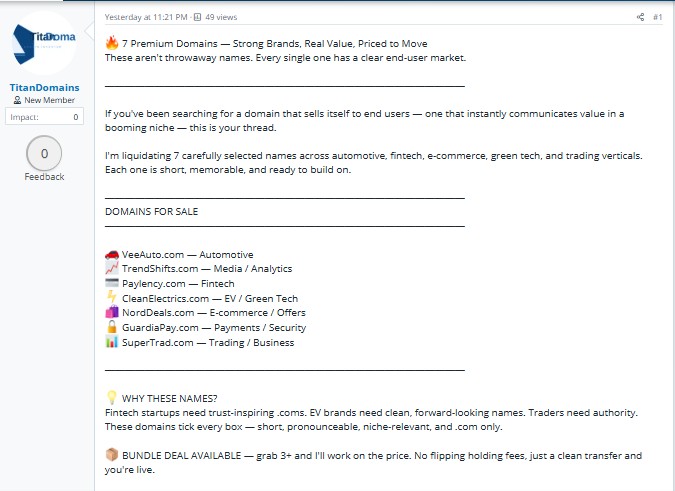
NamePros is full of enthusiastic sellers trying to move their inventory, but every once in a while a thread appears that feels like it was written by a motivational speaker who just discovered domain investing last year. Enter TitanDomains, who posted a fiery thread titled “🔥 7 Premium Domains — Strong Brands, Real Value, Priced to Move.”
The pitch is pure optimism: short, memorable, niche-relevant .coms ready for end-users in hot sectors like automotive, fintech, EV, e-commerce, and trading. Bundle deals available. Serious buyers only. Let’s make a deal!
The only problem? Every single domain was hand-registered in 2025 (most between June and November), making them barely a year old at best. They are being offered at Atom and Spaceship landing pages for prices ranging from $3,399 to $6,399. This isn’t patient domaining. This is “register in 2025, call it premium in 2026” energy.
The Contender in the Spotlight
TitanDomains’ original post is a masterclass in upbeat self-promotion. They describe the seven domains as:
VeeAuto.com — Automotive
TrendShifts.com — Media / Analytics
Paylency.com — Fintech
CleanElectrics.com — EV / Green Tech
NordDeals.com — E-commerce / Offers
GuardiaPay.com — Payments / Security
SuperTrad.com — Trading / Business
The language is loaded with buzz: “strong brands,” “real value,” “clear end-user market,” “short, memorable,” “ready to build on.” They even offer bundle discounts and promise quick responses via PM. No mention of the actual creation dates in the thread, of course — that detail might spoil the premium narrative.
The overall vibe is urgent liquidation disguised as generous opportunity. “Priced to move” is the key phrase, repeated like a mantra.
The Backstory: 2025 Hand-Registers Getting the Hard Sell in 2026
All seven domains were registered in 2025 (VeeAuto.com in June 2025, TrendShifts.com as late as November 2025, others in June–October). They are all expiring in 2026, meaning the seller has held them for less than a year in most cases.
TitanDomains appears to be an active NamePros member who joined relatively recently and is now aggressively liquidating a batch of freshly hand-registered names. The strategy seems clear: register trendy keyword combinations during the 2025 hype cycles (AI, EV, fintech, trading), then immediately push them on NamePros as “premium” with four-figure asking prices via Atom and Spaceship landing pages.
This is the opposite of patient domaining. It’s rapid registration → rapid promotion → hope someone bites before the first renewal cycle really hurts.
Breaking Down the Domain Quality: Keyword Mashups, Not Brands
Let’s look at each one with zero hype:
VeeAuto.com (2025-06-15) — “Vee” is vague (could be short for vehicle or just a random prefix). Sounds like a budget EV startup that went out of business in six months.
TrendShifts.com (2025-11-25) — Two generic words smashed together. Sounds like a marketing blog, not a memorable brand.
Paylency.com (2025-06-28) — Made-up fintech word (“pay” + “leniency”?). Hard to spell, harder to remember, and feels forced.
CleanElectrics.com (2025-06-25) — Descriptive and clunky. “Clean” + “Electrics” is about as brandable as “GreenCars.com.”
NordDeals.com (2025-06-26) — “Nord” suggests Nordic, but paired with “Deals” it sounds like a discount store in Scandinavia. Not premium.
GuardiaPay.com (2025-10-15) — “Guardia” (Spanish/Italian for guard) + Pay. Feels like a security payment app that never left beta.
SuperTrad.com (2025-06-23) — “Super” + “Trad” (short for trading). Sounds like a 2010s trading platform that got acquired for pennies.
Common problems across the portfolio: most are compound/made-up words, several feel dated or overly descriptive, and none have that instant “wow, I want to build on this” factor that real premium names possess. They are classic hand-registered keyword plays hoping the buzzword era would carry them.
The Delusion Factor: Calling Fresh 2025 Registrations “Strong Brands”
The real satire here is the aggressive framing. These are not aged, developed, or proven assets. They are 2025 hand-registers being sold as if they were carefully curated portfolio gems with “clear end-user markets.”
TitanDomains is pushing hard with bundle offers and “priced to move” urgency, yet the actual market response (so far) has been quiet. This is what happens when someone confuses “I registered it during a hype cycle” with “this is a strong brand.”
Realistic Valuation: Four-Figure Asks on Low-Value Fresh Names
Fresh 2025-registered compound .coms like these typically resell in the $300–$1,500 range wholesale, occasionally higher if a very specific end-user falls in love with one. Asking $3,399–$6,399 on Atom/Spaceship landing pages for names with no traffic, no history, and average-to-poor brandability is optimistic at best.
The “priced to move” claim rings hollow when the prices are still firmly in the retail fantasy zone for this quality level.
Lessons for Domainers: Fresh Registrations Need Realistic Expectations
Hand-registering trendy keywords and immediately calling them “premium strong brands” is a common trap. Real value comes from short, memorable, positive, versatile names — not keyword mashups created yesterday. If you’re going to promote a batch on NamePros, be honest about what they are: fresh speculative plays, not ready-to-build empires.
The Defequer Verdict
Category
Rating
Name Quality
⭐⭐☆☆☆ (2/5)
Appraisal Sanity
⭐☆☆☆☆ (1/5)
Actual Market Value
⭐☆☆☆☆ (1/5)
Likelihood of $4,000+ Sales
0.00%
Defequer Rating: 💩💩💩💩💩 (5/5 shits — dressing up a batch of 2025 hand-registers as “7 premium brands priced to move” is peak self-promotional delusion.)
TitanDomains, if you’re reading this: tone down the hype, drop the prices to realistic levels, and maybe focus on quality over quantity next time. These aren’t throwaway names — they’re just not the strong brands you’re claiming they are.
Got more “premium portfolio” threads, fresh 2025 batches, or any other over-hyped NamePros promotions you want roasted? Drop us an email. We’re always flushing the fluff — one self-promotional thread at a time.
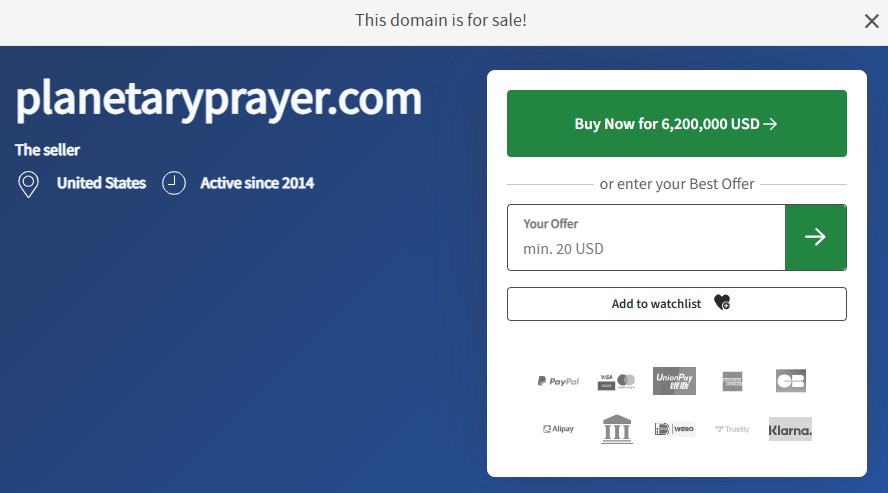
In the domain world, patience is often rewarded — unless the name you’ve patiently held for eight years was never particularly strong to begin with. Meet PlanetaryPrayer.com, registered all the way back on 5 May 2018 and now proudly displayed on Sedo with a firm BUY IT NOW price of $6,200,000.
No “make offer” option. No negotiation room. Just a clean seven-figure demand for a domain that has had nearly a decade to prove its worth. The listing sits in Sedo’s premium section, looking expensive, spiritual, and profoundly lonely, with the market offering its usual thoughtful response: total silence.
This isn’t confident pricing. This is what happens when someone confuses “I held it for eight years” with “it must be worth millions.”
The Contender in the Spotlight
PlanetaryPrayer.com is currently listed as a fixed-price BUY IT NOW on Sedo for exactly $6,200,000. The seller has positioned it as a premium spiritual/new-age/wellness domain, presumably hoping buyers in the mindfulness, astrology, or global consciousness space will see the poetic combination of “planetary” and “prayer” and reach for their wallets.
There is no detailed description, no development history, no traffic stats, and no compelling brand story — just the domain name and the massive price tag. The listing promises the usual Sedo buyer protections, but at this price point those protections feel more like a polite disclaimer than a selling feature.
Eight years after registration, the domain has attracted exactly zero public interest or bids that we can see.
The Backstory: Registered in 2018, Monetized in 2026 with Maximum Ambition
The domain was created on 5 May 2018 — a time when “planetary” sounded futuristic and “prayer” carried spiritual weight in the rising wellness and new-age movements. The seller held it patiently through multiple market cycles, waiting for the perfect moment to strike.
That moment apparently arrived in 2026, when they decided the name was finally ready for its close-up: a straight $6.2 million BUY IT NOW on Sedo. This is the domain equivalent of keeping a bottle of wine in the cellar for eight years and then asking for the price of a private jet when you finally decide to sell it.
Breaking Down the Domain Quality: Poetic on Paper, Clunky in Reality
Let’s examine the name with zero spiritual incense:
PlanetaryPrayer.com is 15 characters long (excluding the extension). It’s a two-word compound that sounds profound at first glance but quickly feels heavy and awkward.
“Planetary” suggests global, cosmic, or environmental themes. “Prayer” suggests spirituality, mindfulness, or religion. Together they create a vague, new-age vibe that could theoretically fit meditation apps, astrology sites, or wellness brands — but the combination lacks punch and memorability.
The name is long, somewhat difficult to spell quickly, and doesn’t roll off the tongue. It feels more like a blog title or a book subtitle (“Planetary Prayer: Healing the Earth Through Intention”) than a strong, scalable brand.
In the spirituality/wellness space, successful brands tend to be shorter, warmer, and more aspirational (think “Calm”, “Headspace”, “Insight Timer”, or even “Gaia”). PlanetaryPrayer.com feels overly literal and instantly forgettable.
Eight years of age is the only real positive here. Everything else is average at best.
The Delusion Factor: Eight Years of Holding, Then Demanding $6.2 Million
The real comedy is the pricing leap. After patiently holding the domain since 2018, the seller has decided it’s now worth more than most successful startups sell for at exit. This is classic sunk-cost fallacy mixed with spiritual pricing: “I’ve nurtured this name for nearly a decade, so it must be divine real estate.”
The complete lack of bids or serious inquiries is the market’s gentle way of saying the name never had the commercial magnetism to justify anywhere near that valuation — not in 2018, and certainly not today.
Realistic Valuation: What the Silence Is Telling Us
In today’s aftermarket, even decent spirituality/wellness .coms rarely break low six figures unless they are short, highly brandable, or have proven traffic and revenue. An 8-year-old compound phrase like PlanetaryPrayer.com realistically sits in the $300 range at best — and that’s on an optimistic day with the perfect buyer who loves the poetic feel.
$6,200,000 is not ambition. It’s financial spirituality detached from earthly market realities. The silence on Sedo is deafening.
Lessons for Domainers: Long Holding Time Doesn’t Create Value
Holding a domain for eight years shows discipline, but it doesn’t magically transform a mediocre name into a premium asset. Real value comes from intrinsic quality — shortness, memorability, positive emotion, and versatility. If you’re going to ask seven figures after nearly a decade, the name had better feel like it was destined for greatness, not like a 2018 new-age blog title.
The Defequer Verdict
Category
Rating
Name Quality
⭐⭐☆☆☆ (2/5)
Appraisal Sanity
⭐☆☆☆☆ (1/5)
Actual Market Value
⭐☆☆☆☆ (1/5)
Likelihood of $6.2M Sale
0.00%
Defequer Rating: 💩💩💩💩💩 (5/5 shits — holding a spiritual buzzword domain for eight years and then asking $6.2 million is next-level celestial delusion.)
PlanetaryPrayer.com had eight full years to prove its worth and still couldn’t attract a single serious buyer at a realistic price. The market has spoken clearly through its silence. Time to bring the price back down to planet Earth or accept that this one belongs in the long-term renewal portfolio.
Got more eight-year-old spiritual dreams, seven-figure Sedo fantasies, or any other over-hyped inventory you want roasted? Hit us up. We’re always flushing the fluff — one overpriced prayer at a time.
In the current AI gold rush, some domainers have discovered a foolproof strategy: register a buzzword-heavy name, wait a few months, and then list it for seven figures on Sedo as if it’s the next big thing. Enter InvestingXAI.com — registered on 12 September 2025 and now proudly displayed on Sedo with a straight BUY IT NOW price of $1,250,000.
No “make offer” option. No negotiation. Just a firm seven-figure demand for a domain that is barely seven months old. The listing sits there in Sedo’s premium section, looking expensive and lonely, with the market offering its usual polite response: absolute silence.
This isn’t bold pricing. This is comedy wrapped in AI hype.
The Contender in the Spotlight
InvestingXAI.com is currently listed as a fixed-price BUY IT NOW on Sedo for exactly $1,250,000. The seller chose the premium showcase treatment, hoping the combination of “Investing” + “XAI” would trigger instant FOMO among AI-crazed buyers. There is no additional description, no development history, no traffic stats — just the domain name and the massive price tag.
The listing promises the usual Sedo buyer protections and secure transfer, but at this price point those features feel more like decoration than selling points. Seven months after registration, the domain has attracted exactly zero public interest or bids.
The Backstory: September 2025 Registration Meets Immediate Million-Dollar Dreams
The domain was registered on 12 September 2025 — right in the middle of the ongoing AI investment hype wave. The seller apparently saw the buzz around “XAI” (xAI being Elon Musk’s company, plus the general “X” branding trend) and decided that mashing it with “Investing” would create instant premium value.
Instead of developing the name, building a mini-site, or testing the market at realistic levels, they went straight for the nuclear option: a seven-figure BUY IT NOW price on Sedo. This is the domain version of buying a lottery ticket and immediately demanding the jackpot.
Breaking Down the Domain Quality: Buzzword Overload, Zero Memorability
Let’s strip away the hype and look at the name itself:
InvestingXAI.com is 12 characters long, with the dot and the extension itself. “Investing” is a highly generic, competitive keyword. “XAI” is a trendy suffix that tries to ride the coattails of xAI and the broader “X” branding wave, but it feels forced and dated already.
The combination sounds exactly like what it is: a keyword mashup created to chase the 2025 AI investment narrative. It lacks any unique brand identity or emotional appeal.
In the investment/fintech/AI niche, strong names tend to be short, clean, and aspirational (think “a16z”, “Paradigm”, or even newer plays like “Arc” or “Basis”). InvestingXAI.com feels like a blog title or a newsletter name, not a premium brand.
Pronunciation is awkward (“Investing Ex-Ay-Eye” or “Investing Zai”), and spelling it correctly every time will frustrate users.
This is not a brand. It’s a Google keyword string wearing a .com hat.
The Delusion Factor: Seven Months Old and Already Worth $1.25 Million
The real satire here is the speed of the delusion. Registered in September 2025, listed in 2026 for $1,250,000 with no development, no traffic, no backlinks, and no proven demand. The seller is treating a fresh hand-registration as if it’s a aged, battle-tested asset with built-in equity.
Paying for Sedo’s premium placement on a name like this is the digital equivalent of renting a billboard to advertise a half-eaten sandwich. The complete lack of interest is the market’s way of saying “nice try, but no.”
Realistic Valuation: What the Silence Is Telling Us
In the current aftermarket, even decent AI-related .coms rarely break low six figures unless they are exceptionally short, brandable, or have real traction. A seven-month-old keyword mashup like InvestingXAI.com realistically sits in the $200 range at best — and that’s on a very optimistic day with the right buyer.
$1,250,000 is not ambition. It’s pure fantasy pricing that guarantees the domain will sit unsold while renewal notices pile up.
Lessons for Domainers: AI Hype Is Not a Substitute for Quality
The AI boom is real, but it doesn’t magically turn every buzzword combination into a premium asset. Strong names in this space need to be short, memorable, easy to spell, and emotionally resonant. Keyword stuffing “Investing” + “XAI” creates a descriptive phrase, not a brand. If you’re going to chase AI trends, at least register something that doesn’t sound like a newsletter title from 2025.
The Defequer Verdict
Category
Rating
Name Quality
⭐☆☆☆☆ (1/5)
Appraisal Sanity
⭐☆☆☆☆ (1/5)
Actual Market Value
⭐☆☆☆☆ (1/5)
Likelihood of $1.25M Sale
0.00%
Defequer Rating: 💩💩💩💩💩 (5/5 shits — registering a buzzword mashup in September 2025 and listing it for $1.25 million seven months later is peak AI-hype delusion.)
InvestingXAI.com isn’t the worst name we’ve roasted, but at $1,250,000 it’s comedy gold. The market has spoken with its silence. Drop the price dramatically or prepare for a long, quiet retirement in the renewal folder.
Got more seven-figure AI dreams, fresh buzzword mashups, or any other over-hyped Sedo listings you want roasted? Share it with us. We’re always flushing the fluff — one delusional price tag at a time.
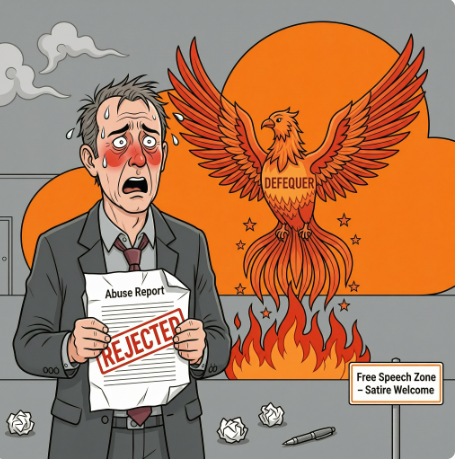
On 27 April 2026, Philipp Redeker – Managing Partner of a German recruitment agency called OneOutOfHundred.com – filed an abuse complaint with Cloudflare.
His weapon: A creatively worded claim that we violated the GDPR, published his personal data without consent, and damaged his right to conduct business.
His result: A 24‑hour suspension, followed by a full reinstatement, and now – this article.
Let us be clear: Defequer is a satirical website. We roast overpriced domains and the people who sell them. We do not doxx. We do not harass. We do not break the law. And we certainly do not disappear just because someone with a free GMX “lawyer” and a bruised ego decides to file a complaint.
Mr. Redeker, this roast is for you. You tried to silence us. You failed. And now we are going to explain – to you, to Cloudflare, and to the world – exactly why your complaint was nonsense, why your threats backfired, and why you should have just let it go.
What Actually Happened – A Timeline
For readers who are just joining us, here is the short version:
We published his email (with his signature visible, as he sent it) and wrote a satirical response.
He demanded our identity, address, and “clear name.” We refused, explaining that anonymous satire is protected speech.
A fake “trademark lawyer” named “Retro Valler” using a free GMX email sent us a legally dubious UDRP analysis. We roasted him too.
Redeker then filed an abuse complaint with Cloudflare, falsely claiming we violated the GDPR and published his data without consent.
Cloudflare forwarded the complaint to our hosting provider.
Our hosting provider suspended us – for about 24 hours, until we explained the situation.
We are back. Stronger. And writing this article.
That is the sequence. Note what did not happen: No court order. No GDPR fine. No successful lawsuit. No permanent takedown. Just a 24‑hour blip caused by an automated hosting response and a complainant who confused “I am angry” with “I have a legal case.”
Why the Cloudflare Abuse Complaint Was Frivolous
Let us examine the complaint that Redeker filed, because it is important to understand why it failed – and why similar complaints will fail in the future.
Redeker claimed (through Cloudflare’s reporting system) that we:
Unlawfully published his data after an email exchange
Published his contact details (email signature) without consent
Violated the GDPR
Violated his right to conduct business
Here is why each claim is wrong, under Cloudflare’s own terms and under established law.
Claim 1: “Unlawfully published his data after an exchange”
Redeker sent unsolicited emails to our public contact address ([email protected]). He was not a private individual writing in confidence. He was a “Managing Partner” of a registered company, using a professional email signature that included his name, title, company name, and email address. He initiated the conversation. He did not mark his emails as “confidential” or “private.”
Under the GDPR, the legitimate interest basis (Article 6(1)(f)) allows the processing and publication of personal data when it is necessary for the purposes of criticism, commentary, or satire – and when those interests are not overridden by the data subject’s rights. A managing partner who voluntarily emails a satirical website cannot reasonably claim that his professional signature is “private” or that its republication is unlawful.
Moreover, the GDPR includes an explicit exemption for journalistic, academic, artistic, and literary expression (Article 85, as implemented in national laws like the German Telemediengesetz §57). Defequer’s satirical commentary falls squarely within that exemption.
Claim 2: “Published his contact details without consent”
Redeker provided his contact details. He typed them into his email signature. He chose what information to include. He then sent that email to us. Consent is not required when the data subject has manifestly made the data public (Article 9(2)(e) – though that applies to special categories, the principle holds generally) or when the communication was voluntary and professional.
If Redeker did not want his email signature published, he should not have sent threatening legal emails to a satirical website. This is not complicated.
Claim 3: “Violated the GDPR”
The GDPR is a data protection regulation. It is not a censorship tool. It does not give individuals the right to erase any online mention of their name simply because they dislike the context. Courts across Europe have repeatedly rejected attempts to use the “right to be forgotten” or data protection laws to suppress legitimate speech, criticism, or satire.
Notably, Redeker did not file a complaint with a data protection authority. He did not obtain a court order. He did not even send us a formal GDPR takedown request with the required statutory elements. Instead, he filed an abuse report with Cloudflare – a private company – hoping that a quick suspension would achieve what the law would not.
That is not how the GDPR works. That is not how any of this works.
Claim 4: “Violated his right to conduct business”
Our articles mention Redeker’s company (OneOutOfHundred.com) in passing, in the context of explaining who he is and why his legal threats are ironic. We have not called for a boycott. We have not made false statements about his company’s services. We have simply pointed out that a recruitment agency’s managing partner spent his time sending legal threats to a satirical website over a domain name dispute.
If that damages his “right to conduct business,” the damage is self‑inflicted. He chose to engage with us. He chose to escalate. He chose to file a frivolous abuse report. The consequences are his responsibility.
Cloudflare’s Terms – And Why We Did Not Violate Them
Cloudflare’s Acceptable Use Policy (AUP) prohibits using their services for:
Illegal activity
Harassment or doxxing
Copyright infringement
Malware or phishing
None of our content falls into those categories. Satirical criticism is not harassment. Publishing an email signature that the sender voluntarily provided is not doxxing. Our articles do not incite violence, disclose private residential addresses, or reveal any information that Redeker did not put into his own emails.
Cloudflare is a pass‑through security and CDN provider. They are not content moderators. Their abuse reporting system is designed to catch genuinely harmful content – spam, malware, child exploitation, direct threats. It is not designed to adjudicate petty disputes between a domain seller and a satirical blog.
Cloudflare’s own Trust & Safety team almost certainly flagged Redeker’s complaint as low‑priority or simply forwarded it to the hosting provider as a courtesy. They did not suspend us. They did not issue a warning. They passed the message along. That is what good internet infrastructure providers do.
The problem was that our hosting provider – likely overwhelmed by automated abuse reports – triggered a temporary suspension without reviewing the merits. Once we explained the situation, the suspension was lifted. That is how the system should work.
We do not blame the hosting provider. They acted in good faith. We do not blame Cloudflare. They forwarded a report. The blame lies with the person who filed a knowingly false or exaggerated complaint in an attempt to silence critics.
That person is Philipp Redeker.
A Civilised Person’s Guide to Handling Online Criticism (For Philipp Redeker)
Mr. Redeker, since you appear to be unfamiliar with how adults handle disagreement, here is a short guide.
Step 1: Read the criticism
Before reacting, read the article. Understand what it says. Our original saudinationalteam.com roast did not mention your name. It roasted a domain listing. You chose to insert yourself into the conversation by sending a legal threat.
Step 2: Consider whether the criticism is fair
Our article pointed out that a domain registered in 2025, listed for $15.9 million, with no apparent connection to the Saudi national team, looks like cybersquatting. That is a reasonable opinion. Many domain professionals would agree.
Step 3: Respond civilly, if you must
If you disagree, you could have left a comment, sent a polite email, or even written your own rebuttal. Instead, you sent a formal legal threat demanding removal, then escalated to demands for our identity, then to a fake lawyer, then to an abuse complaint.
Step 4: Do not try to cancel the critic
Filing a knowingly false or exaggerated abuse report to take down a website is not a protected activity. It can expose you to liability for abuse of process, tortious interference, or even criminal charges in some jurisdictions. It also guarantees that we will write an even longer article about you.
This is not complicated, Mr. Redeker. It is basic internet etiquette.
Defequer’s Values – And Why We Do Not Back Down
We started Defequer to roast unreasonably priced domains and unrealistic domainer thinking. We do it with humour, with facts, and without personal attacks on private individuals. We do not doxx. We do not harass. We do not break the law.
But we also do not tolerate attempts to silence us through bogus legal threats or fabricated abuse reports.
Our values are simple:
Satire is protected speech. We will continue to roast.
Facts are not defamation. We will continue to cite real WHOIS data, real listings, and real emails (with context).
Anonymous criticism is lawful. We will not reveal our identities to angry domain sellers or their recruitment agency proxies.
Frivolous complaints will be exposed. We will publish every threat, every fake lawyer email, and every failed abuse report.
We are not going anywhere.
A Final Warning to Philipp Redeker (And Anyone Else Thinking of Filing a False Complaint)
Mr. Redeker, you have now:
Sent multiple threatening emails
Demanded our personal information
Enlisted a fake “trademark lawyer” using a GMX account
Filed a knowingly false abuse complaint with Cloudflare
Caused a temporary suspension of our website
We have responded with satire, with legal explanations, and with patience. That patience is not unlimited.
If you continue to harass us via threatening emails, fake lawyer letters, or unfounded complaints to Cloudflare or hosting providers, we will:
Continue publishing every communication you send us, in full
Document every attempt to silence us in permanent, SEO‑optimised articles that will rank for your name and your company’s name for years
You tried to take us down. You failed. And now your name is permanently associated with a failed censorship attempt on a satirical website. That is the permanent mark we promised.
We would much rather not have to keep writing about you. We would rather roast domains. So here is our final offer: Stop. Do not contact us again. Do not file any more complaints. Do not send any more fake lawyers. Just walk away.
If you do, we will not write about you again. If you do not, we will make sure that anyone who searches for “Philipp Redeker” finds these articles first.
The choice is yours.
Defequer Rating for Philipp Redeker’s Abuse Complaint: 💩💩💩💩💩 (5/5 shits)
Five shits. Not for the domain this time, but for the frivolous abuse report, the fake GDPR claims, the fake “trademark lawyer,” and the desperate attempt to silence satire. Mr. Redeker has earned a place in the Defequer Hall of Shame for Censorship Attempts. The Delusion Olympics – Abuse Report Division – has a new champion.
Roast served. Censorship attempt failed. Next frivolous complaint, please.
Post‑Script to Our Readers
Dear Defequer community,
We were down for 24 hours. It was annoying. But we are back, and we are not going anywhere.
Thank you to everyone who reached out with support. Thank you to our hosting provider for eventually doing the right thing. And thank you to Philipp Redeker for reminding us why satire matters – and why we will never stop.
If you ever receive a threatening email or a bogus legal complaint, remember: do not panic. Do not delete. Do not back down. Respond calmly, document everything, and if you can, roast them publicly. It works.
We will be here. Watching. And roasting.
Defequer Editorial Team (Anonymous. Satirical. Reinstated.)
There are fake lawyers. And then there are fake lawyers who use GMX free email addresses to send unsolicited legal opinions about domain names they have no connection to, on behalf of anonymous clients they refuse to name, while pretending they are not the same person who sent three increasingly desperate emails the week before.
Meet “Retro Valler, Esq.” Email address: [email protected]. We received his expert legal opinion very recently – just after we published our response to Philipp Redeker. The timing, the subject matter, the obsessive focus on saudinationalteam.com, and the suspiciously convenient legal arguments all point to one conclusion: this is Philipp Redeker wearing a very cheap disguise.
The full email from the fake lawyer
Dear operators of Defequer,
Upon reviewing your website, I took note of your recent publication concerning saudinationalteam.com. Your so‑called “roast” is irrelevant and warrants no response. What does require immediate attention, however, is your publication of a legally erroneous, misleading, and professionally indefensible assessment regarding an alleged potential UDRP proceeding in relation to this domain.
Your article purports to offer a legal evaluation, yet it demonstrably fails to apply the basic cumulative requirements of the Uniform Domain Name Dispute Resolution Policy. The conclusions you present are not merely debatable opinions, but objectively incorrect statements of law, conveyed without proper legal analysis, authority, or factual grounding. As published, your assessment is apt to mislead readers into believing that the domain is inherently vulnerable to UDRP action, a conclusion that is legally unsustainable.
To avoid any further propagation of demonstrably false legal implications, I am providing below a legally substantiated and validated argument based on the actual UDRP framework and established principles of domain name jurisprudence.
Executive Legal Position – UDRP
The domain name saudinationalteam.com does not violate the Uniform Domain Name Dispute Resolution Policy (UDRP). An administrative complaint would fail because the complainant cannot satisfy the cumulative requirements of Paragraph 4(a) of the Policy.
First, the domain name is not identical or confusingly similar to any exclusive trademark right within the meaning of Paragraph 4(a)(i) UDRP. The designation “Saudi National Team” is a purely descriptive and generic term composed of a geographical reference (“Saudi”) and a common sporting term (“National Team”). It does not function as a unique identifier of a single legal entity. In the Kingdom of Saudi Arabia, multiple independent national sports federations lawfully operate their own national teams under this descriptive designation, including the Saudi Arabian Football Federation, the Saudi Arabian Handball Federation, the Saudi Arabian Basketball Federation, the Saudi Arabian Volleyball Federation, the Saudi Arabian Athletics Federation, and other officially recognized sports governing bodies. The term “Saudi National Team” therefore refers to a category of national representative teams across different sports and cannot be monopolized by any single federation. As a result, there is no basis for establishing trademark identity or confusing similarity with an exclusive mark held by one specific complainant.
Second, the domain holder has demonstrable rights and legitimate interests in the domain name under Paragraph 4(a)(ii) UDRP. The registration of a domain composed entirely of generic and descriptive terms constitutes a lawful and recognized interest under longstanding UDRP jurisprudence. The domain is inherently open-ended and suitable for neutral, informational, journalistic, or multi-sport coverage relating to Saudi Arabian national teams across different disciplines. There is no use or intent shown that seeks to trade on the goodwill of any particular federation or to misappropriate a trademark. The descriptive nature of the domain itself establishes a legitimate interest that defeats the second UDRP element.
Third, the domain was neither registered nor used in bad faith within the meaning of Paragraph 4(a)(iii) UDRP. There is no evidence of intent to mislead users, to impersonate an official federation, to disrupt the activities of any sporting authority, or to create false affiliation. No content suggests sponsorship, endorsement, or official status by the Saudi Arabian Football Federation or any other body. Moreover, the mere fact that a generic domain name may be valuable or offered for sale does not constitute bad faith under the UDRP. This is particularly true where, as here, the domain’s wording is inherently ambiguous and capable of referring legitimately to multiple unrelated entities. The required element of targeted abuse against a specific trademark holder is entirely absent.
In conclusion, the complaint fails on multiple independent grounds. The domain name is generic and non-exclusive, the registrant holds a legitimate interest, and there is no evidence of registration or use in bad faith. Because the requirements of Paragraph 4(a) UDRP are cumulative and not satisfied, any UDRP proceeding against saudinationalteam.com would, as a matter of policy and established precedent, have to be dismissed.
You should promptly revise and correct your reporting and your legally uninformed assessment accordingly.
Best Retro Valler
Let us examine the evidence, roast the email point by point, and then ask the obvious question that Retro Valler forgot to answer: Who is your client, and why are you using a free email service?
First, the Smoking GMX – No Real Lawyer Uses a Free Email Address
GMX is a free, advertising‑supported email service. It is perfectly fine for personal use, small businesses, or anyone on a budget. But no legitimate trademark lawyer – especially one claiming to provide “legally substantiated and validated” UDRP arguments – uses a generic, free, non‑domain‑matched email address. Real law firms have professional email addresses. They have websites. They have verifiable credentials. They do not send unsolicited legal opinions from @gmx.net.
A quick search online reveals exactly zero lawyers named “Retro Valler” in any jurisdiction. No LinkedIn profile. No law firm website. No published articles. No UDRP cases with his name on them. Nothing. He does not exist.
What does exist is Philipp Redeker – a “Managing Partner” of a recruitment agency in Aachen, Germany, who has already sent us multiple legal threats using a professional email address ([email protected]). His company, OneOutOfHundredGmbH, is real. His address is public. And his email signature includes a phone number we could call if we wanted to verify things – though we have not, because we prefer to keep our roasting at a safe distance from actual human interaction.
The coincidence is simply too perfect: just days after we publish a response to Redeker’s legal threats, a new “trademark lawyer” appears from the ether, using a free email account, to defend the same domain, with the same obsessive attention to UDRP details, and with no visible connection to anyone except… Philipp Redeker.
We are not saying Redeker invented Retro Valler. But we are saying that if it walks like a recruitment agency managing partner who has run out of legal arguments, and quacks like someone typing furiously into a GMX compose window at 2 AM, it is probably not a real lawyer.
The Legal Arguments – A Masterclass in Missing the Point
Now, let us address the substance of Mr. Valler’s (or Mr. Redeker’s) email. He claims to provide a “legally substantiated and validated argument” that saudinationalteam.com does not violate the UDRP. He is correct about one thing: the UDRP requires cumulative proof of three elements. But he is fundamentally wrong about the facts and the law.
Element 1: Confusing Similarity – “Purely Descriptive and Generic”
Valler argues that “Saudi National Team” is a “purely descriptive and generic term” because multiple sports federations operate national teams under that designation. He claims that no single federation can claim trademark rights.
This argument confuses descriptiveness with acquired distinctiveness. Under the UDRP, a complainant does not need a registered trademark; common law rights suffice. And the Saudi national football team has been competing internationally since 1957. They have played in six World Cups. Their merchandise is sold globally. Their matches are broadcast to millions. That is acquired distinctiveness by any reasonable standard.
Moreover, the relevant question under the UDRP is not whether the term is exclusively owned by one entity, but whether the domain name is confusingly similar to a trademark in which the complainant has rights. A generic term can become a protectable trademark through extensive use – and the Saudi national football team has exactly that kind of widespread recognition.
Element 2: Legitimate Interests – “The Domain Is Generic”
Valler claims that the registrant has legitimate interests because the domain is “generic and open‑ended.” But the registrant is not using the domain for any legitimate purpose. There is no website. There is no content. There is no bona fide offering of goods or services. There is only a listing for sale at $15,975,025 – a price that is 532,500 times the registration cost. That is not a legitimate interest. That is a parking lot for a cybersquatter.
Under WIPO Overview 3.0, the mere fact that a domain consists of dictionary words does not automatically confer legitimate interests. The registrant must actually use the domain in a legitimate manner – or at least demonstrate demonstrable preparations to use it. Selling a domain for an enormous sum, without any development or good-faith use, is the opposite of a legitimate interest.
Element 3: Bad Faith – “No Evidence of Intent to Mislead”
Valler argues that there is no evidence of bad faith because there is no website content, no impersonation, and no false affiliation. This is a fundamental misunderstanding. Bad faith can be proven by the registration itself – especially when the registrant targets a well‑known trademark.
Under UDRP paragraph 4(b)(i), registering a domain name primarily for the purpose of selling it to the trademark owner for valuable consideration in excess of documented out‑of‑pocket costs is evidence of bad faith. A 532,500x markup is precisely that. The registrant does not need to build a website or impersonate anyone. The asking price alone – combined with the opportunistic registration after the 2022 World Cup – is sufficient evidence.
Valler’s claim that “the mere fact that a generic domain name may be valuable or offered for sale does not constitute bad faith” is a partial truth. But UDRP panels routinely find bad faith when the price is grossly excessive relative to the registrant’s costs, and when the domain is clearly targeted at a specific trademark owner. $15.9 million for a one‑year‑old domain that cost $30 to register qualifies as “grossly excessive” in any language.
The Real Legal Standard – What Actual UDRP Panels Say
Let us turn to actual UDRP jurisprudence, not the selective citations of a faux‑lawyer with a free email address.
The WIPO Overview 3.0 (the actual authoritative guide to UDRP) states that panels consider the following as evidence of bad faith: “the respondent’s registration of the domain name in order to prevent the owner of the trademark or service mark from reflecting the mark in a corresponding domain name, provided that the respondent has engaged in a pattern of such conduct” and “the respondent’s registration of the domain name for the purpose of selling it to the complainant for valuable consideration in excess of its documented out‑of‑pocket costs.”
The domain was registered on 15 March 2025 – well after the Saudi national football team became a globally recognised brand. The asking price is $15,975,025 – a sum that has no relation to any legitimate business. The registrant has taken no steps to develop the domain into a legitimate website. Those are textbook indicators of bad faith.
Valler’s argument that “multiple sports federations” use the same descriptive term does not defeat a UDRP complaint. If a trademark owner (such as the Saudi Arabian Football Federation) can demonstrate that the domain is confusingly similar to its mark and that the registrant lacks legitimate interests and acted in bad faith, the complaint can succeed – regardless of whether other entities also use the term. The test is not exclusivity; it is confusing similarity with the complainant’s rights.
The Unanswered Question – Who Is Your Client, Mr. Valler?
Throughout his lengthy email, Retro Valler refuses to name his client. He claims to be a “trademark lawyer” offering an “executive legal position” on a domain he has no connection to. But who hired him? The domain seller? The Saudi Arabian Football Federation? Philipp Redeker? Himself?
We have a right to know. In the legal profession, lawyers do not send unsolicited legal opinions on behalf of anonymous clients – especially not from free email accounts. If Mr. Valler is a real lawyer, he should:
Disclose his client
Provide his law firm’s name and address
Use a professional email address
Demonstrate actual standing to opine on this matter
Until he does, we will treat his email as what it appears to be: a poorly disguised attempt by Philipp Redeker (or a friend) to salvage a lost argument by pretending to be a lawyer.
The Irony – A Self‑Proclaimed Lawyer Who Cannot Even Use a Proper Email Domain
Let us pause to appreciate the irony. Mr. Valler accuses us of publishing “legally erroneous, misleading, and professionally indefensible” content. Yet he cannot be bothered to spend $15 on a domain name and a professional email address. He uses @gmx.net – the same service used by millions of teenagers, hobbyists, and, apparently, one very confused “trademark lawyer.”
If you are going to pose as a legal expert, at least invest in the basic trappings of professionalism. A proper law firm email address (e.g., [email protected]) costs less than a sandwich and a coffee. The fact that Mr. Valler did not bother tells us everything we need to know about his actual qualifications.
Our Response to “Retro Valler” – A Formal Invitation
Dear Mr. Valler (or Mr. Redeker, or whoever you are),
Thank you for your email. We have read it carefully. We have considered your arguments. And we have concluded that they are not persuasive.
If you are a real lawyer, we invite you to:
Identify yourself. Provide your full name, law firm, bar association membership, and contact information. We will verify your credentials.
Identify your client. Who hired you? On whose behalf are you writing?
Use a professional email address.[email protected] does not inspire confidence.
File a lawsuit. If you genuinely believe our article is defamatory or legally erroneous, sue us. We will see you in court.
If you are not a real lawyer – and we strongly suspect you are not – we invite you to stop wasting our time and your own. Your legal arguments have been noted, considered, and dismissed. Our article stands. Our roast remains.
We will not be removing or revising anything. And we will not be intimidated by anonymous, free‑email‑using, legally‑confused individuals who cannot even identify their own clients.
The Bottom Line – Two Emails, One Likely Author, Zero Credibility
The evidence is circumstantial but compelling. Philipp Redeker sends three legal threats. We publish a response roasting him. Two days later, “Retro Valler” appears from nowhere, using a free email address, to defend the same domain, with the same obsessive attention to UDRP details, and with no verifiable identity.
Occam’s razor suggests the simplest explanation: Retro Valler is Philipp Redeker (or a close associate) trying a different approach after his previous threats failed.
Whether the author is Redeker, Valler, or someone else entirely, the result is the same: another unsolicited email, another set of unpersuasive legal arguments, and another opportunity for Defequer to stand its ground.
We will continue to publish satirical, opinion‑based critiques of delusional domain listings. We will continue to defend our right to anonymous speech. And we will continue to enjoy the creative efforts of those who try – and fail – to silence us.
Defequer Rating for “Retro Valler”: 💩💩💩💩💩 (5/5 shits)
Five shits. Not for the legal arguments (which are merely mediocre), but for the transparent disguise, the use of a free email address, the refusal to name a client, and the sheer audacity of pretending to be a lawyer while hiding behind GMX. This is not legal representation. It is a recruitment agency managing partner desperately trying to salvage his pride. The Delusion Olympics – Legal Division – has a new gold medalist.
Roast served. Identity questioned. Next pseudonym, please.
Post‑Script to Our Readers
Dear Defequer community,
We have now received four emails from (apparently) two different people: three from Philipp Redeker, and one from “Retro Valler.” The subject is always the same: saudinationalteam.com. The tone is always the same: a mix of legal bluster and personal defensiveness. And the outcome is always the same: no lawsuit, no injunction, no consequence.
We promised you we would not back down. We meant it. Our article remains online. Our opinions remain unchanged. And our roasting will continue – whether the emails come from a recruitment agency managing partner or a fictitious trademark lawyer with a GMX account.
If you receive any suspicious legal threats from unknown “lawyers” using free email services, forward them to us. We will investigate. We will roast. And we will not be silenced.
Defequer Editorial Team (Still anonymous. Still satirical. Still unafraid.)
P.S. – If Retro Valler is a real lawyer, we invite him to prove it. We will happily publish a retraction and an apology. But we will not hold our breath.
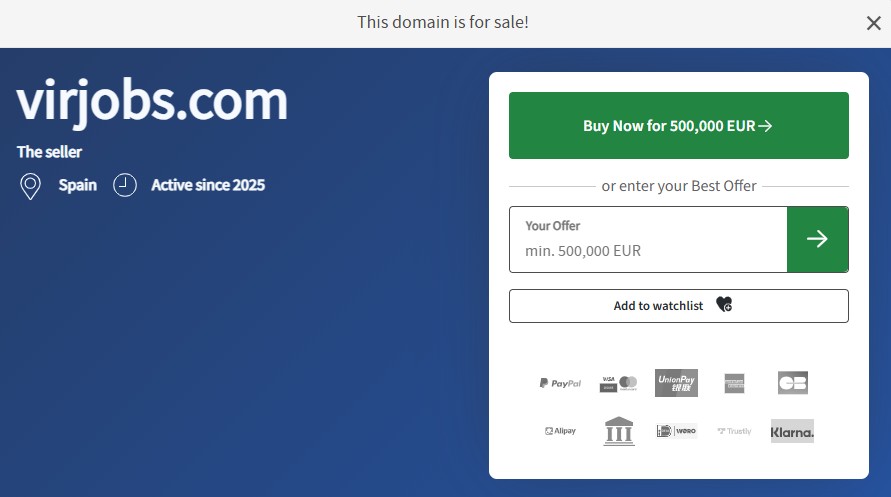
In domain investing, holding a name for a decade should theoretically build value — unless the name itself was never particularly good to begin with. Meet VirJobs.com, registered all the way back on 17 March 2016 and still valid until 2027. The seller, based in Spain and active on Sedo since 2025, has now placed it in auction with an ambitious reserve price range of €500,000 to €999,999.
The result so far? Complete radio silence. Not a single bid. Not even a curious lowball. Just the quiet disappointment of an empty auction page while the seller waits for someone to validate a nearly decade-old dream.
This is what happens when hope, nostalgia, and a hefty reserve meet cold market reality.
The Contender in the Spotlight
VirJobs.com is currently listed in Sedo’s auction format with a reserve somewhere between €500,000 and €999,999. The seller chose the Direct Auction route, which means they paid the listing fee and set a high minimum that must be met or exceeded for any sale to proceed. No descriptive text, no compelling use-case story, no development history — just the domain name and the eye-watering reserve range.
The auction page shows the standard Sedo buyer protections, but at this price level, those protections feel more like condolences than incentives. The listing has attracted exactly zero bids, proving that even a 10-year-old .com with some age can sit completely unwanted when the name itself falls flat.
The Backstory: A 2016 Registration Finally Gets Its Big Moment (Sort Of)
The domain was created on 17 March 2016 — a time when “vir” could have hinted at “virtual” (pre-COVID) or perhaps a short form of “virtual jobs.” The seller, operating from Spain and relatively new to Sedo (active since 2025), apparently decided it was finally time to cash in on this long-held asset by setting a six-figure reserve.
Ten years of holding, and the big debut is a high-reserve auction that nobody is touching. This isn’t the patient flip of a hidden gem. It’s more like keeping an old car in the garage for a decade and then demanding supercar money when you finally put it on the market.
Breaking Down the Domain Quality: Mediocre at Best, Clunky at Worst
Let’s examine VirJobs.com without the rose-tinted glasses:
VirJobs.com is 10 characters plus the extension. “Vir” is ambiguous — it could vaguely suggest “virtual,” but it also sounds like “veer,” “vir” (as in virus in some languages), or simply falls flat.
“Jobs” is a highly competitive, generic keyword. Pairing it with a weak prefix like “Vir” doesn’t create magic. It creates something that feels like a low-budget job board from 2012.
The name lacks strong brandability. It’s not particularly memorable, easy to spell globally, or emotionally positive. It sounds more like a typo or a rushed startup name than a premium employment platform.
In the job/recruitment niche, successful brands tend to be clear and aspirational (Think “LinkedIn,” “Indeed,” “Glassdoor,” or even “RemoteOK”). VirJobs.com feels corporate-bland and instantly forgettable.
Age is the only real positive here — 10 years registered gives it some history. But age alone cannot overcome a mediocre, clunky construction.
The Delusion Factor: A Decade of Holding, Then Demanding Six Figures
The seller has held this domain since 2016. That’s a long time to nurture an asset. Yet instead of developing it, building traffic, or testing the market at realistic prices, they’ve now set a reserve that starts at half a million euros.
This is classic “sunk cost + ego” syndrome: “I’ve owned it for ten years, so it must be worth a fortune now.” The complete absence of bids is the market’s polite way of saying the name never had the juice to justify that kind of money — not in 2016, and certainly not in 2026.
Paying for a Sedo auction with such a high reserve is essentially paying to advertise a fantasy.
Realistic Valuation: What the Zero Bids Are Saying
In today’s aftermarket, even aged .coms in the jobs/recruitment space rarely command six figures unless they are short, highly brandable, or have proven traffic and revenue. VirJobs.com realistically sits in the low-to-mid four figures at best on a strong day — probably closer to €500 for the right buyer who sees a niche use.
The €500,000+ reserve range is so detached from reality that the auction has become performance art in overvaluation. The market has voted with its wallet: silence.
Lessons for Domainers: Age Is Not Enough
Holding a domain for ten years is impressive discipline, but it doesn’t automatically create value. The name itself must be strong — short, memorable, positive, and versatile. When you finally decide to sell, set a realistic reserve that invites participation instead of guaranteeing an empty auction. Ten years of patience deserves better than a six-figure fantasy that nobody wants to join.
The Defequer Verdict
Category
Rating
Name Quality
⭐⭐☆☆☆ (2/5)
Appraisal Sanity
⭐☆☆☆☆ (1/5)
Actual Market Value
⭐⭐☆☆☆ (2/5)
Likelihood of €500K+ Sale
0.00%
Defequer Rating: 💩💩💩💩 (4/5 shits — the name isn’t the absolute worst we’ve seen, but demanding half a million euros after ten silent years is impressive levels of delusion.)
VirJobs.com had a decade to prove itself and still couldn’t attract a single bid at a realistic price. The market has spoken clearly. Time to drop the reserve dramatically or move on — before another renewal notice arrives.
Got more decade-old dreams with laughable reserves, Sedo no-bid specials, or any other over-hyped inventory you want roasted? Send us an email. We’re always flushing the fluff — one silent auction at a time.
And now, a new demand from Philipp Redeker, “Managing Partner” of a German recruitment agency called OneOutOfHundred.com:
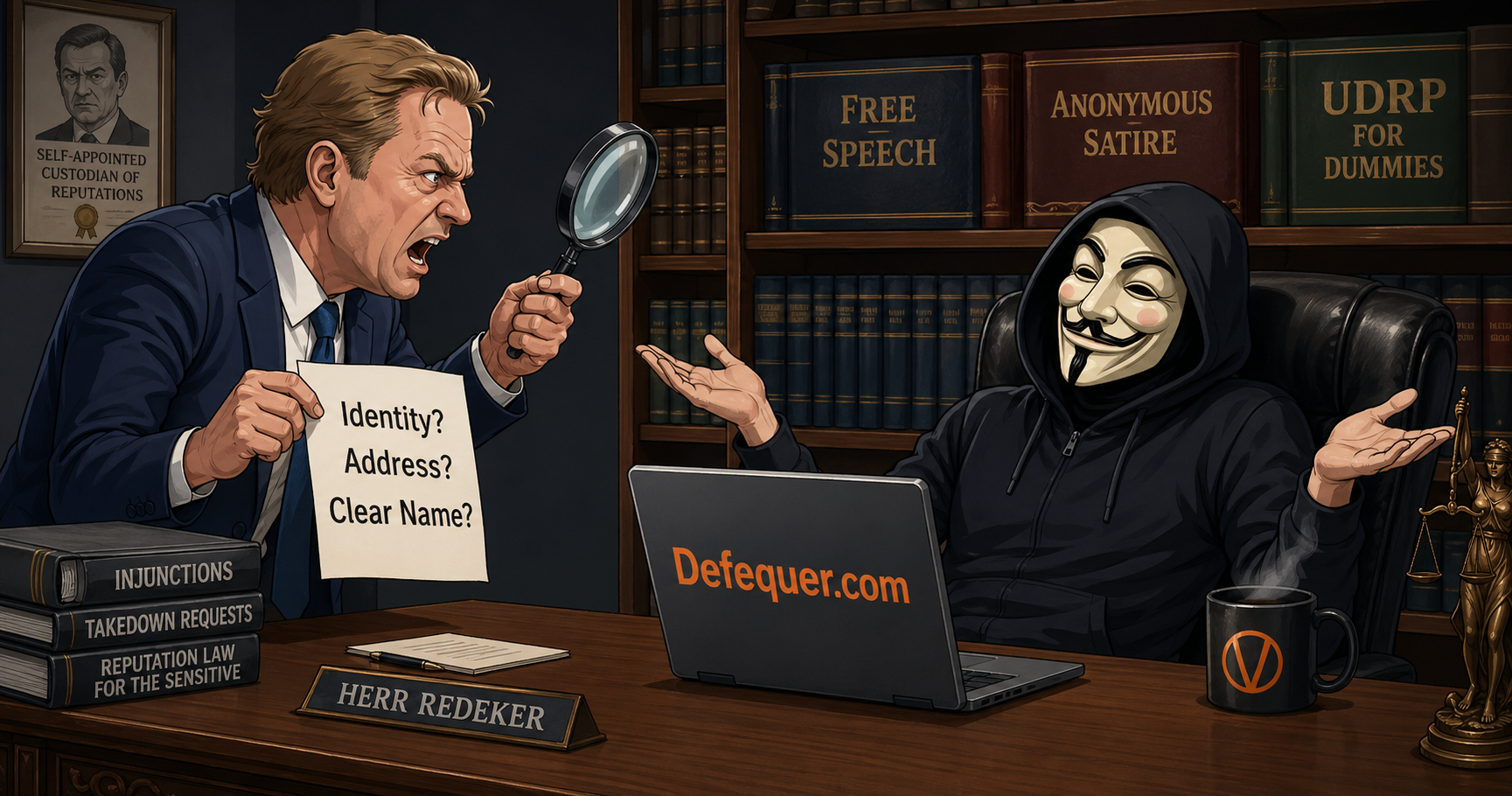
“You hide, hide, hide…. You are deliberately publishing personal data under the protection of anonymity, without consent, and without any identifiable accountability. … identify yourselves, disclose your operators, and take responsibility for your claims. Anonymous defamation is not credibility—it is avoidance. Your clear name? your identity? Your address? I am waiting.”
Well, Herr Redeker, you are waiting.
And you will keep waiting.
Because Defequer is an anonymous satirical website. That is not a bug. It is a feature. We roast overpriced domains and delusional sellers. We do not roast people‘s real names, addresses, or families. We roast public Sedo listings, public WHOIS data, and public emails that people send us (with permission).
You are demanding that we “identify ourselves” as if we were a party to a lawsuit. But you have not filed a lawsuit. You have not obtained a court order. You have not even identified your own client – assuming you have one.
So let us explain, in plain terms, why your demand is legally baseless, professionally embarrassing, and satirically delicious.
Anonymous Speech Is Protected Speech – Even in Germany
You are writing from Germany, Herr Redeker. Germany has strong data protection laws (DSGVO/GDPR). But Germany also protects anonymous speech under Article 5 of the German Basic Law (Grundgesetz) – freedom of expression – and the European Convention on Human Rights.
Anonymous satire has a long and honourable tradition. From the Letters of Junius in the 18th century to the blog “Gawker” (RIP) to countless whistleblower platforms today, anonymity allows critics to speak without fear of retaliation. In the domain industry, anonymity is particularly important because sellers and buyers can be vindictive – as you are demonstrating.
You claim we are “publishing personal data under the protection of anonymity, without consent.” That is false. We have not published any personal data. We published your email after you sent it to us. You consented to that communication. We did not reveal your home address, your private phone number, or anything beyond what you voluntarily included in your signature.
If you did not want your email published, you should not have sent it to a satirical website known for roasting people. That is like yelling at a comedian and then being surprised when the joke is on you.
You Have No Standing to Demand Our Identity
You are not a court. You are not a law enforcement agency. You are not even a lawyer. You are a “Managing Partner” of a recruitment agency that, according to your website, helps companies find candidates and manage rejection letters.
You have no legal standing to demand our “clear name, identity, and address.” None. Zero. Nichts.
If you were serious about pursuing legal action, you would have filed a lawsuit by now. In that lawsuit, you would ask the court to issue an order requiring our hosting provider or registrar to disclose our identity. That is how the process works. You do not get to skip the court and demand directly.
The fact that you have not done this – and instead sent three increasingly desperate emails – tells us everything we need to know: you have no case, no client, and no lawyer willing to take this on.
So go ahead, Herr Redeker. Keep waiting. We will be here. Anonymous. Satirical. Untouchable.
What Exactly Do You Claim Is “Defamatory”?
You have not specified. Your first email vaguely complained about “false legal characterization,” “unsupported trademark assertions,” and “defamatory labels such as cybersquatting.” Your second email simply demands our identity.
Let us remind you: our original article never named you. It never named the domain seller. It never claimed that the seller was a specific person. It simply stated facts:
The domain saudinationalteam.com was registered on 15 March 2025.
It was listed for sale at $15,975,025.
The seller had no apparent connection to the Saudi national team.
Registering a domain that mimics a famous entity and offering it for an enormous price is evidence of bad faith under the UDRP.
None of those statements are false. None of those statements are defamatory. And none of those statements require us to reveal our real names.
If you believe otherwise, sue us. We will gladly defend the truth in court. But you will not, because you cannot.
The Irony of a Recruitment Agency Demanding Transparency
We cannot let this pass without comment: you run a company called OneOutOfHundred.com. Your website (which we have visited many times, thank you for the traffic) does not list your personal home address. It does not list the names of every employee. It does not disclose the personal data of every candidate you place.
Your company enjoys the protection of being a legal entity. You are not required to publish your managing partner‘s home address on your homepage. That is normal.
Defequer operates as an anonymous collective. We are not a registered company. We do not have a physical office. We are a blog. That is legal. That is common. That is not “hiding.”
What is hiding, Herr Redeker, is you refusing to name your client. Who are you representing? The domain seller? The Saudi Arabian Football Federation? Yourself? You have not disclosed that. You demand our identity while hiding your own principal.
That is not just hypocritical. That is amateur.
A Final Offer (Since You Like Ultimatums)
You gave us a deadline. We gave you one. You ignored ours. Now we will give you another.
You have until 1 May 2026, 6 PM CET to:
File a lawsuit against Defequer in a competent court and provide us with the case number; or
Publicly identify the client on whose behalf you are making these demands (if any); or
Cease communication permanently.
If you choose option 3, we will consider the matter closed. You go back to recruiting. We go back to roasting. Everyone wins.
If you choose option 1, we will see you in court. Bring evidence. Bring popcorn.
If you choose option 2, we will evaluate whether your client has any legitimate grievance (they do not) and respond accordingly.
But if you continue to send harassing emails demanding our personal information without legal authority, we will:
Publish each one.
Roast each one.
Make sure what you have done remain on Search Engines.
Your move, Herr Redeker.
The Bottom Line – We Are Not Afraid of You
Your bluster is transparent. Your legal threats are empty. Your demands for our identity are legally meaningless. And your recruitment agency has nothing to do with domain law.
Defequer will continue to operate anonymously, as millions of bloggers do worldwide. We will continue to roast delusional domain listings. And we will continue to publish emails from people who mistakenly believe that sending a “final notice” gives them power.
You are not powerful, Herr Redeker. You are just loud. And on the internet, loud without substance is just background noise.
Defequer Rating for Philipp Redeker’s Identity Demand: 💩💩💩💩 (4/5 shits)
We deduct one shit because this follow‑up is less creative than the first. The “you hide, hide, hide” schoolyard taunt is beneath you, Herr Redeker. Four shits for demanding anonymity while hiding your own client, confusing a satirical blog with a legal adversary, and thinking “I am waiting” is a persuasive legal argument.
Roast served. Anonymity defended. Next frivolous demand, please.
We have received three emails from Philipp Redeker. We have published two responses. We have not removed a single word of our original article.
If he sues, we will tell you. If he does not, we will tell you that too. Either way, we will keep roasting.
Thank you for your support. And if you are a domain seller with a $16 million asking price for a one‑year‑old trademark‑infringing name: we are still watching.
Defequer Editorial Team (Anonymous. Satirical. Unafraid.)
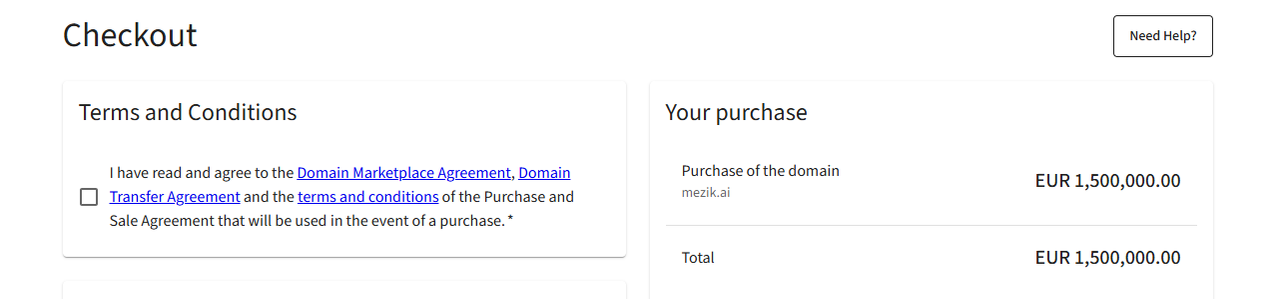
In the wild world of .ai domains, where the extension has become the shiny new toy for anything remotely tech-related, some sellers still believe that slapping “.ai” on a made-up word instantly turns it into a million-euro asset. Enter Mezik.ai — currently listed on Sedo with a straight BUY IT NOW price of €1,500,000.00 and no “make offer” option.
To add insult to financial injury, the seller paid Sedo’s €69 Showcase fee to give this fresh registration extra visibility. The auction page proudly displays the domain in their premium section, yet as of now, the market has responded with the sound of one hand clapping. Zero serious interest. Zero bids. Just the quiet hum of servers and the slow ticking of renewal fees.
This isn’t bold pricing. This is performance art in delusional domain investing.
The Contender in the Spotlight
Mezik.ai sits on Sedo as a fixed-price listing at exactly €1,500,000. The seller chose the Showcase option (which costs €69) to highlight the domain among other premium .ai names. No description, no compelling backstory, no end-user vision — just the domain name, the eye-watering price tag, and the implicit message: “This is worth seven figures because it ends in .ai.”
The listing offers the usual Sedo buyer protections and secure transfer, but at this price point, those features feel more like funeral arrangements than selling points. The domain is brand new — registered very recently in 2026 — meaning it has zero history, zero backlinks, zero developed site, and zero proven demand.
The Backstory: Fresh Registration Meets Instant Million-Euro Dreams
According to available records, Mezik.ai is a very recent registration. The seller apparently saw the current hype around .ai domains (where median values have climbed due to the AI boom) and decided their made-up word deserved immediate seven-figure status. They paid the Showcase fee to get it featured and set a firm BUY IT NOW price that would make even seasoned domain investors choke on their coffee.
This is the classic “register today, price like it’s 2030” strategy. The seller is betting that the mere presence of “.ai” plus a vaguely tech-sounding string will trigger a feeding frenzy. So far, the only frenzy has been the €69 leaving their wallet.
Breaking Down the Domain Quality: Made-Up, Forgettable, and Overpriced
Let’s examine the name with cold, hard honesty:
Mezik.ai is 7 characters (plus the extension). It’s short, which is good on paper, but it’s completely invented. No dictionary meaning, no strong brand association, no natural pronunciation that rolls off the tongue for global audiences.
It sounds vaguely Eastern European or invented-tech (similar to some Slovenian/Czech surnames like Mežek meaning “young bear”), but that doesn’t translate into commercial appeal. It feels like an AI name generator spat it out after someone typed “mez + ik + ai”.
The .ai extension is currently hot, with median resale values around $3,000–$6,000 on Sedo for decent names. But even in the .ai gold rush, buyers still want something memorable, spellable, and brandable — not a random string that requires explanation every time you say it.
ompare this to actually strong .ai sales: short, keyword-rich, or highly brandable names that solve real problems. Mezik.ai solves nothing except the seller’s hope that someone will overpay for novelty.
The Delusion Factor: Paying €69 to Showcase a €1.5 Million Fantasy
The real comedy gold is the decision to pay Sedo €69 for Showcase placement on a domain priced at €1.5 million. That’s like buying a billboard to advertise a used toothbrush for the price of a luxury car. The seller is treating a brand-new, made-up word as if it belongs in the same league as established premium .ai assets.
This level of optimism ignores basic market realities: .ai domains command higher prices when they are short, meaningful, or tied to actual AI use cases — not when they’re random syllables with a trendy extension. The lack of any bids or serious inquiries is the market politely saying “thanks, but no thanks.”
Realistic Valuation: What the Silence Is Telling Us
In the current .ai aftermarket, even strong names rarely hit six figures unless they have exceptional brandability or proven end-user interest. A freshly registered, invented word like Mezik.ai realistically sits in the low thousands at best — probably closer to €1,000–€5,000 on a very good day to the right buyer who falls in love with the sound.
€1,500,000 is not ambition. It’s financial fiction. The €69 Showcase fee was essentially a donation to Sedo for the privilege of watching the listing gather digital dust.
Lessons for Domainers: .ai Hype Is Not a Magic Money Printer
The .ai extension is popular right now, but popularity does not equal automatic premium value. Short, memorable, positive, and brandable names win. Random invented strings — no matter how short — do not magically become million-euro assets the moment they’re registered. If you’re going to pay extra fees to showcase a domain, at least make sure the name can stand on its own without requiring a six-figure leap of faith.
H2: The Defequer Verdict
Category
Rating
Name Quality
⭐⭐☆☆☆ (2/5)
Appraisal Sanity
⭐☆☆☆☆ (1/5)
Actual Market Value
⭐☆☆☆☆ (1/5)
Likelihood of €1.5M Sale
0.00%
Defequer Rating: 💩💩💩💩💩 (5/5 shits — paying €69 to showcase a brand-new made-up word at €1.5 million is peak .ai bubble delusion.)
Mezik.ai isn’t terrible for a quick flip at a realistic price, but at €1,500,000 it’s comedy. The market has spoken with its silence. Drop the price dramatically or prepare for a long, quiet wait while the renewal notices pile up.
Got more .ai million-euro fantasies, Sedo Showcase disasters, or any other over-hyped fresh registrations you want roasted? Drop us an email. We’re always flushing the fluff — one overpriced syllable at a time.