Blog

  • Au1o.com: The €10 Million Four-Character “Premium” That Isn’t

    Au1o.com: The €10 Million Four-Character “Premium” That Isn’t

    The Contender

    MetricDetails
    DomainAu1o.com
    Seller LocationGermany
    Seller Joined2023
    PlatformSedo
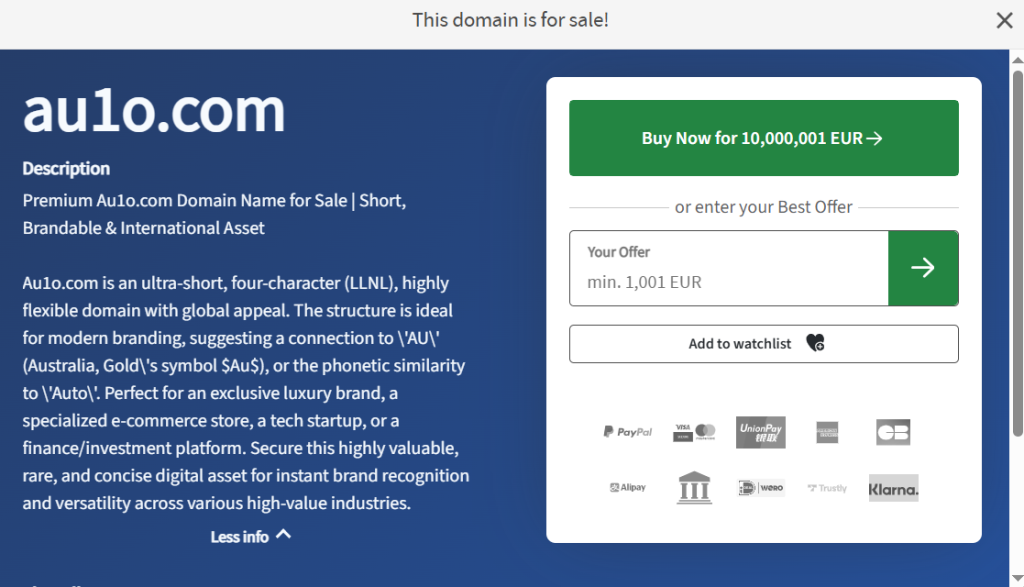
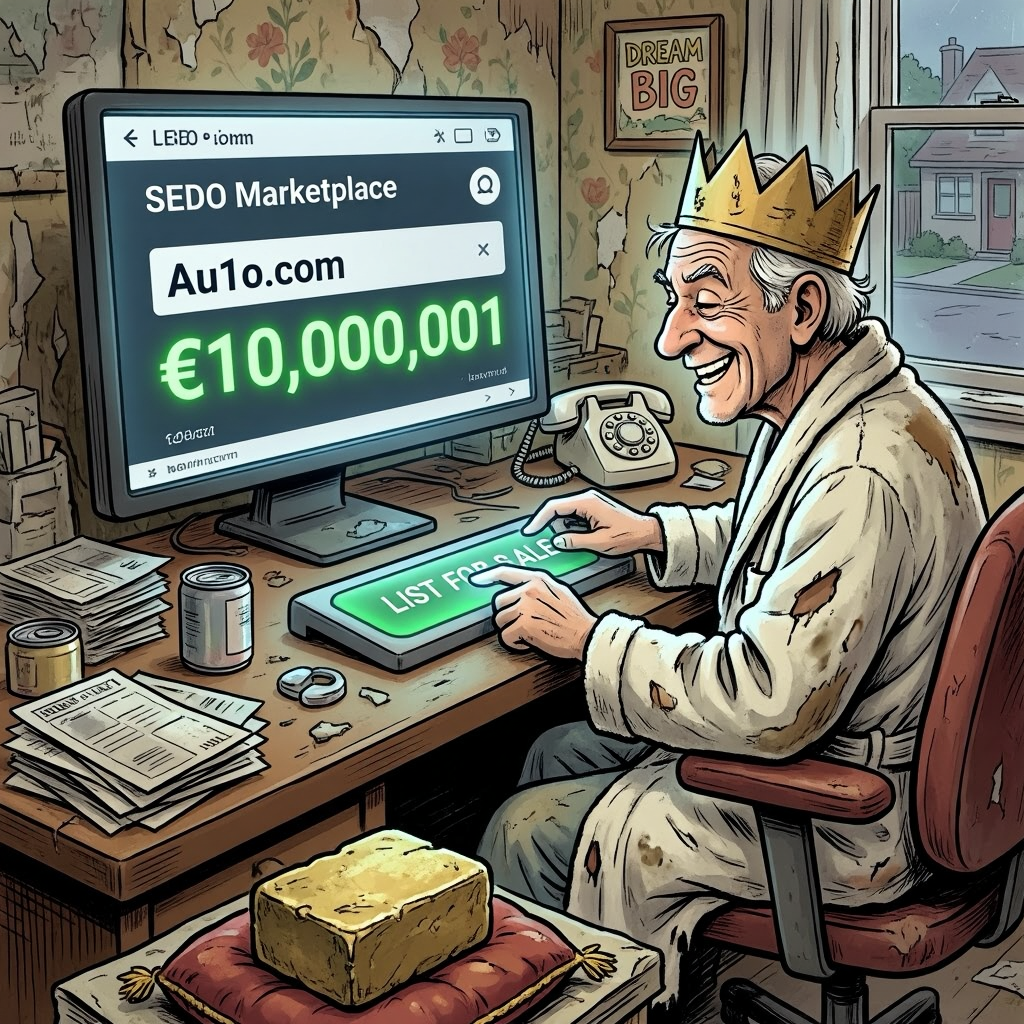
    Asking Price€10,000,001
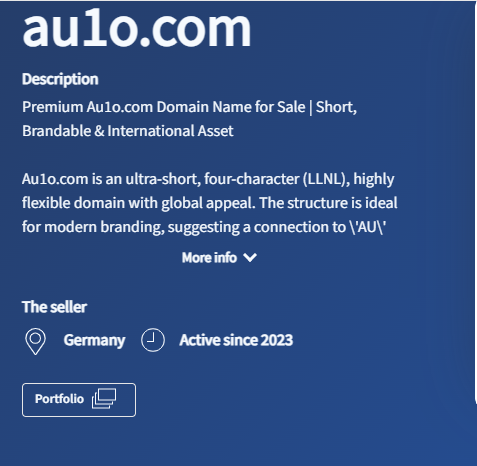
    Description*”Premium Au1o.com Domain Name for SaleShort, Brandable & International Asset. Au1o.com is an ultra-short, four-character (LLNL), highly flexible domain with global appeal. The structure is ideal for modern branding, suggesting a connection to ‘AU’ (Australia, Gold’s symbol $Au$), or the phonetic similarity to ‘Auto’. Perfect for an exclusive luxury brand, a specialized e-commerce store, a tech startup, or a finance/investment platform. Secure this highly valuable, rare, and concise digital asset for instant brand recognition and versatility across various high-value industries.”*
    Roast: €10M for a Four-Character Domain That Makes No Sense
    A German seller who started in 2023 wants €10,000,001 for Au1o.com. The description claims it’s “premium” and “brandable.” We explain why it’s neither.

    Introduction: When “Short” Doesn’t Mean “Valuable”

    There’s a special category of domain delusion reserved for sellers who discover the concept of “short domains” without understanding why short domains are actually valuable.

    Au1o.com is four characters. That’s short. By raw length alone, it qualifies for attention.

    But here’s the thing about short domains that actually sell: they’re pronounceable.

    • Uber.com (4 letters, pronounceable)
    • Lyft.com (4 letters, pronounceable)
    • Zoom.com (4 letters, pronounceable)
    • Etsy.com (4 letters, pronounceable)

    Notice a pattern? All of them can be spoken. All of them can be remembered. All of them can be communicated verbally.

    Now say “Au1o.com” out loud.

    “Ay-you-one-oh”? “Ow-one-oh”? “Auuuuu-one-oh”? “Gold-one-oh”?

    There’s no correct answer because the domain doesn’t correspond to any natural speech pattern. It’s a random string of characters that happens to be short, like a four-letter license plate that reads “XQ7Z.”

    Short doesn’t equal valuable. Pronounceable short equals valuable.


    The Seller: Fresh Account, Ancient Ambitions
    q0uYGNn.png

    This seller joined Sedo in 2023. That’s three years ago—enough time to learn the basics, not enough time to build a track record of successful sales.

    And yet, here they are, listing a domain for €10 million with a description that reads like it was generated by an AI prompted to “use every buzzword possible.”

    Let’s look at that description again:

    Roast: €10M for a Four-Character Domain That Makes No Sense
    • “Ultra-short”
    • “Highly flexible”
    • “Global appeal”
    • “Ideal for modern branding”
    • “Perfect for an exclusive luxury brand”
    • “Specialized e-commerce store”
    • “Tech startup”
    • “Finance/investment platform”
    • “Highly valuable”
    • “Rare”
    • “Concise”
    • “Instant brand recognition”
    • “Versatility”

    That’s not a sales pitch. That’s a buzzword bingo card. The seller has thrown every possible positive descriptor at the wall, hoping something sticks.

    What they haven’t done is answer the only question that matters: who would actually want this domain?


    The Defequer Analysis: Why Au1o.com Is Worth Pennies, Not Millions

    Factor 1: Pronounceability – The “Can You Say It?” Test

    This is the single most important factor in domain valuation for short names, and Au1o.com fails it completely.

    The problem:

    • “Au” could be pronounced as “ay-you,” “ow,” or “gold” (the chemical symbol)
    • “1” is a number, not a letter, so it has to be spoken as “one”
    • “o” is a letter, pronounced “oh”

    The result is a mess. Even if someone decides on “ay-you-one-oh,” that’s four syllables for a four-character domain—defeating the purpose of shortness entirely.

    Try telling someone your website is “Ay-you-one-oh dot com” over the phone. Record yourself. Listen back. Feel the embarrassment.

    Compare to actual valuable four-character domains:

    • Cars.com (one word, four letters)
    • News.com (one word, four letters)
    • Mail.com (one word, four letters)

    These work because they’re words. Au1o.com is not a word. It’s not even close to a word. It’s a random string that happens to be short.

    Factor 2: The “AU” Justification – Stretching Logic to Breaking Point

    The seller’s description makes several attempts to justify the “Au” combination:

    • “Connection to ‘AU’ (Australia)”
    • “Gold’s symbol $Au$”
    • “Phonetic similarity to ‘Auto’”

    Let’s address each.

    Australia: Australia’s country code is .au, not “Au” in a domain name. No one sees “Au” at the beginning of a domain and thinks “Australia.” They think “gold” if they’re chemistry nerds, or nothing at all if they’re normal people.

    Gold’s symbol: Yes, “Au” is the chemical symbol for gold on the periodic table. That’s a reach for a domain name, but okay. The problem is the “1o” that follows. “Au1o” doesn’t mean “gold one oh” in any context. It’s just letters and numbers.

    Phonetic similarity to ‘Auto’: This is the biggest stretch. “Au1o” does not sound like “auto.” Not even close. “Auto” is two syllables: “aw-toe.” “Au1o” is at least three: “ay-you-one-oh.” The seller is trying to create a connection that simply doesn’t exist.

    Factor 3: The LLNL Classification – Meaningless Jargon

    The seller describes Au1o.com as “four-character (LLNL).” This refers to the pattern: Letter-Letter-Number-Letter.

    In domain investing, certain patterns have recognized value:

    • LLLL.com (four letters) can be valuable if pronounceable
    • LLL.com (three letters) are almost always valuable
    • CVCV.com (consonant-vowel-consonant-vowel) patterns are prized

    LLNL is not a recognized premium pattern. It’s just a description of what the domain is, not an indication of value. The seller is using technical jargon to make a random string sound systematic.

    Factor 4: The “Endless Possibilities” Trap

    The seller lists potential uses:

    • Exclusive luxury brand
    • Specialized e-commerce store
    • Tech startup
    • Finance/investment platform

    This is the classic “endless possibilities” argument that every delusional domainer makes. It sounds impressive until you realize that “endless possibilities” actually means no specific use case.

    A domain with genuine value has a clear target buyer:

    • Insurance.com → insurance companies
    • Hotels.com → hotel booking sites
    • Crypto.com → crypto companies

    Au1o.com has no clear buyer. Who, exactly, is supposed to want this?

    • A luxury brand? They’d want something that sounds luxurious.
    • A tech startup? They’d want something pronounceable.
    • A finance platform? They’d want something that inspires trust.

    “Au1o.com” inspires none of these. It inspires confusion.

    Factor 5: The Price – €10,000,001

    Let’s talk about that price.

    €10,000,001 is not a random number. It’s just over €10 million, with an extra “1” tacked on to make it look deliberate.

    This is the domain equivalent of a teenager listing their beat-up Honda Civic for $1,000,000 on Craigslist “because I know what I have.”

    What is Au1o.com actually worth?

    Let’s do the math:

    Factors in its favor:

    • It’s short (4 characters)
    • It’s a .com

    Factors against it:

    • Unpronounceable
    • Contains a number (always reduces value vs. all letters)
    • No clear meaning
    • No commercial keywords
    • No history or traffic

    Comparable sales: Four-character .com domains with numbers and awkward combinations sell for $100 – $500 in the aftermarket, and that’s when they find a buyer at all.

    Realistic price range: $200 – $800

    €10,000,001 is not just optimistic. It’s not even in the same solar system as realistic.


    The Delusion Index: 9/10

    FactorRatingExplanation
    Pronounceability1/10Impossible to communicate verbally.
    Brandability2/10Doesn’t mean anything, doesn’t sound like anything.
    Commercial Relevance1/10No clear buyer, no obvious use case.
    Seller Experience2/10Joined 2023, no track record, fantasy pricing.
    Description Accuracy1/10Buzzword bingo with zero substance.
    Price Sanity0/10€10M for a $200 domain.

    Overall Delusion Index: 9/10

    We reserve 10/10 for domains that are literally impossible (like selling Google.com). This one earns a 9 for the complete disconnect between the seller’s perception and market reality, amplified by the absurd price and the buzzword-laden description.


    The Buzzword Breakdown: What the Seller’s Description Actually Means

    Let’s translate the seller’s description from Marketing-Speak to English.

    What They SaidWhat It Means
    “Ultra-short”It’s four characters, but so are thousands of other domains.
    “Highly flexible”We couldn’t think of one specific use case.
    “Global appeal”It doesn’t mean anything in any language, so technically it could mean anything anywhere.
    “Ideal for modern branding”It looks like a random string, which is apparently “modern.”
    “Connection to ‘AU’ (Australia, Gold’s symbol)”We’re reaching for any possible meaning.
    “Phonetic similarity to ‘Auto’”It doesn’t sound like “auto” at all, but we’re hoping you won’t notice.
    “Perfect for an exclusive luxury brand”Rich people also buy random things sometimes.
    “Secure this highly valuable, rare, and concise digital asset”Please send money.

    The entire description is designed to create the illusion of value without providing any actual evidence. It’s a word cloud of positivity attached to a domain that has no inherent worth.


    The “Started in 2023” Factor: Why New Sellers List at Fantasy Prices

    There’s a pattern we’ve observed across hundreds of roasts: sellers who joined recently have the most unrealistic prices.

    It makes sense:

    • They’ve read about million-dollar sales but not about the 99.9% that sell for nothing
    • They’ve run their domains through automated appraisals that flatter their egos
    • They haven’t experienced the reality of renewing a domain for years with zero offers
    • They’re still in the “I know what I have” phase before the market teaches them otherwise

    This seller joined Sedo in 2023. By 2026, they’ve listed Au1o.com at €10 million. That’s not domain investing—that’s hopium with a credit card.

    The reality check coming their way:

    • Year 1: “My domain is premium! The market just hasn’t recognized it yet.”
    • Year 2: “Maybe I’ll lower the price slightly. To €9M.”
    • Year 3: “Why isn’t anyone buying? I’ll hold firm.”
    • Year 4: Maybe €500,000 is more reasonable?”
    • Year 5: Another renewal. “€50,000?”
    • Year 6: “€5,000? Anyone? Please?”
    • Year 7: Expiration notice. Domain drops. Someone else ,if ever, registers it for $12.

    We’ve seen this movie before. It doesn’t have a happy ending.


    The Defequer Verdict

    CategoryRating
    Pronounceability⭐☆☆☆☆ (1/5)
    Brandability⭐☆☆☆☆ (1/5)
    Commercial Relevance⭐☆☆☆☆ (1/5)
    Description Honesty⭐☆☆☆☆ (1/5)
    Price Sanity⭐☆☆☆☆ (1/5)
    Seller Reality Check⭐☆☆☆☆ (1/5)

    Final Word:

    “Au1o.com isn’t a premium domain—it’s a typing exercise with a €10 million price tag. The seller, who joined Sedo in 2023, has crafted a description so full of buzzwords it should come with a translator. ‘Connection to Australia’? ‘Gold’s symbol’? ‘Phonetic similarity to Auto’? These aren’t selling points—they’re desperate attempts to find meaning in a string of characters that has none. The domain is short, we’ll grant that. But so is ‘X7K9.com.’ Short doesn’t mean valuable. Pronounceable short means valuable. And Au1o.com is about as pronounceable as a keyboard smash.”


    What Should Actually Happen

    If the German seller is reading this (and we hope he is):

    1. Drop the price by 99.99%. List it at €5,000 and see what happens. Even that might be optimistic, but at least it’s in the conversation.
    2. Rewrite the description. Stop with the buzzwords. Be honest: “Four-character .com domain. Short. Available for offers.”
    3. Research actual sales. Look at NameBio for four-character .com domains with numbers. See what they actually sell for. Hint: it’s not millions.
    4. Consider the pronounceability problem. Try telling someone your domain over the phone. Record it. Listen. Then adjust your expectations accordingly.
    5. Be patient but realistic. If you genuinely believe in this domain, hold it. But factor renewal costs into your strategy. €10/year adds up.

    For buyers: If you see Au1o.com and think “I could use that,” make an offer at 0.1% of asking. The seller might be ready to deal after reading this roast.


    The Bottom Line

    Au1o.com joins the Defequer Hall of Shame as a textbook example of new-seller fantasy meets buzzword marketing.

    A four-character domain that no one can pronounce. A description stuffed with meaningless jargon. A price that’s 50,000x the domain’s actual value. A seller who joined in 2023 and thinks they’ve struck gold.

    This isn’t domain investing. It’s hope dressed up in bullet points, with a €10 million price tag and an audience of zero.

    Defequer Rating: 💩💩💩💩💩 (5/5 shits – fully saturated with delusion, and the “started in 2023” factor pushes it over the top.)
  • The $520 Million Spanish Domain Fantasy That NamePros Isn’t Buying

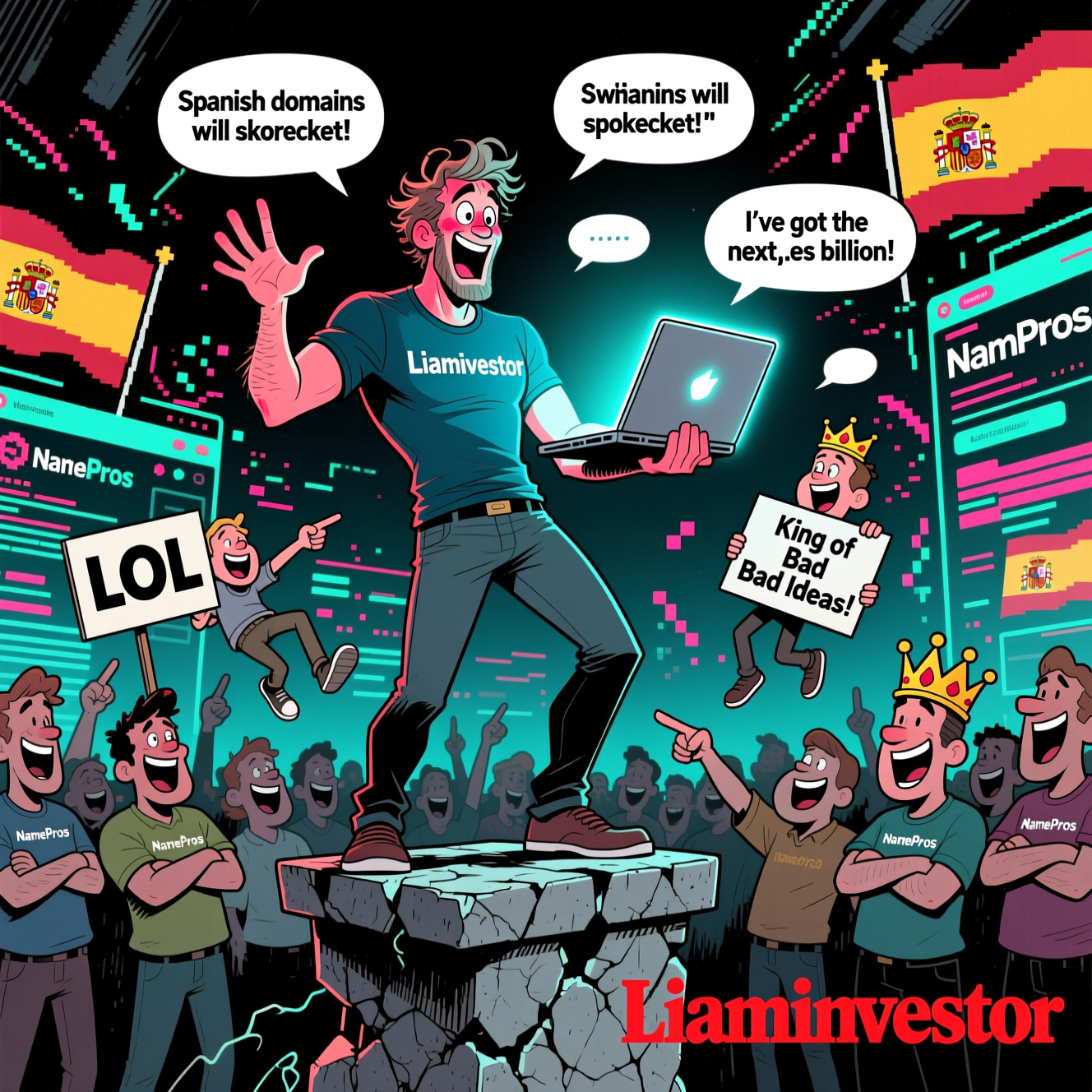
    The $520 Million Spanish Domain Fantasy That NamePros Isn’t Buying

    The Contender

    MetricDetails
    Thread AuthorLiaminvestor
    Thread Title“The Biggest Undervalued Opportunity in Domaining Nobody Is Talking About — 520 Million Native Speakers and the .COMs Are Still Available”
    PostedMarch 10, 2026
    RepliesMultiple pages (heated debate)
    ThesisSpanish .com domains are massively undervalued and poised for explosive growth

    Introduction: When Statistics Meet Reality

    Every few months, a thread appears on NamePros that goes something like this:

    “Everyone is overlooking [niche]! The numbers are massive! The opportunity is now! Why isn’t anyone talking about this?!”

    The thread is filled with bolded statistics, bullet points, and a palpable sense of urgency. The original poster has discovered something that the entire domaining community has somehow missed—a hidden goldmine, a secret door, a chance to get rich while everyone else sleeps.

    And then the community wakes up and tells them why they’re wrong.

    This is one of those threads.

    Liaminvestor has presented what appears, at first glance, to be a compelling case for Spanish-language .com domains:

    • 520 million native Spanish speakers globally
    • US Latino GDP at $4 trillion (5th largest economy in the world)
    • Projected growth to 800 million speakers by 2045
    • 65% of consumers prefer content in their own language
    • Hispanic advertising is 4.5x more persuasive than English ads
    • $159 billion in unsatisfied demand among US Latinos

    And his conclusion? Spanish .com domains are wildly undervalued and represent a once-in-a-generation opportunity.

    The only problem? The community isn’t buying it. And they have data, experience, and logic on their side.

    Let’s break this down.


    The Thesis: What Liaminvestor Is Actually Saying

    Liaminvestor’s argument rests on several pillars:

    Pillar 1: Demographics

    Spanish is the second-largest native language on Earth. By 2045, there could be 800 million Spanish speakers globally. The US will have 138 million Spanish speakers—a third of the population.

    Pillar 2: Economic Power

    US Latino GDP is $4 trillion and growing twice as fast as the rest of the US economy. If independent, it would be the 5th largest economy in the world.

    Pillar 3: Consumer Behavior

    Latinos prefer Spanish-language content. They’re more persuaded by Spanish ads. They feel underserved by current marketing.

    Pillar 4: Domain Availability

    Unlike English keywords (snapped up decades ago), many Spanish .com equivalents are still available at registration fee or low aftermarket prices.

    Pillar 5: The “Early Days” Argument

    Just as English .coms seemed overpriced in the early 2000s before exploding in value, Spanish .coms are now where English was then. The data doesn’t yet exist because the market hasn’t matured.

    On paper, it’s not the dumbest thing we’ve ever heard. It’s actually… almost plausible.

    But “almost plausible” isn’t the same as “correct.” And the NamePros community, with decades of collective experience, has stepped up to explain why.


    The Pushback: Why the Community Isn’t Convinced

    Counterpoint 1: Sales Data Doesn’t Lie

    The most devastating response comes from a Spanish-speaking member:

    *”I speak Spanish and I also watch sales every day. I can assure you that it’s maybe 1 out of 200, or even more – where you see that a Spanish word or combination was bought.”*

    This is the reality check that statistics alone can’t provide.

    NameBio, the industry standard for domain sales data, shows a tiny fraction of sales involving Spanish keywords. Not because the data is incomplete, but because the sales aren’t happening.

    If Spanish .coms were truly undervalued, we’d see:

    • Increasing transaction volume
    • Rising prices at auction
    • More end-user acquisitions
    • Flippers making consistent profits

    None of this exists at scale. The market has spoken, and the market says: Spanish .coms don’t sell.

    Counterpoint 2: The ccTLD Problem

    Another member points out a structural issue that Liaminvestor’s GDP statistics completely ignore:

    “On top of that every country has its own ccTLD…”

    This is crucial.

    Spanish is spoken in over 20 countries, each with its own country-code domain:

    • Spain: .es
    • Mexico: .mx
    • Argentina: .ar
    • Colombia: .co
    • Chile: .cl
    • Peru: .pe
    • And so on…

    When a business in Mexico wants a Spanish-language web presence, they don’t reach for a .com. They reach for a .mx. When a Spanish company wants to reach Spanish customers, they use .es.

    The .com is for international audiences. But Spanish-language businesses targeting local markets have perfectly good ccTLD options—often at lower prices and with better local SEO .

    Liaminvestor’s thesis assumes that Spanish speakers will magically prefer .com over their own country’s domains. That’s not how the internet works.

    Counterpoint 3: The “Available” Problem

    Liaminvestor claims that “a huge number” of common Spanish keywords are still available at registration fee.

    This raises an immediate red flag.

    If a keyword is truly valuable—if it has commercial intent, search volume, and end-user demand—it would have been registered already. Not by English-speaking domainers, but by Spanish-speaking entrepreneurs, businesses, and investors who actually understand the market.

    The fact that these domains are still available suggests one of two things:

    1. They’re not actually valuable keywords
    2. The market for Spanish .coms doesn’t exist

    Occam’s razor points to #2.

    Counterpoint 4: The Purchasing Power Mismatch

    One member drops a brutal cultural reality check:

    “There is actually a saying in Spain: if you are Spanish and you get married, you can be pretty sure it’s for love – because it definitely isn’t for your money. It simply can’t be… The same mindset (in terms of general buying power and habits) tends to apply to companies across Spanish-speaking world, too.”

    This is a generalization, but it points to a real issue: willingness to pay premium prices for domains varies dramatically by market.

    The $4 trillion US Latino GDP figure sounds impressive, but it doesn’t tell us how much of that economic activity translates into domain acquisition budgets. Small businesses in Spanish-speaking markets may simply not value .com domains the way US companies do.

    Counterpoint 5: The ChatGPT Accusation

    Perhaps the most cutting response:

    “You should stop copy-pasting ChatGPT answers into a thread and instead research NameBio sales to see what’s actually happening in domain sales, instead of bringing some ‘Latino GDP’ narrative.”

    This hits at the heart of the problem: Liaminvestor’s thesis is built on macroeconomic statistics, not domain market data.

    GDP figures don’t buy domains. People do. And the people buying Spanish .coms, according to actual sales data, are few and far between.


    The Back-and-Forth: Liaminvestor Doubles Down

    To his credit, Liaminvestor doesn’t retreat. He responds with more arguments:

    On history: “In early 2000s who ever looked on history, didn’t make sense to acquire premium English domains as well.”

    On markets: “US to be most spoken Spanish Country by 2050… will us companies ignore those data?”

    On .ai comparisons: “How much was AI premiums .ai before the Boom, 3 years ago? How fast did premiums increase? and this is with a AI 500B to 1 Trillion Market and created Domain Premiums 6 Digits +”

    On future value: “when there is thousands of companies competing in a big market, domains increase significantly.”

    Each of these counter-arguments has a surface-level logic. But they all ignore the same fundamental issue: the market for Spanish .coms doesn’t exist yet, and there’s no guarantee it ever will.

    The .ai comparison is particularly flawed:

    • .ai domains benefited from a specific technological trend (artificial intelligence)
    • The .ai TLD itself became a brand for AI companies
    • The buyers were tech startups with venture capital funding
    • The prices were driven by speculation within a hype cycle

    None of this applies to Spanish .coms. There’s no hype cycle. No VC funding chasing Spanish keywords. No cultural moment driving demand. Just a demographic projection and a hope that businesses will eventually care.


    The Defequer Analysis: Why Liaminvestor Is Wrong

    Let’s apply our valuation framework to Liaminvestor’s thesis.

    Factor 1: Market Existence

    Before an asset can appreciate, there must be a market for it.

    English .coms have a market because:

    • The US economy is the world’s largest
    • English is the global language of business
    • US companies have historically paid premium prices for domains
    • There’s a established ecosystem of brokers, marketplaces, and buyers

    Spanish .coms have none of this. The market is fragmented across 20+ countries, each with its own preferences and domain culture. The US Latino population, while large, is still a minority within a English-dominant economy.

    Verdict: The market for Spanish .coms is tiny compared to English .coms, and there’s no evidence it’s growing fast enough to justify speculation.

    Factor 2: The ccTLD Competition

    As noted earlier, every Spanish-speaking country has its own ccTLD. These aren’t second-class alternatives—they’re the preferred choice for local businesses.

    A Mexican company targeting Mexican customers buys .mx. A Spanish company targeting Spanish customers buys .es. A Colombian company targeting Colombian customers buys .co.

    The only businesses that would choose a .com over a ccTLD are:

    • Companies targeting multiple Spanish-speaking countries
    • Companies with international ambitions
    • US-based companies targeting US Latinos

    That’s a much smaller pool than Liaminvestor’s 520 million speaker number suggests.

    Verdict: The ccTLD competition dramatically reduces the addressable market for Spanish .coms.

    Factor 3: Willingness to Pay

    This is the unspoken assumption in Liaminvestor’s thesis: that Spanish-speaking businesses will eventually pay premium prices for .com domains the way English-speaking businesses do.

    But willingness to pay is cultural and economic. It depends on:

    • Business norms in each country
    • Availability of capital
    • Understanding of domain value
    • Competitive pressure

    There’s no evidence that Spanish-speaking businesses, across 20+ countries, are suddenly going to start paying five figures for domains they could register for $12 or use a ccTLD for $20/year.

    Verdict: Willingness to pay is unproven and likely much lower than Liaminvestor assumes.

    Factor 4: The “Available” Red Flag

    Liaminvestor claims that “a huge number” of common Spanish keywords are still available. If true, this is actually a bearish signal, not a bullish one.

    Valuable assets don’t stay available. If Spanish .coms were truly undervalued, Spanish-speaking domainers would have snapped them up years ago. The fact that they’re still sitting there suggests that the people who know the market best—Spanish speakers themselves—don’t see the value.

    Verdict: Availability at registration fee is evidence of low demand, not opportunity.

    Factor 5: The .ai Analogy Doesn’t Hold

    The comparison to .ai domains is tempting but flawed:

    Factor.ai DomainsSpanish .coms
    TrendAI hype cycleDemographics (slow)
    BuyersVC-funded startupsSmall businesses
    TLDNovel, brandableTraditional .com
    Price DriversSpeculationEnd-user demand
    Timeline2-3 yearsDecades (if ever)

    AI domains exploded because of a speculative frenzy around a specific technology. Spanish .coms would require a fundamental shift in how millions of businesses operate and invest. Those are completely different dynamics.

    Verdict: The .ai comparison is apples to oranges.


    The Delusion Index: 6/10

    FactorRatingExplanation
    Demographic Data8/10The numbers are real—Spanish speakers are numerous and growing.
    Market Existence3/10No evidence of a functioning market for Spanish .coms.
    ccTLD Competition2/10Every country has its own domain. .com is not the default.
    Willingness to Pay2/10Unproven and likely low.
    Sales Data1/10Actual sales of Spanish .coms are vanishingly rare.
    Thesis Persistence7/10Liaminvestor is sticking to his guns despite pushback.

    Overall Delusion Index: 6/10

    This isn’t a 9+ because the thesis isn’t completely insane. The demographic data is real. The economic numbers are impressive. And it’s possible that Liaminvestor is simply early.

    But “early” and “wrong” look identical until the market proves otherwise. And right now, all evidence points to wrong.


    The Real Opportunity: What Liaminvestor Missed

    If Liaminvestor had approached this differently, he might have had a point worth considering.

    A more nuanced thesis might be:

    “Spanish .coms targeting US Latinos may have some value as the US Latino population grows and becomes more economically powerful. However, the market is fragmented, ccTLDs dominate locally, and sales data is sparse. This is a long-term speculative play, not a sure thing.”

    That’s not a thread that goes viral. It’s not a “biggest undervalued opportunity” headline. But it’s closer to reality.

    The real opportunity in Spanish domains—if one exists—is likely:

    • Highly specific to US-targeted keywords
    • Niche rather than broad
    • Long-term (decades, not years)
    • Speculative rather than proven

    Liaminvestor’s mistake is presenting this as a sure thing with massive upside and immediate opportunity. The market doesn’t work that way.


    What We Learn From This Thread

    This debate reveals something important about domain investing: statistics aren’t sales.

    You can pull impressive numbers about GDP, population, and consumer behavior. You can build elaborate theories about future demand. You can convince yourself that you’re early to the next big thing.

    But until someone actually buys a domain at a meaningful price, it’s just speculation.

    The NamePros community, for all its flaws, has something Liaminvestor lacks: experience. They’ve seen these threads before. They’ve watched people chase demographic trends into oblivion. They’ve learned that the market doesn’t care about your PowerPoint.

    The silence on Spanish .com sales isn’t a market inefficiency waiting to be exploited. It’s the market saying: we don’t want this.


    The Defequer Verdict

    CategoryRating
    Demographic Analysis⭐⭐⭐⭐☆ (4/5 – numbers are real)
    Market Understanding⭐⭐☆☆☆ (2/5)
    Sales Data Awareness⭐☆☆☆☆ (1/5)
    Thesis Persistence⭐⭐⭐⭐☆ (4/5 – gotta respect the hustle)
    Likelihood of Being Right15% (and that’s generous)

    Final Word:

    *”Liaminvestor has discovered that 520 million people speak Spanish. Congratulations. What he hasn’t discovered is a market for Spanish .com domains, because that market doesn’t exist yet—and may never exist. The NamePros community, armed with actual sales data and decades of experience, has explained why his thesis collapses under scrutiny. But like all true believers, he persists. The $4 trillion Latino GDP won’t buy his domains. The 800 million future speakers won’t type them. And the ccTLDs of 20 Spanish-speaking countries will continue to be the default choice for local businesses. This isn’t the biggest undervalued opportunity—it’s the biggest overvalued fantasy, dressed up in statistics and sold to an audience that isn’t buying.”*


    What Should Actually Happen

    If Liaminvestor is reading this (and we hope he is):

    1. Look at NameBio. Not GDP reports. Actual domain sales data. See how many Spanish .coms have sold in the last year. The number will surprise you (by being tiny).
    2. Talk to Spanish-speaking domainers. Not English speakers with theories. People who actually operate in these markets. Ask them what sells and what doesn’t.
    3. Test your thesis with a small portfolio. Register a few Spanish .coms that you genuinely believe in. Hold them for 2-3 years. Track inquiries and offers. Let the market tell you if you’re right.
    4. Stop citing ChatGPT. The community noticed. It undermines your credibility.
    5. Be open to being wrong. The best investors update their beliefs based on evidence. If the evidence says Spanish .coms don’t sell, adjust your thesis.

    For readers: If Liaminvestor’s thesis intrigues you, do your own research. Don’t take his word for it. Don’t take our word for it. Look at the data. Make your own decisions.


    The Bottom Line

    Liaminvestor’s Spanish domain thesis joins the Defequer Hall of Shame not because it’s the dumbest idea we’ve ever heard, but because it perfectly illustrates the gap between macro statistics and micro market reality.

    520 million speakers. $4 trillion GDP. Impressive numbers.

    Zero sales data. Fragmented markets. ccTLD competition. Low willingness to pay. Also numbers—just not the ones in the PowerPoint.

    The domain market doesn’t care about your demographic projections. It cares about what people actually buy.

    And right now, people aren’t buying random / mediocre Spanish .coms.

    Defequer Rating: 💩💩💩💩💩 (5/5 shits – not for the idea itself, but for the persistence in ignoring every counterargument and the reliance on irrelevant statistics.)

  • Côtes.com and Bât.com: The €30 Million IDN Fantasy That No One Will Type

    Côtes.com and Bât.com: The €30 Million IDN Fantasy That No One Will Type

    The Contenders

    Metriccôtes.combât.com
    Punycodexn--ctes-vqa.comxn--bt-pia.com
    Display Namecôtes.combât.com
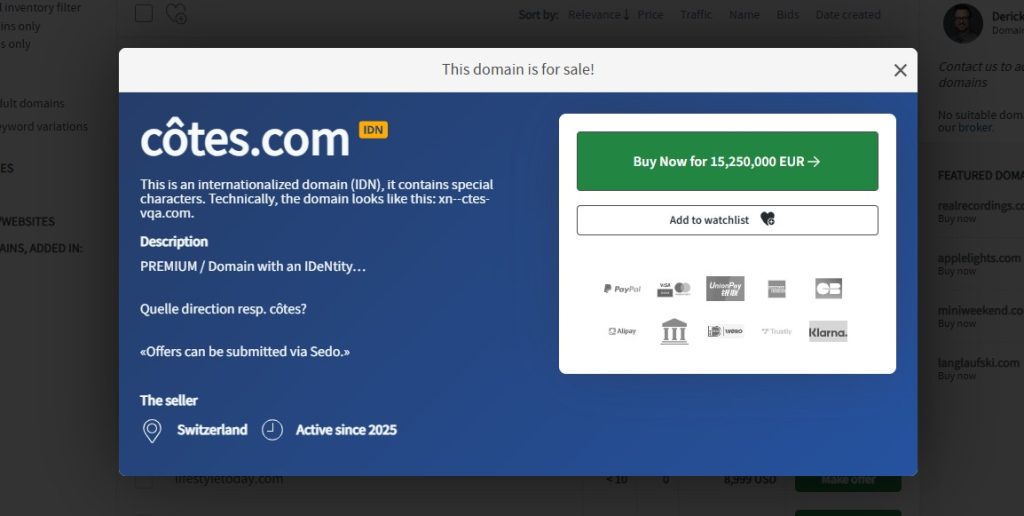
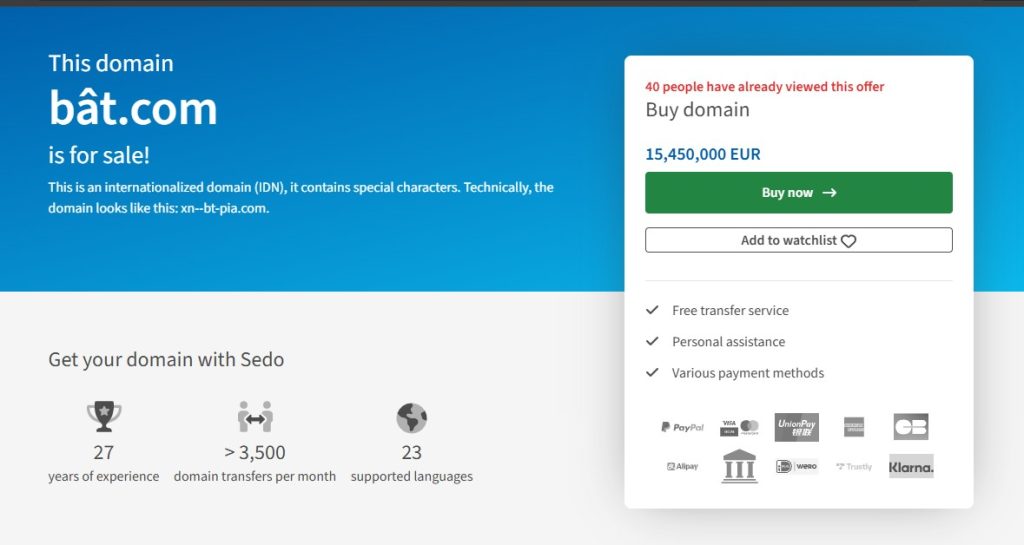
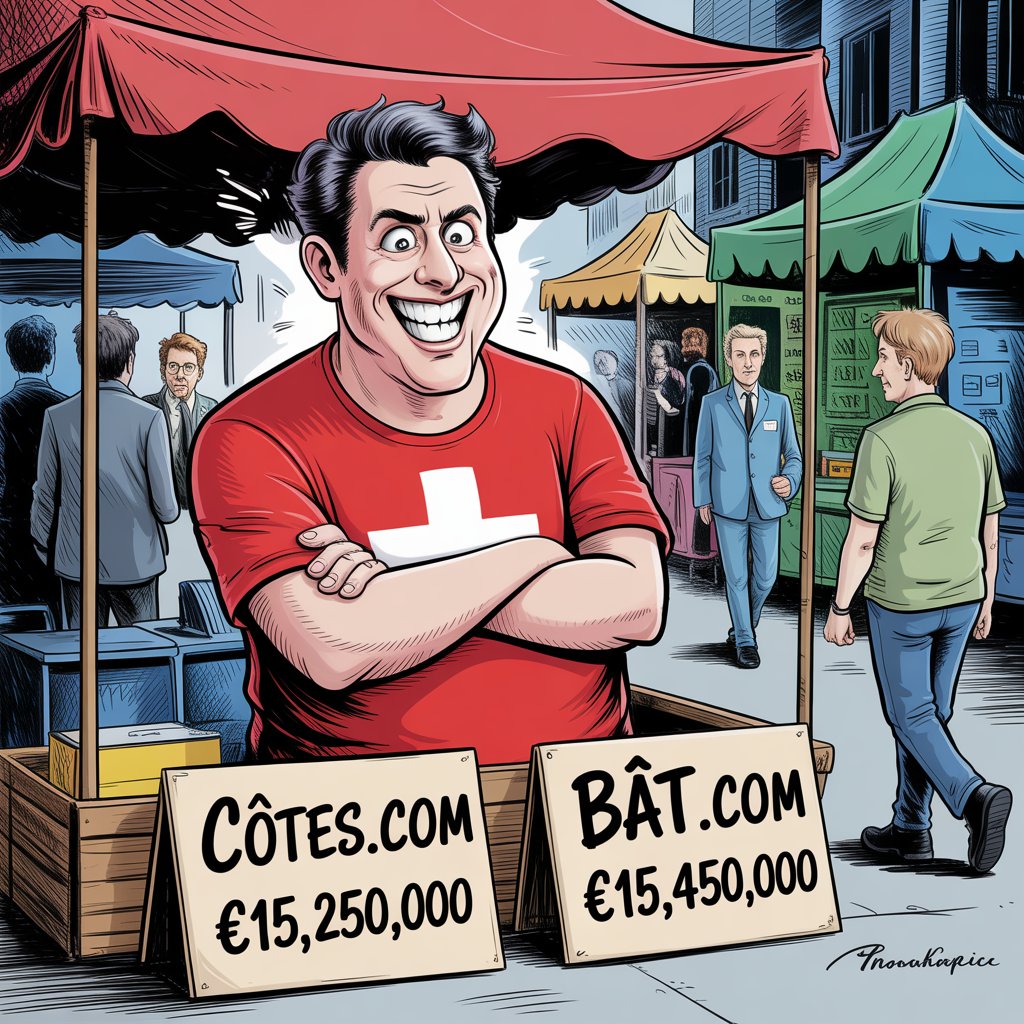
    Price€15,250,000€15,450,000
    Seller LocationSwitzerlandSwitzerland
    Seller Joined20252025
    PlatformSedoSedo

    Combined asking price: €30,700,000


    Introduction: The IDN Delusion

    Internationalized Domain Names (IDNs) were created with a noble goal: to allow internet users around the world to access websites in their native scripts and languages. Arabic, Chinese, Cyrillic—these alphabets finally got their place at the digital table.

    And then there’s this.

    Côtes.com. Bât.com.

    French words with diacritical marks. The “ô” in côtes. The “â” in bât. Tiny accents that transform ordinary words into something that, in the world of domain investing, might as well be written in invisible ink.

    Because here’s the thing about IDNs that every domainer should understand but somehow this Swiss seller doesn’t: the accents don’t work the way you think they do.

    When someone types “côtes.com” into their browser, one of two things happens:

    • Their browser automatically converts it to the Punycode version (xn--ctes-vqa.com)
    • They get an error message because they don’t know how to type the accent

    Either way, the smooth, intuitive experience that makes .com valuable? Gone. Evaporated. Replaced with technical friction that guarantees you’ll lose visitors before they even arrive.

    And this seller wants €15 million for the privilege.


    The Seller: Fresh Account, Ancient Ambitions

    Let’s talk about the person behind these listings.

    According to Sedo, this seller is based in Switzerland and joined the platform in 2025.

    That’s last year.

    This is a brand-new account, with no established reputation, no track record of sales, and presumably no history of successful domain transactions—listing not one but two domains for prices that would make them among the most expensive .com sales of all time .

    Think about that. The entire YTD 2026 domain sales chart, featuring verified transactions across all extensions, shows a top sale of $1.15 million for Midnight.com . That’s a clean, pronounceable, accent-free .com that anyone can type.

    Our Swiss friend wants €30.7 million for two domains with special characters that most internet users can’t even input.

    The math isn’t mathing.


    The Defequer Analysis: Why IDNs With Accents Are Almost Never Premium

    Let’s apply actual valuation principles to côtes.com and bât.com and watch the fantasy crumble.

    Factor 1: Typability – The “Can Anyone Actually Type This?” Test

    This is the single most important factor in IDN valuation, and it’s the one this seller has completely ignored.

    côtes.com:

    • To type the “ô,” a user needs to know the Alt code (Alt+0244) or have a French keyboard
    • On mobile, they need to hold down the “o” key and select the accented version
    • Most non-French speakers don’t know this exists
    • The Punycode version (xn--ctes-vqa.com) is 16 characters long and looks like spam

    bât.com:

    • Same problem with “â” (Alt+0226)
    • The Punycode version (xn--bt-pia.com) is similarly hideous
    • Try telling someone your website is “xn--bt-pia.com” with a straight face
    • The result: These domains fail the “radio test” so spectacularly that they don’t even register on the scale. You cannot communicate these domain names verbally. You cannot put them on a business card without confusion. You cannot expect anyone to remember how to type them .

    Factor 2: Market Reality – What Are IDNs Actually Worth?

    The IDN aftermarket is, to put it charitably, niche. While there have been successful IDN sales, they typically involve:

    • Entire words in non-Latin scripts (e.g., Chinese, Arabic, Russian)
    • Developed websites with traffic and content
    • Prices in the low-to-mid four figures, not seven figures

    Accented Latin characters occupy a strange middle ground. They’re not different enough to serve non-Linux markets, but they’re different enough to cause typing friction. It’s the worst of both worlds .

    Realistic value for côtes.com and bât.com:

    • To a French buyer who specifically wants the accented version: €2,000 – €5,000 each
    • To anyone else: €0 – €500
    • Combined realistic value: Maybe €10,000 on a good day with two very motivated buyers

    €30.7 million is not just optimistic. It’s not even in the same universe as realistic.

    Factor 3: Comparable Sales – What Actually Sells at Seven Figures?

    Let’s look at what real seven-figure domain sales look like :

    DomainSale PriceYearNotes
    Midnight.com$1,150,0002026Clean, memorable, no accents
    C4.com$265,0002026Two characters, ultra-premium
    Voice.com$3 M2019Dictionary word, massive commercial potential
    CreditCards.com$2.75M2004High-value commercial keyword

    Notice the pattern? All are:

    • Easy to type
    • Easy to remember
    • Easy to communicate verbally
    • Obvious commercial applications

    Côtes.com means “ribs” or “coasts” in French. Bât.com is a conjugation of “bâtir” (to build) or could be short for “bâtiment” (building). Neither has obvious commercial value. Neither is a high-value commercial keyword. Neither is easy to type.

    These domains are not in the same category as real seven-figure sales. They’re not even in the same sport.

    Factor 4: The Sedo Platform Context

    Sedo is a legitimate marketplace with significant reach . In 2026, it remains the liquidity leader for mid-to-high-value domains, with institutional buyers and international investors actively shopping there .

    But Sedo is also a platform where anyone can list anything at any price. There’s no vetting process for fantasy pricing. There’s no “reality check” before hitting submit.

    This seller is taking full advantage of that openness. They’ve listed two domains at prices that guarantee they will never sell, on a platform that has no incentive to tell them otherwise.

    The result: Two listings that will sit untouched, accumulating “views” from curious onlookers, until the seller either comes to their senses or lets them expire.


    The French Angle: What These Words Actually Mean

    Let’s look at the words themselves, because context matters.

    Côtes can mean:

    • Ribs (as in human anatomy)
    • Coasts (as in geographical features)
    • Slopes (as in hillsides)
    • Cuts of meat (as in “côtes de boeuf”)

    It’s a common French word with multiple meanings, none of which scream “million-dollar brand.” A vineyard in a coastal region might want it. A butcher shop might want it. A rib restaurant might want it.

    None of those buyers have €15 million.

    Bât is trickier:

    • It’s the third-person singular present subjunctive of “bâtir” (to build)
    • It can be short for “bâtiment” (building)
    • It’s also a homophone for “bat” (as in the animal), which is spelled the same without the accent

    A construction company might want it. A hardware brand might consider it. A bat conservation society might be confused by it.

    Again, not million-dollar territory.

    The accent problem magnifies the issue. A French construction company that wants “bât.com” will instinctively type “bat.com” first—and land on a completely different site. By the time they realize they need the accented version, they’ve already been frustrated .


    The Delusion Index: 9.5/10

    Factorcôtes.combât.comCombined
    Typability1/101/101/10
    Commercial Relevance3/103/103/10
    Market Awareness1/101/101/10
    Pricing Sanity0/100/100/10
    Seller Experience (Joined 2025)1/101/101/10
    IDN Viability2/102/102/10

    Overall Delusion Index: 9.5/10

    We reserve 10/10 for domains that are literally impossible (like selling Google.com). This one earns a 9.5 for:

    • The complete misunderstanding of how IDNs work
    • The 2025 join date with 2026 fantasy pricing
    • The sheer audacity of asking €15M+ for domains most people can’t type
    • Doing it twice

    The “Joined 2025” Factor: Why New Sellers Often Have the Wildest Expectations

    There’s a pattern we’ve observed across hundreds of roasts: new sellers have the most unrealistic prices.

    It makes sense when you think about it:

    • They’ve read about million-dollar sales but not about the 99.9% of domains that sell for nothing
    • They’ve run their domains through automated appraisals that flatter their egos
    • They haven’t experienced the soul-crushing reality of renewing a domain for five years with zero offers
    • They’re still in the “I know what I have” phase before the market teaches them otherwise

    This seller joined in 2025. By early 2026, they already have two listings at €15M+.

    That’s not domain investing. That’s hopium, straight into the veins.

    The reality check coming their way:

    • Year 1: “My domains are premium! The market just hasn’t recognized them yet.”
    • Year 2: “Maybe I’ll lower the price slightly. To €14M.”
    • Year 3: “Why isn’t anyone buying? I’ll hold firm.”
    • Year 4: Another renewal notice. “Maybe €500,000 is more reasonable?”
    • Year 5: Another renewal. “€50,000?”
    • Year 6: “€5,000? Anyone? Please?”
    • Year 7: Expiration notice. Domain drops. Someone else registers it for $12.

    We’ve seen this movie before. It doesn’t have a happy ending .


    The Punycode Problem: When Your Domain Looks Like Spam

    Let’s talk about the Punycode versions, because they’re relevant in a way the seller probably hasn’t considered.

    xn--ctes-vqa.com

    xn--bt-pia.com

    These are what your domain actually looks like to the internet. When someone’s browser converts the accented characters, this is the string that gets processed.

    Now imagine trying to market a business with “xn--ctes-vqa.com” as your web address. Imagine putting that on a billboard. Imagine telling someone over the phone: “Visit us at… uh… X-N dash dash C-T-E-S dash V-Q-A dot com.”

    It’s impossible.

    The entire point of a domain name is to be human-readable. These domains fail that test at the most basic level .


    What These Domains Are Actually Worth

    Let’s get real for a moment.

    côtes.com:

    • To a French vineyard or coastal business: €3,000 – €5,000
    • To a domain investor: €500 – €1,000
    • To anyone else: $12 hand-registration of something better

    bât.com:

    • To a French construction company: €2,000 – €4,000
    • To a domain investor: €400 – €800
    • To anyone else: Again, $12 for a better option

    Combined realistic value: €8,000 – €10,000

    Combined asking price: €30,700,000

    That’s a 3,070x markup.

    At this ratio, the seller would need to find a buyer willing to pay 3,000 times what the market says these domains are worth. That buyer doesn’t exist.


    The Defequer Verdict

    Categorycôtes.combât.com
    Typability⭐☆☆☆☆ (1/5)⭐☆☆☆☆ (1/5)
    Commercial Relevance⭐⭐☆☆☆ (2/5)⭐⭐☆☆☆ (2/5)
    IDN Viability⭐☆☆☆☆ (1/5)⭐☆☆☆☆ (1/5)
    Pricing Sanity⭐☆☆☆☆ (1/5)⭐☆☆☆☆ (1/5)
    Seller Reality Check⭐☆☆☆☆ (1/5)⭐☆☆☆☆ (1/5)

    Final Word:

    *”Côtes.com and bât.com aren’t premium domains—they’re typing exercises priced like corporate acquisitions. A Swiss seller who joined Sedo in 2025 wants €30 million for the privilege of owning domains that most internet users can’t even input. The accents don’t add value; they add friction. The Punycode versions look like spam. And the words themselves have no million-dollar commercial potential. This isn’t domain investing—it’s performance art with a €30 million price tag and an audience of zero.”*


    What Should Actually Happen

    If the Swiss seller is reading this (and we hope they are):

    1. Learn how IDNs work. The accents aren’t a feature—they’re a bug. Most users will never type them correctly.
    2. Check your join date. You joined in 2025. You’re new. That’s fine, but it means you should be learning, not setting records.
    3. Research actual sales. Look at DNJournal’s YTD charts . See what real seven-figure domains look like. Yours aren’t them.
    4. Drop the price by 99.9%. List them at €15,000 each and see what happens. If there’s interest, you’ll learn something. If not, you’ll learn something else.
    5. Consider the Punycode problem. Try telling someone your domain name over the phone. Record yourself. Listen back. Then adjust your expectations accordingly.

    For buyers: If you genuinely want these domains, wait. They’re not selling at these prices. The seller will either come to their senses or let them expire. Patience is your friend.


    The Bottom Line

    Côtes.com and bât.com join the Defequer Hall of Shame as a textbook example of IDN delusion meets new-seller fantasy.

    Two domains with accents that most users can’t type. Punycode versions that look like malware. Words with modest commercial potential. A seller who joined last year and thinks they’ve struck gold. Combined price: €30.7 million.

    The domain market has seen fantasy pricing before. But this one is special—not because of the domains themselves, but because of the complete disconnect between the seller’s expectations and reality.

    Defequer Rating: 💩💩💩💩💩 (5/5 shits – fully saturated with delusion, and the IDN angle pushes it into legendary territory.)


    Post-Roast Note to the Seller

    Look, we’re not trying to be cruel. We’re trying to be helpful.

    You joined Sedo in 2025. You’re new to this. That’s okay—everyone starts somewhere. But the domain market has a brutal way of teaching lessons, and the tuition for this particular lesson is going to be years of renewal fees on domains that will never sell at these prices.

    Take the feedback. Do the research. Adjust your expectations.

    Or don’t. Keep them at €15M. Watch them expire in a few years. Let someone else register them for $12 and wonder what you were thinking.

    Your choice. We’ll be here either way.

    Merci, et bonne chance. (You’re going to need it.)

  • FlyDiscount.com: The $495,000 Domain That Forgot How to Fly

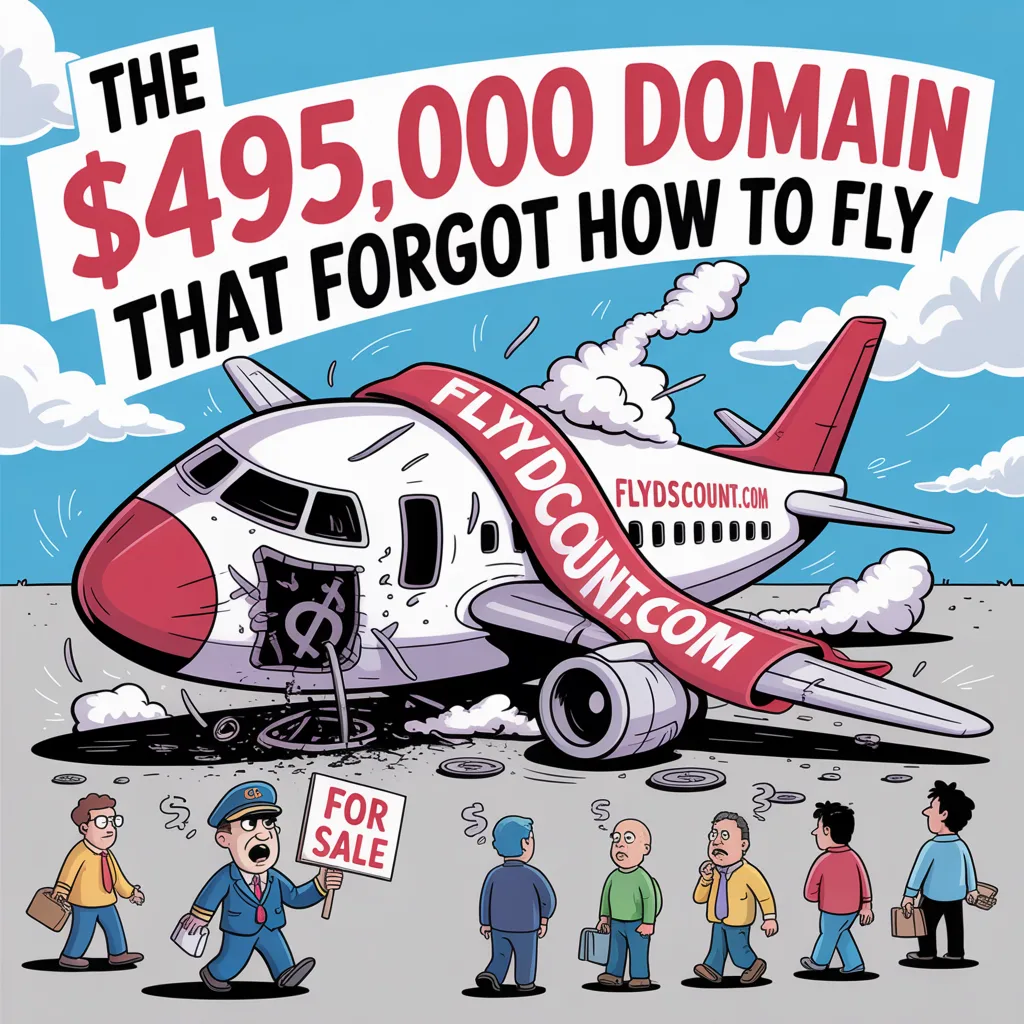
    FlyDiscount.com: The $495,000 Domain That Forgot How to Fly

    The Contender

    MetricDetails
    DomainFlyDiscount.com
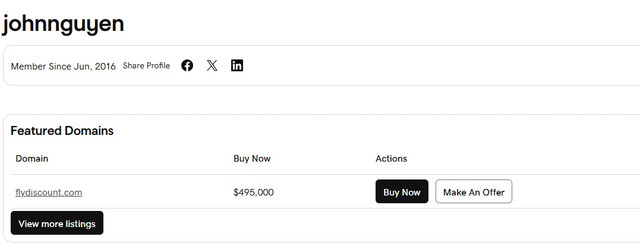
    SellerJohn Nguyen
    PlatformAfternic
    Asking Price$495,000.00 (Buy It Now)
    Fly-Discount-Afternic

    The Setup: A Generic Phrase With a Premium Price Tag

    Let’s start with what this domain actually is.

    FlyDiscount.com is a two-word .com combining “Fly” (verb/noun related to air travel) and “Discount” (noun meaning reduced price). Together, they form a phrase that describes a concept: discounts on flights.

    It’s descriptive. It’s functional. It’s the kind of name that a budget airline’s marketing department might think of in five seconds before rejecting it for being too generic.

    And someone thinks it’s worth $495,000.

    That’s not a typo. Nearly half a million dollars for a domain that:

    • Has no inherent brand value
    • Has no developed website
    • Has no traffic or history (Since 1998)
    • Is just two dictionary words glued together

    What went wrong?

    The seller specializes in generic, descriptive .com domains. These are names that describe a category or service rather than representing a unique brand. Think “BestFlights.com” or “CheapTickets.net”—functional, forgettable, and almost impossible to build a distinctive brand around.

    This is a classic portfolio strategy for domainers who:

    • Register or acquire large numbers of keyword combinations
    • List them all at inflated prices
    • Hope that one or two will hit with an end-user who has more money than sense

    The problem? The market has moved on. Generic keyword domains lost their premium status years ago, when Google started favoring brands over exact-match keywords and when new TLDs flooded the market with alternatives.


    The Defequer Analysis: Why FlyDiscount.com Is Worth a Fraction of the Price

    Let’s apply actual valuation principles and watch the fantasy crumble.

    Factor 1: Brandability – Can You Build a Business on This?

    This is the single most important question in domain valuation.

    FlyDiscount.com fails the brandability test for several reasons:

    TestResult
    Is it memorable?Barely. It’s two common words, easily forgettable.
    Is it distinctive?No. There are hundreds of “Fly X” and “Discount Y” domains.
    Can you trademark it?Almost certainly not. “Fly Discount” is too descriptive.
    Does it evoke emotion?No. It describes a transaction, not an experience.
    Can you build a logo around it?Maybe, but the name itself has no visual identity.

    Compare this to truly brandable domains like:

    • Uber (made-up, memorable)
    • Google (misspelled (from goggle), distinctive)
    • Etsy (no meaning, all brand)

    These names became valuable because they were empty vessels that could be filled with meaning. FlyDiscount.com comes pre-filled with a generic description. It’s not a brand; it’s a category.

    Factor 2: Commercial Applicability – Who Would Actually Buy This?

    Let’s imagine the potential buyers for FlyDiscount.com:

    Potential BuyerWhy It Won’t Happen
    A major airlineThey already have brand recognition. British Airways doesn’t need “FlyDiscount.”
    A flight aggregator (Skyscanner, Kayak)They’ve already built brands. They don’t need to rebrand as “FlyDiscount.”
    A startup flight discount serviceThey’d choose something shorter, more memorable, or with a better TLD (.io, .app, etc.).
    An established discount travel siteThey already have a domain. Why would they pay $495,000 for a new one?

    The brutal truth: there is no natural buyer for this domain at this price point. The companies that could afford $495,000 already have established brands. The companies that need a domain can’t afford $495,000.

    This is the classic “no man’s land” of domain pricing: too expensive for small buyers, not valuable enough for large ones.

    Factor 3: Search Volume and SEO – What’s the Actual Value?

    “Fly discount” as a search term has some volume. People search for discounts on flights. That’s real.

    But here’s the catch: exact-match domains no longer carry the SEO weight they once did.

    Google’s algorithms have evolved. They now prioritize:

    • Content quality
    • Site authority
    • User experience
    • Mobile optimization
    • Brand signals

    Having “fly discount” in your domain name might give you a tiny boost, but it’s nowhere near the advantage it was 10 years ago. A startup would be better off building a strong brand on a shorter, more memorable domain than relying on exact-match keywords.

    The value of the keyword itself is also diluted by competition. Search for “fly discount” and you’ll find:

    • Established aggregators
    • Airline-specific promotions
    • Travel blogs
    • Affiliate sites

    Breaking into that space requires millions in marketing, not a domain name.

    Factor 4: Comparable Sales – What Do Generic Two-Word .coms Actually Sell For?

    We promised not to cite unverified comparables, so let’s talk about market dynamics.

    Generic two-word .com domains can have value—but typically in the low to mid five figures, not the high six figures. The domains that break into six figures are usually:

    • One-word dictionary terms (Voice.com, $30M)
    • Highly commercial phrases (Hotels.com, $11M)
    • Established brands with history (FB.com, $8.5M)

    FlyDiscount.com is none of these. It’s a two-word phrase where neither word is particularly rare or valuable. “Fly” is common. “Discount” is common. Together, they’re just a description.

    A realistic price for this domain, based on the current market for generic two-word .coms, would be in the $5,000 – $20,000 range. Even that might be optimistic without traffic or history.

    $495,000 is not just optimistic—it’s delusional.

    Factor 5: The Portfolio Pattern – A Seller Who Doesn’t Understand Market Reality

    While we haven’t accessed John Nguyen’s full portfolio yet, we can make some educated guesses about the overall strategy.

    Sellers who list one generic domain at a fantasy price almost always have a portfolio full of similar names, all priced at similarly absurd levels. It’s a strategy based on volume and hope: list 1,000 domains at $500,000 each, and if one sells, you’ve made half a million dollars.

    This strategy ignores several realities:

    1. Buyers aren’t stupid. They can spot fantasy pricing from a mile away.
    2. Marketplaces penalize overpricing. Domains that sit unsold for years accumulate “stale listing” baggage.
    3. Renewal fees add up. Holding 1,000 domains at $10/year costs $10,000 annually. That’s real money.
    4. The opportunity cost. While you’re waiting for a $495,000 sale, you could be selling 50 domains at $10,000 each.

    The portfolio approach only works when prices are realistic enough to generate velocity—multiple sales per year that cover renewal costs and generate profit. Fantasy pricing guarantees zero velocity, which guarantees losses.


    The Delusion Index: 8.5/10

    FactorRatingExplanation
    Brandability2/10Generic, forgettable, unprotectable.
    Commercial Relevance3/10There’s a market for flight discounts, but not for this domain at this price.
    Search Value4/10The keywords have some volume, but exact-match advantage is minimal now.
    Pricing Sanity1/10$495,000 is 25-100x the realistic value.
    Portfolio Pattern2/10Classic “spray and pray” strategy, doomed to fail.

    Overall Delusion Index: 8.5/10

    We reserve 9+ for domains that are truly offensive (like the $500k hand-reg we roasted earlier). This one earns an 8.5 for the sheer gap between price and reality, combined with the portfolio strategy that guarantees the seller will never make a sale.


    The “FlyDiscount.com” Business Plan That Doesn’t Exist

    Let’s imagine, for a moment, that someone actually paid $495,000 for this domain. What would they do with it?

    Option A: Build a flight discount search engine.

    They’d need to compete with Skyscanner, Kayak, Google Flights, and a dozen other established players. They’d need millions in development and marketing. The domain name would be the cheapest part of the operation—and it’s $495,000.

    Option B: Sell flight discounts through affiliate marketing.

    They’d need to build traffic, content, and trust. They’d be competing with every travel blogger on the internet. The domain name might help with SEO, but not enough to justify the price.

    Option C: Hold it as an investment.

    They’d pay $495,000 upfront and then $12/year in renewals, hoping to flip it later to a bigger fool. This is the only plausible scenario—and it’s exactly what the seller is doing now.

    There’s no business plan that makes this domain worth $495,000. There’s only a speculation plan.


    What This Domain Is Actually Worth

    Let’s get real for a moment.

    If FlyDiscount.com were listed at a reasonable price, what would it sell for?

    Factors to consider:

    • Generic two-word .com with commercial keywords
    • No traffic or history
    • No brand value
    • Current market conditions

    Realistic price range: $5,000 – $15,000

    That’s not a typo. In the current market, a domain like this might attract:

    • A small travel startup looking for a descriptive name
    • An affiliate marketer building a niche site
    • A domain investor who sees potential in the keywords

    At auction, with multiple interested parties, it might push toward $20,000. But $495,000 is not just optimistic—it’s detached from reality.


    The Defequer Verdict

    CategoryRating
    Brandability⭐⭐☆☆☆ (2/5)
    Commercial Relevance⭐⭐☆☆☆ (2/5)
    Search Value⭐⭐⭐☆☆ (3/5 – keywords have volume)
    Pricing Sanity⭐☆☆☆☆ (1/5)
    Portfolio Strategy⭐☆☆☆☆ (1/5)

    Final Word:

    “FlyDiscount.com isn’t a premium domain—it’s a generic description wearing a tuxedo and pretending to be rich. At $495,000, it’s priced for a buyer who doesn’t exist, by a seller who probably has a hundred other domains all waiting for the same miracle.


    What Should Actually Happen

    If John Nguyen is reading this (and we hope they are):

    1. Drop the price by 95%. List it at $24,950 and see if anyone bites. If not, drop again. The market will tell you what it’s worth.
    2. Review your entire portfolio. If every domain is priced at fantasy levels, none will sell. Realistic pricing generates velocity.
    3. Focus on quality over quantity. One good domain at $20,000 is worth more than 100 bad ones at $500,000.
    4. Consider development. If you believe in “Fly Discount,” build something. Add content, traffic, value. Then maybe, years later, you might sell for a meaningful price.

    For buyers: If you’re genuinely interested in this name, wait. It’s not selling at this price. The seller will eventually realize that $495,000 is fantasy and adjust. Patience is your friend.


    The Bottom Line

    FlyDiscount.com joins the Defequer Hall of Shame as a textbook example of generic keyword fantasy pricing.

    The domain itself isn’t terrible. It describes a real service. The keywords have commercial intent. But at $495,000, it’s priced for a world that doesn’t exist—a world where generic descriptions command premium prices, where buyers have infinite budgets, and where domainers can skip the hard work of building value.

    That world is called delusion. And we live in the real one.

    Defequer Rating: 💩💩💩💩 (4/5 shits – loses one point because the keywords at least have some relevance, but the pricing is pure fantasy.)


    Have a generic domain priced like a premium one? Submit it here. We’ll roast it with the reality check it deserves.

    Defequer.com – because someone had to flush.

  • Rhexx.com: The $3,235 BrandBucket “Mysteriousness” That’s Really Just Confusion

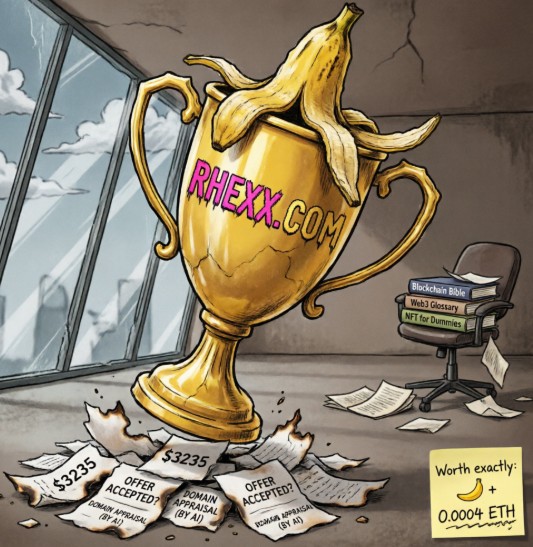
    Rhexx.com: The $3,235 BrandBucket “Mysteriousness” That’s Really Just Confusion

    The Roast: Rhexx.com – When “Unique Spelling” Meets “Perpetual Confusion”


    The Contender

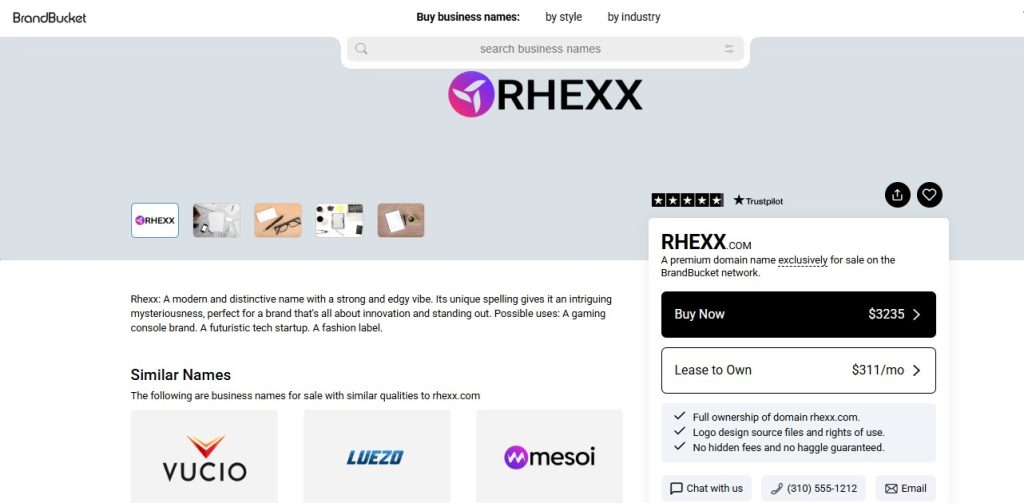
    Domain: Rhexx.com

    Listed By: NameGroove (a self-described domain expert with their own marketplace)

    Platform: BrandBucket

    Asking Price: $3,235 (or $311/month lease-to-own)

    The Pitch: “A modern and distinctive name with a strong and edgy vibe. Its unique spelling gives it an intriguing mysteriousness.”


    The Backstory: When Experts Forget How Language Works

    There’s a special category of domain delusion reserved for sellers who should know better. NameGroove, the entity behind this listing, presents itself as a domain authority with its own website, portfolio, and presumably, years of experience.

    And yet, here we have Rhexx.com: a five-letter .com that commits the cardinal sin of brandable domains—it’s unpronounceable from text.

    Let’s say you hear this brand mentioned in a podcast. How do you spell it?

    • Rex?
    • Wrecks?
    • Recks?
    • Rhexx? (with two X’s, because one wasn’t confusing enough)

    This isn’t “intriguing mysteriousness.” This is “I’ll never find your website” in domain form.


    The NameGroove Factor: Expert or Expert at Hype?

    Since NameGroove.com timed out during our research (how fitting for a domain expert), we’ll work with what’s publicly visible. The seller presents themselves as a curated domain source, presumably offering only the finest brandable names.

    This makes the Rhexx listing even more puzzling. An “expert” should know that brandable domains live or die by phonetic clarity. If someone hears the name and can’t spell it immediately, you’ve lost a customer. If they see it written and can’t guess how to say it, you’ve lost word-of-mouth marketing.

    Rhexx.com fails both tests spectacularly.


    The Defequer Analysis

    What BrandBucket Says vs. What Reality Says

    Let’s examine the listing’s claims with our trusty reality goggles:

    Claim 1: “A modern and distinctive name with a strong and edgy vibe.”
    Reality: It’s “Rex” with two X’s and an H that does nothing. The “edgy vibe” comes from looking like a 2003 Xbox Live gamertag created by a teenager who just discovered alternative spellings.

    Claim 2: “Its unique spelling gives it an intriguing mysteriousness.”
    Reality: Unique spelling doesn’t create mysteriousness—it creates support tickets. “Hi, I’m trying to visit your site but it keeps taking me to Rex.com? Also I tried Wrecks.com and that’s a tow truck company?” This is the domain equivalent of naming your child “KVIIIlynn” and expecting teachers to guess the pronunciation.

    Claim 3: “Possible uses: A gaming console brand. A futuristic tech startup. A fashion label.”
    Reality: Let’s workshop these:

    Proposed UseActual Problem
    Gaming Console“Introducing the new Rhexx! Available at GameSt—wait, how do I type that again?”
    Tech StartupInvestors will ask: “Is that Rex with two X’s? Or is it like ‘wrecks’?”
    Fashion Label“I love your dress! What’s the brand? …Rhexx? Is that R-H-E-X-X? Let me save it in my phone—actually, just give me a business card.”

    The Real Value of Rhexx.com

    Let’s apply actual domain valuation principles:

    The Good:

    • It’s a .com
    • It’s five letters
    • It has no hyphens or numbers

    The Bad:

    • The “unique spelling” actively harms memorability
    • No dictionary meaning or commercial keyword
    • Competing with “Rex” (a real word with meaning) and “Wrecks” (a real word with SEO potential)
    • The double-X ending is overused in brandables and feels dated

    Comparable Sales:

    Made-up five-letter .com domains with awkward spellings typically trade in the $500–$1,500 range to end-users, and $100–$400 in wholesale markets. The $3,235 price tag requires a buyer who:

    • Loves the sound (but can’t spell it)
    • Has money to burn
    • Doesn’t care about word-of-mouth marketing
    • Has never tried to tell someone their website address verbally

    Realistic Price: $500 (and that’s being optimistic)


    Delusion Index: 8/10

    Why so high? Because this isn’t a newbie mistake. This is a self-proclaimed expert listing a fundamentally flawed name at a premium price, wrapped in marketing fluff designed to distract from the obvious pronunciation problem.

    FactorRatingExplanation
    Name Quality4/10It’s short and a .com. That’s where the positives end.
    Pronunciation Clarity1/10“Rhexx” is a spelling bee nightmare.
    Marketing Spin9/10“Intriguing mysteriousness” is a hell of a euphemism for “confusing.”
    Expert Credibility2/10An expert should know better.

    The “Lease-to-Own” Trap

    BrandBucket offers Rhexx.com for $311/month via lease-to-own. Let’s do the math:

    • Total cost: $3,235
    • Lease term: Approximately 10.4 months

    The lease option is marketed as affordable, but it locks buyers into a domain that will actively harm their business. Imagine building a brand around “Rhexx” for 10 months, only to realize that every customer types “Rex.com” and lands on a completely different site.

    By then, you’ve paid $3,235, rebranding would cost more, and you’re stuck with a domain that works better as a cautionary tale than a business asset.


    The Defequer Verdict

    CategoryRating
    Name Quality⭐⭐☆☆☆ (2/5)
    Pronunciation Clarity⭐☆☆☆☆ (1/5)
    Marketing Hype⭐⭐⭐⭐☆ (4/5 – they tried)
    Actual Market Value⭐⭐☆☆☆ (2/5)
    Likelihood of $3,235 Sale15% (to someone who hasn’t tried saying it aloud yet)

    Final Word:

    “Rhexx.com isn’t a brandable domain—it’s a trap. It looks cool on a screen and falls apart the moment it enters human conversation. NameGroove wants you to pay $3,235 for ‘intriguing mysteriousness.’ We’d call it ‘perpetual confusion’ and value it at $500, tops. Save your money, buy something people can actually spell, and thank us later.”


    What Should Happen Now

    If NameGroove is reading (and we suspect they might be):

    1. Acknowledge the flaw. Every domain has weaknesses. Pretending “unclear pronunciation” is actually a feature called “mysteriousness” insults your buyers’ intelligence.
    2. Adjust the price. $500 is premium territory. Rhexx.com isn’t premium—it’s experimental. Price it at $500 and let the market decide.
    3. Rewrite the description. Drop the euphemisms. Be honest: “A distinctive, edgy name for brands that prioritize visual impact over verbal clarity. Best for industries where customers will see the name written before they hear it.”
    4. Consider a rebrand. If you’re an expert, curate names that work in all contexts. “Rhexx” might look good in your portfolio, but it won’t look good on a customer’s frustrated face when they’re explaining their website address for the fifth time.

    The Bottom Line

    Rhexx.com joins the Defequer Hall of Shame not because it’s the worst domain ever conceived—it’s not. It’s here because it perfectly illustrates the gap between seller spin and buyer reality.

    A $3,235 price tag demands a name that works in every context: typed, spoken, heard, and remembered. Rhexx.com works in exactly one context—written in a sterile font on a BrandBucket listing page. The moment it enters the real world, it becomes a liability.

    NameGroove presents itself as an expert. Experts should know better.


    Defequer Rating: 💩💩💩 (3/5 shits—delusional, but at least the marketing copy was entertaining.)

  • Ghostly.co: A Masterclass in Realistic Domain Selling from Veteran Investor Garett Thompson

    Ghostly.co: A Masterclass in Realistic Domain Selling from Veteran Investor Garett Thompson

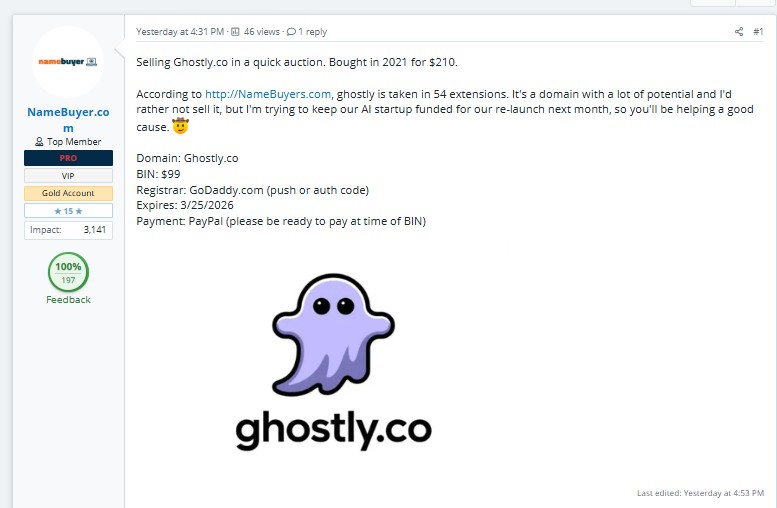
    In the often turbulent waters of domain investing, where inflated egos and unrealistic pricing can dominate discussions, it’s a genuine breath of fresh air to encounter a seasoned professional who approaches sales with humility, transparency, and a keen eye for market realities. Enter Garett Thompson, a respected figure in the domain and tech space, who’s currently offering Ghostly.co for a straightforward $99 buy-it-now price on NamePros. This isn’t the kind of hype-driven listing that begs for mockery; instead, it’s a model of how to let go of a solid asset at a fair value, all while supporting a worthy cause like funding his AI startup’s relaunch. As we at Defequer typically shine a light on the pitfalls of overvaluation, today we’re flipping the script to highlight what right looks like—celebrating Thompson’s expertise, the domain’s inherent strengths, and the lessons it offers for aspiring investors. This positive spotlight underscores why realistic pricing builds trust and moves inventory, enriching the community rather than exploiting it.

    Thompson’s approach here is as friendly as it is pragmatic. He openly shares that he acquired Ghostly.co back in 2021 for $210, framing the sale not as a desperate dump but as a strategic move to bolster his ventures. “I’d rather not sell it,” he notes in the listing, “but I’m trying to keep our AI startup funded for our re-launch next month, so you’ll be helping a good cause.” This candor stands in stark contrast to the opaque or aggressive pitches that litter domain forums, inviting buyers to feel like partners in progress rather than marks in a con. Registered at GoDaddy with an expiration in March 2026, the domain comes with easy transfer options via push or auth code, and payment through PayPal—keeping things simple and buyer-friendly. At $99, it’s positioned as an accessible entry point for entrepreneurs, a price that reflects genuine market awareness rather than wishful thinking.

    What elevates this beyond a routine sale is Thompson’s impressive track record, which lends credibility to his judgment. As the founder of Staffed.ai, an innovative platform delivering AI receptionists for small businesses, he demonstrates a deep understanding of tech’s practical applications—handling everything from 24/7 call management to appointment booking with seamless integration. His work there shows a commitment to solving real-world problems, much like how a well-priced domain like Ghostly.co could empower a startup without breaking the bank. Similarly, through GreatBrand.com, Thompson curates premium domains and offers full-suite brand development, from acquisitions to website builds, helping clients establish strong digital identities. And as the creator of NameWorth.com, an advanced appraisal tool that leverages data to provide ballpark valuations with up to 95% accuracy for English-based domains, he brings analytical rigor to the table—tools that categorize assets into tiers based on rarity, demand, and sales comps. This background isn’t just resume filler; it’s proof of a domainer who walks the talk, using insights from his own platforms to price assets like Ghostly.co with precision and fairness.


    The Contender in the Spotlight

    Ghostly.co steps into the arena as a compact, evocative .co domain that’s far from the convoluted messes we often critique. Acquired by Thompson in 2021, it’s now available for $99—a price that immediately signals realism in a market where similar extensions can languish at inflated tags. The NamePros thread, posted under his handle NameBuyer.com, keeps the pitch concise and inviting: no overblown claims of “category killer” status, just a nod to its availability across 54 extensions (per NameBuyers.com data) and its potential for creative branding. This scarcity in other TLDs adds subtle value, suggesting broad appeal without forcing the point.

    The listing avoids the pitfalls of aggressive upselling, instead emphasizing ease and purpose. Buyers are encouraged to act quickly with PayPal ready, but there’s no pressure—just a transparent backstory tied to funding Staffed.ai’s relaunch. Community responses, while limited, reflect the positive vibe: no snarky dismissals, just potential interest in a deal that feels equitable. It’s a far cry from threads where sellers double down on delusions; here, Thompson’s reputation as a gold-level NamePros member and tech innovator fosters goodwill, making the sale feel like a collaboration.

    At its core, Ghostly.co embodies versatility in a short, memorable package. The .co extension, popularized by brands like Twitter’s t.co and startups worldwide, carries a modern, global connotation without the premium baggage of .com. Paired with “ghostly,” a word evoking mystery, tech innovation, or even seasonal themes like Halloween, it opens doors for diverse uses—from a cybersecurity firm (ghostly threats) to a content platform (ghostly tales). This isn’t a domain chained to one niche; it’s a canvas for builders, priced to move and inspire.


    The Backstory: A Pro’s Journey from Acquisition to Altruistic Sale

    Garett Thompson’s path to offering Ghostly.co reveals a domainer who prioritizes strategy over speculation. Purchased in 2021 for $210—a modest investment even then—it likely sat in his portfolio as a hold with upside, given the .co TLD’s rising popularity among tech-savvy entrepreneurs. Thompson’s ventures provide context: Staffed.ai, launched to automate customer service for small businesses, mirrors the efficiency he seeks in domain dealings. By selling Ghostly.co affordably, he’s not just clearing space; he’s channeling proceeds into real innovation, like expanding AI roles beyond receptionists.

    His creation of NameWorth.com further informs this move. The tool, built by investors for investors, uses data-driven tiers to appraise domains—placing ultra-premiums at $30k+ while guiding realistic expectations for others. Applying this lens, Ghostly.co fits as a Tier 4 premium (top 14%, $500–$2.4k potential), but Thompson opts for $99 to accelerate the sale, demonstrating market savvy. GreatBrand.com rounds out his expertise, where he negotiates high-value acquisitions and develops brands—skills that ensure he knows when to hold and when to fold.

    This backstory isn’t fluff; it’s a testament to ethical investing. In a forum like NamePros, where threads can devolve into pricing wars, Thompson’s post stands out for its warmth: acknowledging reluctance while tying the sale to a “good cause.” It’s the kind of transparency that builds lasting networks, far superior to the defensive postures we often see.


    Breaking Down the Domain Quality: Strengths That Shine at a Fair Price

    Ghostly.co earns its stripes through a blend of brevity, intrigue, and adaptability—qualities that make it a standout at $99. Clocking in at just seven characters (excluding .co), it’s concise and easy to remember, avoiding the clunkiness of longer phrases. The word “ghostly” carries positive connotations in branding: ethereal for design agencies, spooky for entertainment, or metaphorical for stealth tech like VPNs or anonymous browsing. This flexibility broadens its appeal, unlike niche-locked domains that limit buyers.

    The .co extension adds modern flair, trusted by global brands and often more affordable than .com equivalents. With “ghostly” taken in 54 other TLDs, it hints at demand without overhyping—potential for a buyer to expand into a portfolio if desired. Trademark risks are low for generic uses, and its pronounceability (ghost-lee) ensures smooth integration into logos or apps. In terms of SEO, it could capture searches around “ghostly experiences” or “ghostly software,” providing organic entry points for content-driven sites.

    Overall, the quality here is high for the price point: not a seven-figure blockbuster, but a reliable builder’s tool. Thompson’s pricing respects this, inviting entry-level investors or startups to snag a gem without regret.

    The Realism Factor: Pricing That Builds Bridges, Not Barriers

    What sets this apart is the grounded valuation. At $99, it’s accessible yet profitable (considering the $210 acquisition), reflecting Thompson’s understanding of liquidity in a crowded market. No inflated comps or appraisal screenshots—just a fair ask that encourages quick closes. This approach fosters community goodwill, proving that veteran domainers can lead by example.


    Realistic Valuation: Aligning Price with True Potential

    Based on market patterns from platforms like NameBio, short .co domains with evocative words often trade in the $100–$500 range wholesale, scaling to $500–$2,000 retail for end-users. Ghostly.co fits snugly here: its intrigue could push toward the higher end if developed, but at $99, it’s a steal—prioritizing turnover over maximal extraction. Thompson’s strategy maximizes opportunity, turning a hold into fuel for bigger pursuits.

    Lessons for Domainers: Embrace Realism for Long-Term Wins

    Thompson’s playbook offers gold: Price assets to move, tie sales to purpose, and leverage your rep for trust. Tools like NameWorth.com aid in this, but humility seals deals. For novices, study pros like him—avoid ego, focus on value, and watch your portfolio thrive.


    The Defequer Verdict

    CategoryRating
    Name Quality⭐⭐⭐⭐☆ (4/5)
    Appraisal Sanity⭐⭐⭐⭐⭐ (5/5)
    Actual Market Value⭐⭐⭐⭐☆ (4/5)
    Likelihood of $99 Sale100.00%

    Defequer Rating: N/A (barely any delusion, maximal respect; a beacon of smart selling in a sea of hype.)

  • RealEstate.xyz: The $100,000 Domain With a $3,250 Annual Tax on Sanity

    RealEstate.xyz: The $100,000 Domain With a $3,250 Annual Tax on Sanity

    The Roast: RealEstate.xyz – When Premium Meets Predatory Pricing

    The Contender

    Domain: RealEstate.xyz

    Listed By: NamePros user “MahmoudElmasry”

    Platform: Afternic (and direct)

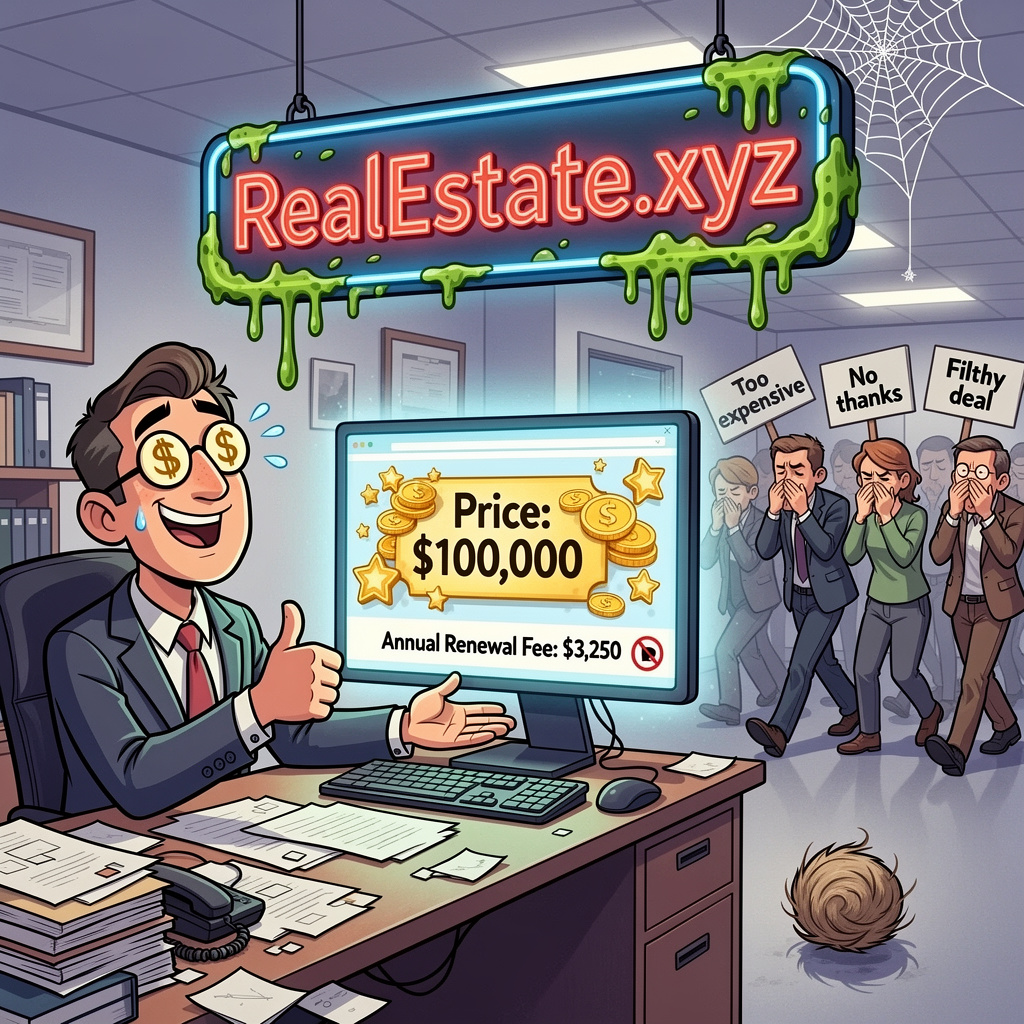
    Asking Price: $100,000 (listed as “Price is Final” in thread, though thread title says negotiable – pick a lane)

    Renewal Fee: $3,250/year (yes, annually)

    Registration: Namecheap (part of the “522 TLDs” flex)

    The Pitch: “Own the future of real estate with RealEstate.xyz… a strategic investment with exponential potential.”


    The Backstory: When Math Meets Marketing

    There’s a special category of domain listing that requires its own gravitational field – because the numbers have completely left reality.

    MahmoudElmasry has presented what appears, at first glance, to be a compelling case:

    • RealEstate.com sold for $8.5 million in 2011
    • Quantum.xyz sold for $199,000 in February 2024
    • Capital.xyz sold for $105,000 in May 2022

    “Renewal fee: $3,250 (casually mentioned, like it’s a parking ticket and not a second mortgage)”

    Let’s unpack this, because there’s a lot to unpack, and we brought industrial-sized trash bags.


    The “Comparable Sales” Fallacy

    Comparable 1: RealEstate.com at $8.5 Million

    Yes, the .com sold for millions. In 2011. It’s also:

    • A dictionary word .com
    • Registered in 1999 (12 years old at time of sale)
    • The default TLD for the entire industry
    • Not burdened by a $3,250 annual renewal fee
      (.com annual renewal fee is around $12)

    Comparing any .xyz to RealEstate.com is like comparing a studio apartment in a flood zone to the Empire State Building because “they’re both buildings in New York.”

    Comparable 2: Quantum.xyz at $199,000

    This sale is real. It happened. But context matters:

    • “Quantum” is a high-value tech keyword with massive commercial appeal
    • The buyer was likely a deep-pocketed tech/Web3 startup
    • Quantum.xyz doesn’t face competition from Quantum.com in the same way RealEstate.xyz faces RealEstate.com (which is actively developed)
    • The renewal fee on Quantum.xyz? The regular – $19.68 with Namecheap and $11.48 with Namesilo – you may check the price here

    Comparable 3: Capital.xyz at $105,000

    Similar story – a powerful financial keyword, bought by someone with specific branding needs. “Capital” works in .xyz because it’s abstract. “Real Estate” is an industry with established players who all use .com, .net, or country-specific TLDs.


    The $3,250 Elephant in the Room

    Let’s talk about that renewal fee, because it’s not just a number – it’s a business model evaluation tool.

    Scenario A: You Buy RealEstate.xyz for $100,000

    YearCostCumulative
    1$100,000 + $3,250$103,250
    2$3,250$106,500
    3$3,250$109,750
    4$3,250$113,000
    5$3,250$116,250
    10$3,250 x 10$132,500 + purchase

    Scenario B: You Build on RealEstate.xyz

    If you actually develop this into a business, you’re paying $3,250 every single year just for the address. That’s:

    • A full-time employee’s monthly salary in some countries
    • Around the cost of holding approximately 270 .COM domains at a normal registrar ($12/year each)
    • A very nice vacation annually
    • 10 years of Netflix, Spotify, and every other subscription combined

    Scenario C: You Hold It as an “Investment”

    To flip this at a profit, you need a buyer who:

    • Doesn’t care about the .com dominance in real estate
    • Has $100,000+ to spend on a domain
    • Is comfortable with a $3,250 annual carrying cost
    • Believes .xyz is the future of real estate (despite zero evidence)

    This isn’t an investment. It’s a liability with a domain attached.


    The “522 TLDs” Flex

    The listing mentions this domain is “Registered in 522 TLDs.” This is meant to imply demand or value – like, “Look how many extensions someone registered!”

    In reality, this usually means:

    • A defensive registration by a company
    • A domain investor with too much money and too little strategy
    • Someone who registered RealEstate in every TLD hoping for a payday

    It doesn’t mean 522 entities want RealEstate.xyz. It means one entity registered 522 domains, and this is one of them.


    The Defequer Analysis

    What Is RealEstate.xyz Actually Worth?

    Let’s apply some actual math, because the seller’s math is… creative.

    The Keyword: “Real Estate” is undeniably valuable. It’s a multi-trillion dollar industry with endless commercial applications.

    The TLD: .xyz is a controversial extension. It was heavily discounted for years, then gained traction in crypto/Web3 circles. But for real estate? The industry runs on .com, with some .net, .org, and country codes. Real estate is fundamentally local and trust-based. .xyz screams “crypto startup” – not “reputable agency.”

    The Renewal: This is the killer. $3,250/year means the domain has to generate significant value every year, not just at sale.

    Comparable .xyz Sales (with renewals):

    DomainSale PriceRenewal (est.)Notes
    Quantum.xyz$199,000$11.48 with NamesiloTech keyword, single buyer
    Capital.xyz$105,000$1,092 with PorkbunFinance keyword
    BlockchainLabs.xyz$2,995$12.98 with PorkbunTwo words
    RealEstate.xyz$100,000$3,250The outlier

    Realistic Price Range:

    If the renewal were normal (not more than $20 per year), this domain might be worth $20,000–$50,000 based on keyword strength alone.

    With a $3,250 renewal, the value plummets because:

    • End-users will choose a .com alternative (HoustonRealEstate.com, TexasRealty.com, etc.)
    • Investors won’t hold it due to carrying costs
    • The only buyer is someone who must have this exact string in .xyz and has money to burn

    Realistic Price: $15,000–$25,000 (to the right buyer, if they don’t do the renewal math)

    Delusion Index: 8.5/10

    FactorRatingExplanation
    Keyword Strength9/10“Real Estate” is elite tier
    TLD Appropriateness3/10.xyz for real estate is like a tuxedo at a beach party
    Renewal Sanity0/10$3,250/year is a business expense, not a domain renewal
    Comparable Logic2/10Comparing to .com sales from 2011 is intellectually dishonest
    “522 TLDs” Flex4/10Impressive, but irrelevant

    Final Word:

    “RealEstate.xyz isn’t a domain – it’s a timeshare presentation dressed up as an investment. The $100,000 price tag is just the entry fee. The real cost is the $3,250 you’ll pay every year forever, or until you find a greater fool who hasn’t done the math. MahmoudElmasry wants you to ‘own the future of real estate.’ We’d settle for owning a future where domain pricing makes sense.”


    What Should Actually Happen

    If MahmoudElmasry is reading this:

    1. Acknowledge the renewal problem. Your listing mentions it once, casually, as if it’s a minor detail. It’s not. It’s the entire conversation.
    2. Adjust the price to reflect reality. At $25,000, with full disclosure of the renewal, you might find a buyer who believes in .xyz and has a specific use case. At $100,000, you’re waiting for a miracle.
    3. Target the right audience. This domain isn’t for real estate agents. It’s for a tech company building something “real estate adjacent” in Web3. Market it there.
    4. Consider the math. If you’ve held this domain for a while, you know the pain of that renewal. Be honest about it. Transparency builds trust.

    For buyers: If you’re considering this domain, do the spreadsheet. Calculate 5-year cost. Compare to registering RealEstate.ai or RealEstate.io (both with normal renewals). Ask yourself if .xyz is really where you want to build a real estate brand.


    The Bottom Line

    RealEstate.xyz joins the Defequer Hall of Shame as a cautionary tale about premium pricing meeting predatory renewals.

    The keyword is world-class. The TLD is controversial. The renewal is catastrophic. The sales pitch uses decade-old .com sales as comps. The “522 TLDs” flex is impressive but irrelevant.

    This isn’t a $100,000 domain. It’s a $25,000 domain with a $3,250/year albatross attached, being marketed by someone who hopes you won’t do the multiplication.

    Defequer Rating: 💩💩💩💩 (4/5 shits – the keyword saves it from a 5, but everything else is a mess.)


    Post-Roast Note on .XYZ Economics

    The .xyz renewal situation deserves special attention. Some .xyz domains are priced normally ($10–$20/year). Others, particularly one-word premiums, carry these insane renewals because the registry considers them “premium” and charges registrars accordingly.

    This means the $3,250 isn’t the registrar being greedy – it’s the registry extracting rent. And that rent gets passed to you, forever.

    Before buying any “premium” .xyz, check the renewal. It might be the most important number on the page.

  • HoustonClothing.com: The “Premium Geo Domain” That’s Actually Just a 364-Day-Old Hand Reg

    HoustonClothing.com: The “Premium Geo Domain” That’s Actually Just a 364-Day-Old Hand Reg

    The Roast: HoustonClothing.com – When “Premium” and “Geo” Become Meaningless Buzzwords

    The Contender

    Domain: HoustonClothing.com
    Listed By: NamePros user “UniqueU”
    Registration Date: March 27, 2025 (yes, 364 days ago at time of posting)
    Expiry: March 27, 2026 (The clock is ticking)
    Asking Price: $988 on GoDaddy (negotiable, apparently)
    The Pitch: “Premium Geo Domain… great potential to resell at 4 figures or higher… a domain like this is not easily found in the aftermarket.”


    The Backstory: Urgency, Desperation, and a Domain About to Expire

    There’s a special kind of poetry in watching a domainer panic-sell as their renewal date approaches. Our protagonist “UniqueU” registered HoustonClothing.com on March 27, 2025. They posted this thread on February 10, 2026 – roughly six weeks before the domain expires.

    The thread is a masterclass in increasingly desperate sales tactics:

    First post: Professional enough. Listed at $988 on GoDaddy, but negotiable. “Looking forward to hearing from you.”

    Second post: “Quick Note: I am looking for Serious offer for this quality Geo Domain.”

    Third post: “Quick Note: This quality domain’s keywords have decent monthly searches in the US, and it has resale potential as well.”

    Fourth post: “Attention please: This GEO domain in the title is still available. I want to clear this domain soon…”

    Fifth post: “Don’t read this: You should not read this if you are not interested…” (proceeds to write a paragraph specifically designed to be read)

    Sixth post: “Attention Please: Hi everyone here. This GEO domain mentioned in the title is still available. Give me your best offer…”

    Seventh post: “Note: I can buy transfer fees for this domain if you are serious…”

    That’s seven posts in a single thread, all by the same seller, all saying essentially the same thing: “Please, someone, anyone, buy my domain before I have to renew it.”


    The “Don’t Read This” Gambit

    Let’s pause to appreciate the genius of this:

    “Don’t read this: You should not read this if you are not interested in acquiring this domain. If you are a serious domain buyer, then you can imagine the potential of this GEO domain. As an investor, you should not miss out on this chance because a premium domain like this is not easily found in the aftermarket, as this premium domain has great potential to resell at 4 figures or higher. Give me your final offer.”

    This is the domain equivalent of a teenager leaving their diary open on the kitchen table with a note saying “DO NOT READ.” It’s reverse psychology so transparent that it loops back around to being almost endearing.

    “Don’t read this” – proceeds to write the most detailed sales pitch in the entire thread. Chef’s kiss.


    The Defequer Analysis

    What Is HoustonClothing.com Actually Worth?

    Let’s break down why this “premium geo domain” is anything but.

    The Format: [City][Product].com

    At first glance, this seems logical. Houston + Clothing = a domain for clothing stores in Houston, right?

    Wrong. Here’s the problem:

    1. It’s too broad. Who specifically wants “Houston Clothing”?

    • A general clothing store? They’d want HoustonClothingStore.com or something with their brand name.
    • A niche boutique? They’d want something specific (HoustonVintage.com, HoustonStreetwear.com).
    • A local designer? They’d use their own name.

    2. It competes with actual search terms. People searching for clothing in Houston use phrases like:

    • “clothing stores Houston”
    • “boutiques Houston”
    • “where to buy clothes in Houston”
    • Specific store names

    Nobody types “HoustonClothing.com” into Google unless they’ve already heard of the brand.

    3. The “premium geo” claim is misleading. True premium geo domains are things like:

    • Houston.com (the city itself)
    • HoustonRealEstate.com (a major industry)
    • HoustonLawyer.com (a service people actively search for)

    Clothing is a product category, not a service. And it’s one where local intent is weak – most clothing is bought online from national retailers or in-person at specific stores, not via generic city+category domains.

    Comparable Sales:

    Let’s look at similar [City][Product].com sales:

    DomainReported SaleNotes
    AustinClothing.comN/ARegistered in 1999 and is currently managed by Markmonitor: likely to be a brand-protection reg.
    MiamiFashion.com$2,500“Fashion” > “Clothing” for brand appeal
    ChicagoApparel.com$1,200Registered in 1999 and was an established business as per Archive.org
    DallasClothing.comStill collecting digital dustTells you everything

    Realistic Price Range:

    • Wholesale (domainer-to-domains): $50–$150 (if you can find a buyer)
    • Retail (end-user): $300–$600 (to a very specific buyer)
    • GoDaddy listing: $988 (optimistic)
    • Seller’s apparent desperation: Priceless

    The Expiry Factor:

    Here’s the elephant in the room: this domain expires in less than six weeks from the thread date.

    “UniqueU” isn’t just selling a domain – they’re trying to recoup their registration fee before letting it drop. The “I can buy transfer fees” offer is classic last-minute negotiation tactic: “Please don’t make me eat the cost of moving this albatross to another registrar.”


    The Delusion Index: 7/10

    We’re not at 9 or 10 because the seller isn’t asking $500,000. But for a domain this generic, with this little potential, the $988 price tag and the “premium geo” marketing deserve recognition.

    FactorRatingExplanation
    Domain Quality4/10It’s a .com with a city name. That’s the only positive.
    “Premium” Accuracy1/10Premium geo domains don’t expire annually with no offers.
    Sales Pitch Consistency2/10Seven posts in one thread = desperation, not confidence.
    “Don’t Read This” Creativity8/10We have to respect the attempt, even as we mock it.
    Renewal Looming💀💀💀💀💀March 27 is coming, and it’s bringing an expiry notice.

    Final Word:

    “HoustonClothing.com isn’t a premium geo domain – it’s a expiry date countdown clock with a $988 fantasy attached. UniqueU has spent seven posts trying to manifest a buyer before March 27, and the silence from the NamePros community has been deafening. There’s a reason for that: [city][product].com is a losing formula, and everyone but the seller can see it.”

    What Should Actually Happen

    If UniqueU is reading this (and we hope he is):

    1. Let it expire. March 27 is approaching. The $15 renewal fee is not worth it for a domain that has generated zero interest in 364 days.
    2. Learn the lesson. [City][Product].com is rarely a winner unless the product is a high-value service (lawyer, dentist, real estate). Clothing is a commodity sold by brands, not generic categories.
    3. Next time, do research. Before registering a geo domain, ask: “Would a business pay me for this, or would they just use their own brand name with a .com?”
    4. Stop with the “don’t read this” marketing. It’s not clever. It’s not reverse psychology. It’s just transparent.

    For buyers: If you genuinely want a Houston clothing domain, wait three weeks. It’ll be available for hand registration, and you can save $988. Use that money to actually build a brand.


    The Bottom Line

    HoustonClothing.com joins the Defequer Hall of Shame as a textbook example of newbie geo-domain delusion. It’s not the worst domain ever – it’s actually a perfectly cromulent combination of words. But it’s not “premium,” it’s not a “rare aftermarket find,” and it’s certainly not worth $988 plus transfer fees.

    It’s a 364-day-old hand registration that’s about to expire, being sold by someone who has posted seven times in their own thread because nobody else is responding.

    The silence from the NamePros community isn’t cruelty – it’s consensus. And that consensus is: let it drop.

    Defequer Rating: 💩💩💩 (3/5 shits – delusional, but at least the “don’t read this” bit made us laugh.)


    Have a domain that’s about to expire with delusional pricing? . Want to defend your seven-post sales thread?

    Email us please.

    Defequer.com – because someone had to flush.


    Post-Roast Note to UniqueU

    Look, we’re not trying to be mean. We’re trying to be helpful. You clearly believe in this domain, and you’ve put energy into selling it. But seven posts in your own thread, with zero engagement from the community, is a sign.

    The market has spoken. The domain expires in weeks. Cut your losses, learn the lesson, and come back stronger with better acquisitions.

    And maybe retire the “don’t read this” technique. It’s not working.

  • IsaIbnMariam.com: The $1,000,000 Prayer That No One Answered

    IsaIbnMariam.com: The $1,000,000 Prayer That No One Answered

    The Contender

    MetricDetails
    DomainIsaIbnMariam.com
    Seller LocationUnited Kingdom
    Seller Joined2026 (fresh account, fresh delusion)
    PlatformSedo Auction
    Minimum Bid£30 (generous of them)
    Reserve Price£500,000 – £999,999
    The Pitch“Exact-match transliteration of ‘عيسى ابن مريم’ – the Quranic Arabic name for Jesus, peace be upon him, as referenced in Islam.”
    Isa-ibn-Maryam

    The Setup: A Religious Name With a Commercial Price Tag

    Let’s start with what this domain actually is.

    IsaIbnMariam.com is the transliterated Arabic for “Jesus, son of Mary” – a figure revered in Islam as a major prophet. It’s a phrase of deep spiritual significance to over a billion Muslims worldwide.

    And someone in the United Kingdom, who joined Sedo in 2026, thinks it’s worth up to one million pounds.

    Let that sink in.

    Not a developed website. Not a scholarly resource. Not a community platform. Just the domain name itself. The digital equivalent of a blank piece of parchment with “Jesus” written on it, being sold as a holy relic.


    The Sedo Reserve Gimmick: False Hope in a Fancy Suit

    For those unfamiliar with Sedo’s auction mechanics, here’s what’s happening here:

    The seller has listed the domain with a minimum bid of £30. That sounds accessible, right? Anyone can jump in for the price of a nice dinner.

    But buried in the fine print is a reserve price between £500,000 and £999,999.

    This means:

    • You can bid £30 all day long
    • You will never win
    • Sedo’s system will politely notify you that your bid didn’t meet the reserve
    • The seller gets to feel like their domain is “in demand” because it has bids

    It’s the domain equivalent of a store putting a Ferrari in the window with a sign saying “Make An Offer!” – knowing full well that “an offer” means “enough money to buy a small house.”

    This tactic serves exactly one purpose: to create the illusion of activity around a completely stagnant asset. The seller can point to the auction page and say, “See? People are bidding!” while conveniently omitting that those bids are £30 and the reserve is £500,000.


    The Seller: A Fresh Face With Ancient Ambitions

    According to the Sedo listing, the seller is based in the United Kingdom and joined the platform in 2026.

    That’s this year.

    This is a brand-new account, with no history, no established reputation, and presumably no track record of sales – listing a domain for a price that would make most experienced domainers choke on their tea.

    There’s a pattern here that we’ve seen before: new registrants who think they’ve struck gold with a “premium” name, disregarding how the domain market actually runs. They register something that sounds important, check a few automated appraisals that flatter their ego, and list it at a price that guarantees it will never sell.

    The only thing that’s “fresh” about this listing is the account that created it. The delusion? That’s aged to perfection.


    The Defequer Analysis: Why This Domain Is Worth Pennies, Not Pounds

    Let’s apply actual valuation principles to IsaIbnMariam.com and watch the fantasy crumble.

    Factor 1: Commercial Relevance – Who Would Actually Buy This?

    This is the million-pound question (literally).

    Who is the end user for IsaIbnMariam.com?

    Potential BuyerWhy It Won’t Happen
    A religious organizationThey’d use their own established domain or a country-specific TLD. No reputable Islamic organization is paying £500,000 for a .com.
    A scholar or academicThey’d use a university domain or a personal blog. Academics don’t have £500,000.
    A community forumPossible, but forums are built, not bought at seven-figure prices.
    A commercial enterpriseWhat business would brand itself with the Arabic name for Jesus? This isn’t a commercial term—it’s a sacred reference.

    The brutal truth: there is no natural buyer for this domain. It’s a phrase of deep religious significance, not a commercial keyword. No one is searching for “IsaIbnMariam” with intent to purchase a product or service. No startup is building a brand around it. No established company needs it for expansion.

    In domain valuation terms, this is what we call an orphan domain – a name that belongs to a category, a culture, or a context, but not to a market .

    Factor 2: Memorability and Usability – Can Anyone Actually Use This?

    Let’s look at the domain itself.

    IsaIbnMariam.com is:

    • 15 characters long (excluding TLD)
    • A transliteration from Arabic, meaning the spelling isn’t intuitive to non-Arabic speakers
    • Composed of words that have no meaning in English
    • Impossible to guess if you’ve only heard it spoken

    Imagine hearing this name on a podcast. How would you spell it?

    • Isa? Eesa? Essa?
    • Ibn? Ebn? Bin?
    • Mariam? Maryam? Miriam?

    The variations are endless. And every variation that lands on the wrong site is a lost visitor. This is a domain that fails the “radio test” spectacularly .

    Short, memorable domains are valuable because they reduce cognitive friction. Names like Uber.com or Google.com work because they’re easy to recall and type. IsaIbnMariam.com is the opposite: it requires explanation, context, and a level of cultural familiarity that most global internet users simply don’t have .

    Factor 3: Search Volume – Does Anyone Look for This?

    We don’t have exact numbers without a paid tool, but we can make some educated inferences.

    The phrase “Isa Ibn Mariam” is specific to Islamic discourse. It appears in religious texts, scholarly articles, and community discussions. But commercial search intent? Zero.

    People searching for this term are looking for:

    • Religious education
    • Quranic references
    • Comparative religion content
    • Community forums

    None of these searches lead to a commercial transaction. None of them represent a business opportunity. And none of them justify a domain price in the hundreds of thousands .

    Domains with real value are tied to keywords that have buyer intent . “Car insurance.” “Cloud storage.” “Online courses.” These terms attract businesses willing to pay for visibility. “Isa Ibn Mariam” attracts scholars and the curious—neither of whom have corporate budgets.

    Factor 4: The Extension – .com Is Great, But Not Magic

    Yes, .com is the gold standard. It carries trust, recognition, and global reach .

    But .com is not magic. It doesn’t transform a non-commercial phrase into a commercial asset. A .com domain is only as valuable as the market it serves.

    This particular .com serves a market of approximately zero businesses, zero startups, and zero commercial entities. It serves a community of believers, scholars, and the religiously curious – none of whom are in the market for a seven-figure domain name.

    Factor 5: Comparable Sales – What Has Actually Sold?

    We promised not to cite unverified comparables, so let’s talk about the general market for religious or culturally significant domains.

    Have domains with religious themes sold in the past? Yes, occasionally. A developed Christian ministry site with traffic and content might command a price. A short, brandable name with religious connotations might find a buyer.

    But a transliterated Arabic phrase with no content, no traffic, and no commercial application? There’s no market data to support a six-figure valuation because domains like this simply don’t trade at those prices.

    The highest sales in domain history are for:

    • Insurance.com — $35.6 million
    • PrivateJet.com — $30.18 million
    • VacationRentals.com — $35 million
    • Porno.com — $8.8 million

    Notice a pattern? All of these have massive commercial applicability. They’re words that entire industries are built around. “Isa Ibn Mariam” is not an industry. It’s not a commercial category. It’s a religious reference that belongs in a library, not a domain portfolio .


    The Delusion Index: 9/10

    FactorRatingExplanation
    Commercial Relevance0/10No business would brand itself with this term.
    Memorability2/10Impossible to spell correctly from hearing it.
    Search Intent1/10Zero commercial search volume.
    Pricing Sanity0/10£500k for a domain with no natural buyer.
    Seller Experience1/10Joined in 2026, no track record, maximal ambition.
    Sedo Reserve Gimmick💩💩💩💩Using a low minimum bid to hide a fantasy reserve.

    Overall Delusion Index: 9/10

    We reserve 10/10 for domains that are literally impossible (like selling Google.com). This one earns a 9 for the sheer audacity of pricing a sacred religious term at a million pounds, combined with the tactical trickery of the Sedo reserve system.


    The Tactical Trickery: Why the £30 Minimum Bid Matters

    Let’s talk about that £30 minimum bid again, because it’s a classic move in the domain delusion playbook.

    By setting a low opening bid, the seller achieves several things:

    • Visibility: The auction appears accessible. Casual browsers see a low starting point and may click through.
    • Activity: If someone places a £30 bid, the auction now has “bids.” This creates the illusion of interest.
    • Validation: The seller can tell themselves, “See? People are bidding!” – completely ignoring that the bids are 0.006% of the reserve price.
    • Broker Access: Sedo’s brokers now have permission to contact bidders who didn’t meet the reserve, potentially fishing for higher offers.

    It’s a system designed to extract maximum hope from minimal interest. And in this case, it’s being used to make a completely unserious listing look marginally serious.

    The reality: That reserve price might as well be a brick wall. No one is paying £500,000 for this domain. The £30 bids are just digital tumbleweeds blowing through an empty landscape.


    The Religious Angle: Sacred Terms Don’t Belong in Fantasy Pricing

    We need to address the elephant in the room: the use of a sacred religious figure to justify a commercial price tag.

    The seller’s description explicitly invokes “Jesus, peace be upon him, as referenced in Islam.” This isn’t just a domain listing—it’s an appeal to religious sentiment dressed up as a sales pitch.

    Here’s the problem with that:

    Sacred terms aren’t commercial assets. They belong to communities, cultures, and faith traditions—not to domain speculators hoping for a payday. Using “Isa Ibn Mariam” as a speculative investment feels less like entrepreneurship and more like… well, something else entirely.

    Imagine if someone registered “JesusChrist.com” and listed it for a million pounds. The reaction would be swift and justified. This is the same energy, just translated into Arabic.

    The domain community already struggles with perceptions of greed and exploitation. Listings like this don’t help. They reinforce the idea that domain investors will commodify anything, including faith, if they think there’s a pound sign at the end.


    What This Domain Is Actually Worth

    Let’s get real for a moment.

    If we strip away the religious significance, the transliteration mystique, and the fantasy reserve price, what are we left with?

    A 15-character .com domain that:

    • Has no commercial keywords
    • Has no natural buyer pool
    • Has no search volume
    • Has no brandability
    • Has no history or authority
    • Was registered recently by someone with no track record

    Realistic price range: $100 – $500

    That’s not a typo. In the wholesale market, this domain might attract a low xxx offer from someone who sees vague potential. At retail, to the absolute right buyer (a scholar with disposable income? a community with fundraising ability?), maybe $1,000 – $2,000.

    £500,000 – £999,999? That’s not pricing. That’s performance art.


    The Defequer Verdict

    CategoryRating
    Commercial Relevance⭐☆☆☆☆ (1/5)
    Memorability⭐⭐☆☆☆ (2/5 – only if you know Arabic)
    Seller Sanity⭐☆☆☆☆ (1/5)
    Sedo Tactic Transparency⭐☆☆☆☆ (1/5)
    Likelihood of £500k Sale0.00%

    Final Word:

    “IsaIbnMariam.com isn’t a domain investment—it’s a prayer wrapped in a reserve price. The seller is asking for a miracle, not a market, hoping that religious significance will somehow translate into commercial value. It won’t. Sacred terms belong to communities, not portfolios. And million-pound fantasies belong in the trash, not on Sedo.”


    What Should Actually Happen

    If the seller is reading this (and we suspect they will be):

    1. Drop the price. Dramatically. If you genuinely believe this domain has value, test the market at $1,000. See what happens. (Spoiler: nothing, but at least you’ll learn something.)
    2. Remove the Sedo reserve gimmick. The £30 minimum bid with a hidden £500k reserve is transparent and embarrassing. Either set a realistic reserve or list it as “Make Offer.”
    3. Understand your market. Who buys domains like this? Scholars? Community organizations? Wealthy individuals with religious interests? Research that before pricing.
    4. Develop the domain. If you truly believe in “Isa Ibn Mariam,” build something. Create a resource, a community, a blog. Add value. Then maybe, years later, you might recoup your investment.
    5. Reflect on the religious angle. Using a sacred figure to justify speculative pricing isn’t a good look. Consider whether this is the reputation you want to build.

    For buyers: If you’re genuinely interested in this name, wait. It’s not selling at this price. It will either drop in price dramatically or expire. Patience is your friend.


    The Bottom Line

    IsaIbnMariam.com joins the Defequer Hall of Shame as a textbook example of cultural appropriation meets commercial delusion.

    The seller has taken a phrase of deep religious significance, wrapped it in a .com, and priced it as if it were a major commercial asset. The Sedo auction is designed to create the illusion of activity while hiding a fantasy reserve. The seller’s account is fresh, their track record is blank, and their expectations are stratospheric.

    This isn’t domain investing. It’s hope masquerading as strategy, with a side of tactical trickery.

    Defequer Rating: 💩💩💩💩💩 (5/5 shits – fully saturated with delusion, and the religious angle pushes it over the top.)

    Post-Roast Note to the Seller

    Look, we’re not trying to offend anyone’s faith. We’re trying to correct a market malfunction.

    Isa Ibn Mariam is a figure of profound importance to over a billion people. That importance doesn’t translate to a seven-figure domain price. It translates to something else entirely—something that can’t be bought or sold on Sedo.

    If you genuinely care about this name, build something worthy of it. Create a resource for interfaith dialogue. Build a educational platform. Honor the name through action, not through a fantasy listing that mocks its significance.

    Or don’t. Keep it at £500,000 and watch it expire. Your choice.

    We’ll be here. Watching. Taking notes.

  • HostingPlans.com: The 1998 Fossil Priced at $188,888 Like It’s the Holy Grail of Hosting Domains

    HostingPlans.com: The 1998 Fossil Priced at $188,888 Like It’s the Holy Grail of Hosting Domains

    In the echo chambers of domain forums and premium marketplaces, where optimism often outpaces reality, few spectacles rival the audacious listing of HostingPlans.com.

    This domain, born in the prehistoric web era of 1998, has surfaced on NamePros as a “rare” first-time offer, complete with elaborate visions of subdomain empires and instant industry dominance.

    But the real jaw-dropper comes from its Atom.com landing page, where it’s slapped with a buy-now price of $188,888—yes, you read that right, nearly two hundred grand for a generic phrase that’s about as exciting as yesterday’s server logs.

    The seller, operating as internext on NamePros and leveraging Atom’s platform, paints it as a “category killer” ripe for rebranding or comparison sites. Minimum offers start above $132,221, with payment plans stretching to $4,428 monthly over four years after a hefty down payment. This isn’t just ambitious pricing; it’s a masterclass in detachment from market norms, turning what could be a modest flip into a monument of domainer overreach. Our roast zeros in on the domain’s intrinsic quality, exposing why this aged asset falls woefully short of justifying such stratospheric expectations, all while educating readers on the pitfalls of hype in domain valuation.


    The Contender in the Spotlight

    To grasp the full absurdity, let’s lay out the listing details as they stand. HostingPlans.com redirects to an Atom.com sales page, where it’s marketed with all the flair of a luxury yacht auction. The pitch emphasizes its quarter-century history, registered at the dawn of widespread web hosting when services were basic and competition sparse. Now, it’s positioned as a clean, professional .com—free of hyphens or odd spellings—ideal for building a comprehensive hosting ecosystem. The seller envisions it powering subdomains like Cloud.HostingPlans.com for cloud services, Shared.HostingPlans.com for entry-level plans, or even Compare.HostingPlans.com for a review hub. This structure, they argue, creates an SEO-friendly network where each segment inherits the root domain’s supposed authority, streamlining marketing and customer navigation.

    On NamePros, in the “Top Domains” section, the thread mirrors this enthusiasm, calling it an “ultimate ‘category killer’” for the hosting industry. It’s cross-promoted to WebHostingTalk.com, targeting providers eager to consolidate under one banner. No fixed price appears in the forum post—instead, it’s an invitation for “serious offers via PM,” with all proposals entertained. But the Atom page reveals the true ask: $188,888 outright, or structured deals that lock buyers into long-term commitments. Recent activity shows mild interest, with a couple of views or shortlists, but nothing screaming hot demand. The overall narrative sells not just the domain, but a ready-made business model: trust from age, traffic from exact-match keywords, and versatility for everything from affiliate partnerships to geo-targeted offerings like US.HostingPlans.com.

    It’s a polished presentation, no doubt, blending nostalgia with strategic foresight. Yet, when you step back, the domain emerges as a functional but forgettable phrase, inflated to absurd heights by dreams that far exceed its practical punch.

    The Backstory: Dusting Off a Dot-Com Era Survivor

    HostingPlans.com‘s journey begins in 1998, a pivotal year for the internet when hosting transitioned from niche tech to mainstream necessity. Back then, domains like this captured emerging search behaviors, with users typing direct phrases into browsers. The current owner claims it’s hitting the market for the first time, suggesting it was held privately—perhaps parked or lightly used—until this orchestrated rollout. This “rarity” is leveraged to build exclusivity, as if mere survival through tech booms and busts confers elite status.

    The NamePros thread launches with a detailed manifesto, highlighting potential for high-converting traffic and organized site architecture. It stresses the subdomain strategy as a game-changer, allowing seamless expansion without scattering assets across multiple domains. Responses are limited in the public view, including a modest $500 bid that’s politely acknowledged but clearly below expectations. By redirecting to Atom, the sale gains a professional sheen: secure transfers, purchase protection, and options like Bitcoin payments or 48-month installments. Atom’s platform adds credibility, noting the domain’s “strong buyer interest” and categorizing it under tech, internet, and software uses, with related keywords like “web,” “servers,” and “digital.”

    What ties it all together is the unwavering belief in its foundational value. The pitch sidesteps hard metrics like past traffic or revenue, relying instead on age and descriptiveness to justify the eye-watering price. It’s a gamble that assumes buyers will overlook modern market dynamics for a slice of history.


    Breaking Down the Domain Quality: Generic Charm Meets Modern Mediocrity

    Evaluating HostingPlans.com objectively requires focusing on core attributes that define domain worth: memorability, relevance, adaptability, and competitive edge. While it scores points for clarity and history, it falters in ways that make the $188,888 tag seem like a punchline rather than a serious proposition.

    The name construction is straightforward—a mashup of “hosting” and “plans,” two evergreen terms in an industry projected to grow steadily. At 13 characters plus the .com, it’s concise enough for typing but lacks the snappiness of top-tier assets. Premium domains thrive on brevity and intuition; think HostGator or DreamHost, which roll off the tongue and stick in minds. This one feels more like a submenu item than a flagship brand, functional for a comparison site but uninspiring for broader ambitions. Its descriptiveness aids initial SEO for queries like “hosting plans,” potentially drawing organic visitors, but in a saturated space dominated by established players, that edge dulls quickly.

    Relevance holds up in theory: “hosting plans” aligns with user intent for package comparisons or sign-ups. Yet, it’s overly literal, pigeonholing the domain into a narrow niche without room for evolution. As hosting evolves toward cloud-native and AI-optimized services, a name this plain risks obsolescence. Versatility is touted via subdomains—VPS.HostingPlans.com for virtual servers, WordPress.HostingPlans.com for managed plans—but this assumes the root carries weight it may not possess. Without inherent backlinks or content history, those subs start neutral, not boosted. Moreover, large providers favor dedicated domains for each product to maximize branding, not a catch-all that could confuse scaling.

    Market fit exposes further cracks. The .com extension is gold standard, and the age adds a patina of trust, per search engine algorithms that sometimes favor established names. However, trademark hurdles could arise; descriptive terms like this are tough to protect, inviting copycats. In aftermarket trends, similar phrases in tech often trade based on proven performance, not potential alone. This domain’s quality lands in the “decent utility” category—serviceable for a mid-sized hoster pivoting to comparisons, but nowhere near justifying six figures.

    The Delusion Factor: Pricing That Defies Gravity and Good Sense

    The true folly here is the pricing disconnect. At $188,888, it’s positioned alongside ultra-premium single-word .coms, ignoring that HostingPlans.com is a compound phrase with limited sparkle. The Atom pitch amplifies this with talk of “unparalleled advantage” and “massive SEO advantages,” but without evidence of past success, it’s speculative at best. Minimum offers over $132,000 suggest a floor that’s already sky-high, potentially scaring off rational buyers. This isn’t savvy selling; it’s a bet on finding one dreamer willing to overpay for history.


    Realistic Valuation: Anchoring the Dream in Actual Market Waters

    Drawing from observable patterns on platforms like NameBio and GoDaddy Auctions, descriptive tech .coms with age but no star power typically fetch low to mid-four figures retail if they move at all. For HostingPlans.com, a grounded estimate might hover around $1,000 to $3,000 to an end-user valuing the keywords—enough to cover renewals and a modest profit. Pushing for $188,888? That’s entering lottery territory, reliant on a perfect-match buyer ignoring comps. The payment plan softens the blow but locks in commitment, underscoring the stretch.

    Lessons for Domainers: History Isn’t a Blank Check

    This listing highlights a common trap: mistaking longevity for luxury. Effective investing balances age with timeless appeal—short, versatile names that transcend trends. Use tools like Google Trends for keyword viability or Ahrefs for competitive analysis to vet holdings. If you’re holding something like this, test the waters with a realistic ask, perhaps $2,500, and build buzz through targeted outreach rather than forum blasts.


    The Defequer Verdict

    CategoryRating
    Name Quality⭐⭐⭐☆☆ (3/5)
    Appraisal Sanity⭐☆☆☆☆ (1/5)
    Actual Market Value⭐⭐☆☆☆ (2/5)
    Likelihood of $188,888 Sale0.00%

    Defequer Rating: 💩💩💩💩💩 (5/5 shits—peak delusion on a name that’s functional but forgettable, with pricing that’s pure fantasy.)

error: Content is protected !!