

The Contender
| Metric | Details |
|---|---|
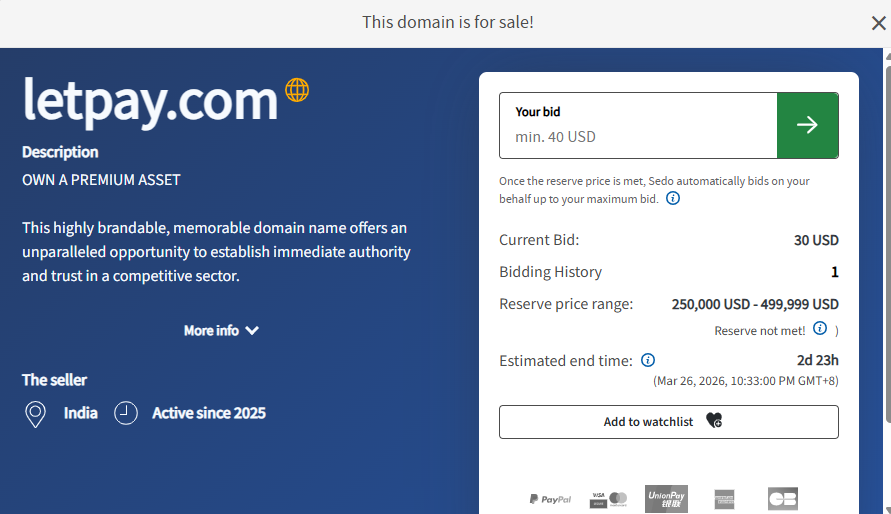
| Domain | LetPay.com |
| Registration Date | 2005 |
| Renewal Paid Through | 2033 (8 years prepaid) |
| Seller Location | India |
| Sedo Member Since | 2025 |
| Auction Type | Sedo auction with reserve |
| Reserve Range | $250,000 – $499,999 |
| Actual Bids | 1 bid at $30 |
| Seller’s Cost | $59 auction listing fee (wasted) |
| The Pitch | “Premium asset… instant credibility… SEO advantage… brand authority… type‑in traffic” |
| The Disclaimer | A full paragraph clarifying no affiliation with any existing trademark holders (because they know it’s a risk) |
Introduction: The Auction That Told the Whole Story
There’s a lot to unpack with LetPay.com. An aged domain (2005). A seller who just started domaining in 2025. A reserve price that would make a seasoned investor blush. And an auction result so embarrassing it’s almost poetic.
Let’s start with the auction itself.
The seller paid $59 to run a Sedo auction. They set a reserve between $250,000 and $499,999. They wrote a polished pitch about “instant credibility,” “SEO advantage,” and “type‑in traffic.”
The result? One bid. $30. That’s it.
The auction ended. The reserve wasn’t met. The domain didn’t sell. The seller wasted $59 and got nothing but a public record of how little the market values their “premium asset.”
Sometimes the market speaks so clearly that a roast almost writes itself.
The Seller: New to Domaining, Old to the Domain
The seller is based in India and joined Sedo in 2025. That’s last year. They’re new to the game—which explains the fantasy pricing, the buzzword‑heavy pitch, and the lack of market awareness.
But here’s where it gets interesting: the domain itself was registered in 2005. That’s 20 years ago. So the seller didn’t register it—they acquired it recently, probably from an expired auction or a closeout, and are now trying to flip it at a massive markup.
The question: Did they pay a few hundred dollars for a 2005‑registered domain and decide it was worth $250,000? Or did they inherit it somehow and assume age alone equals value?
Either way, they’ve prepaid renewals through 2033—eight years of holding costs on a domain that just attracted a single $30 bid. That’s either confidence or sunk‑cost fallacy. Given the auction result, we know which one.
The Auction Fiasco: $30 vs. $250,000
Let’s sit with this for a moment.
The seller set a reserve starting at $250,000. The market responded with a single bid of $30. That’s not a lowball—that’s a signal.
In auction theory, the opening bid reflects the highest price someone is willing to pay at that moment. The fact that only one person bid, and that bid was $30, tells you everything about the domain’s actual market value.
The seller paid $59 for the privilege of learning that.
Now, $30 is obviously too low for a 20‑year‑old .com with a decent word combination. But it’s also a far cry from $250,000. The real value lies somewhere in between—probably in the low four figures—but the auction result suggests even that might be optimistic without the right buyer.
The Pitch: Buzzword Bingo With a Side of Legal Cover
Let’s look at the seller’s pitch, because it’s a masterclass in overpromising:
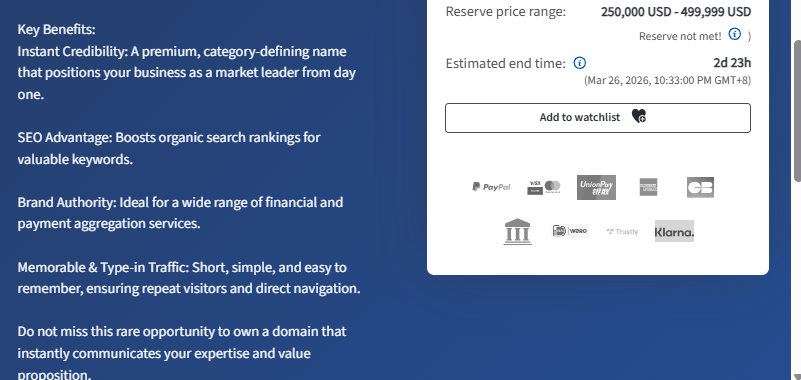
“This highly brandable, memorable domain name offers an unparalleled opportunity to establish immediate authority and trust in a competitive sector.”
Translation: It’s a .com with two common words. Nothing more.
“Instant Credibility: A premium, category‑defining name that positions your business as a market leader from day one.”
What category does “LetPay” define? Letting people pay? It’s descriptive, not “category‑defining.”
“SEO Advantage: Boosts organic search rankings for valuable keywords.”
This is a myth. Exact‑match domains haven’t carried significant SEO weight in over a decade. Google devalued them years ago.
“Memorable & Type‑in Traffic: Short, simple, and easy to remember, ensuring repeat visitors and direct navigation.”
“LetPay” is short. It’s also ambiguous—does it mean “let people pay” or “let (as in lease) payment”? The type‑in traffic argument is also outdated; people don’t type random word combinations into browsers anymore.
Then there’s the disclaimer—a full paragraph that reads like a lawyer’s CYA note:
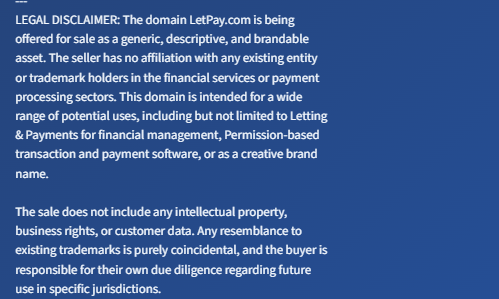
“The seller has no affiliation with any existing entity or trademark holders in the financial services or payment processing sectors. … Any resemblance to existing trademarks is purely coincidental…”
This is the part that makes us raise an eyebrow. Why the elaborate disclaimer? Because the seller knows there’s a trademark risk.
A quick search for “LetPay” reveals multiple payment‑related services using similar names. The disclaimer doesn’t protect the buyer from a UDRP. It just shifts the liability.
The Defequer Analysis: Why LetPay.com Isn’t Worth $250,000
Factor 1: The Age Paradox – Old Domain, New Seller
The domain was registered in 2005. That’s a legitimate asset—aged domains have inherent value if they have a clean history and some backlinks.
But here’s the catch: the seller didn’t own it for those 20 years. They acquired it recently. The age doesn’t transfer to them as credibility; it’s just a number. Without knowing the domain’s history—whether it was developed, whether it has backlinks, whether it was parked on spam pages—the age is just a data point, not a guarantee of value.
The seller prepaid renewals through 2033, which suggests they’re planning to hold it for a while. But holding a domain doesn’t make it more valuable; it just costs money.
Factor 2: The Trademark Risk – Why the Disclaimer Is a Red Flag
Let’s talk about that disclaimer.
When a seller goes out of their way to say “I have no affiliation with any existing entity or trademark holders” and “any resemblance is purely coincidental,” they’re telegraphing that they know there’s a risk.
A quick search shows multiple “LetPay” or “LetPay”‑adjacent financial services. If a trademark holder exists, the buyer could face a UDRP challenge. The disclaimer doesn’t protect them; it just tells them “you’re on your own.”
Factor 3: The Auction Result – The Market Has Spoken
The $30 bid is not a fluke. It’s the market telling the seller what this domain is worth to the only person willing to bid.
Yes, auctions can fail to capture true value if the right buyers don’t see it. But a single bid at 0.012% of the reserve is not “the right buyer missed it”—it’s “no one serious was interested.”
Factor 4: The Price – $250,000 for a Two‑Word .com
Let’s put that number in perspective.
$250,000 buys:
- A truly premium one‑word .com (like
Voice.comis $30M, but $250k gets you in the conversation for a strong generic) - A portfolio of 50‑100 quality domains
- A developed business with actual revenue
- A house in most cities
What it doesn’t buy is a two‑word .com with ambiguous meaning and a potential trademark problem. Even if “LetPay” were a perfect brand, $250,000 is far above what comparable domains sell for.
Factor 5: The “Type‑in Traffic” Myth
The seller claims the domain gets “type‑in traffic.” This is almost certainly false.
Type‑in traffic exists for domains that are:
- Ultra‑short (
123.com,sex.com) - Ultra‑common dictionary words (
car.com,hotel.com) - Established brands people already know
“LetPay.com” is none of these. No one is waking up and typing “let pay” into their browser. The traffic argument is a relic from the early 2000s that sellers trot out to justify fantasy pricing.
What the Seller Got Right (and Wrong)
Let’s give credit where it’s due:
What they got right:
- It’s a .com
- It’s short (6 letters)
- It was registered in 2005 (age has some value)
- The pitch is well‑written (even if it’s overblown)
What they got wrong:
- The price (by a factor of 50‑100x)
- The trademark risk (the disclaimer is a giveaway)
- The “type‑in traffic” claim (unsubstantiated)
- The auction strategy ($59 auction listing fee for a $30 bid is a bad ROI)
- The prepaid renewals (eight years of holding costs on a domain that just bombed)
The Delusion Index: 8/10
| Factor | Rating | Explanation |
|---|---|---|
| Domain Age | 7/10 | 2005 registration is legit, but the seller didn’t own it that whole time. |
| Trademark Risk | 3/10 | The disclaimer suggests they know there’s exposure. |
| Auction Result | 1/10 | One $30 bid on a $250k reserve is devastating. |
| Price Sanity | 1/10 | $250k is 50‑100x the actual value. |
| Seller Experience | 2/10 | Joined 2025, already making classic newbie mistakes. |
Overall Delusion Index: 8/10
This is a high score because the seller paid for an auction, got humiliated by the result, and still seems to believe the domain is worth a quarter million dollars. The disclaimer alone tells you they know there’s a problem—they just hope someone else won’t notice.
What LetPay.com Is Actually Worth
Let’s do the math the seller should have done.
Factors in its favor:
- 2005 registration (if the history is clean)
- Short .com
- “Let” + “Pay” has some conceptual value
Factors against it:
- Trademark risk
- Ambiguous meaning (let as in “allow” vs. let as in “lease”)
- No evidence of traffic or backlinks
- Auction result shows minimal market interest
Realistic price range: $2,000 at most
At the high end, to a buyer who sees a clear use case (e.g., a lease‑payment platform or a permission‑based payment system) and is willing to ignore the trademark risk. At the low end, to a domain investor who wants to sit on it for a few years.
$250,000 is not just optimistic—it’s 125x the actual value. The auction result proved it.
The Defequer Verdict
| Category | Rating |
|---|---|
| Domain Age | ⭐⭐⭐☆☆ (3/5 – aged, but unknown history) |
| Brandability | ⭐⭐☆☆☆ (2/5 – ambiguous meaning) |
| Trademark Safety | ⭐⭐☆☆☆ (2/5 – disclaimer screams risk) |
| Price Sanity | ⭐☆☆☆☆ (1/5) |
| Auction Strategy | ⭐☆☆☆☆ (1/5 – $59 for a $30 bid) |
Final Word:
“LetPay.com is a 20‑year‑old domain that just got treated like a 20‑day‑old hand‑reg. The seller, who joined Sedo in 2025, paid $59 to run an auction with a $250,000 reserve. The market responded with one bid: $30. That’s not a lowball—it’s a verdict. The seller prepaid renewals through 2033, wrote a pitch full of outdated SEO myths, and added a legal disclaimer that practically admits trademark risk. The only thing ‘premium’ about this listing is the gap between expectation and reality.”
What Should Actually Happen
If the seller is reading this (and we hope he is):
- Cancel any future auctions. You’ve already learned the lesson—don’t pay to learn it again.
- Drop the price to $4,995. See if there’s interest. If not, drop again.
- Investigate the domain’s history. Use Archive.org and backlink tools. Find out if the 20 years of age actually mean anything.
- Ditch the “type‑in traffic” and “SEO advantage” claims. They’re not true, and they make you look like you don’t know the market.
- Address the trademark risk honestly. Either research whether “LetPay” is trademarked in payment classes, or disclose it clearly so buyers know what they’re getting into.
For buyers: If you’re interested in LetPay.com, make an offer at $500. The auction result gives you all the leverage you need. And do your own trademark search before buying.
The Bottom Line
LetPay.com joins the Defequer Hall of Shame as a case study in auction‑funded delusion.
A seller new to domaining. An aged domain with an unknown history. A fantasy reserve. A $59 auction fee. One bid at $30. The market couldn’t have been clearer if it had sent a registered letter.
Defequer Rating: 💩💩💩💩 (4/5 shits – the auction result is the final piece of evidence that makes this roast sing.)