
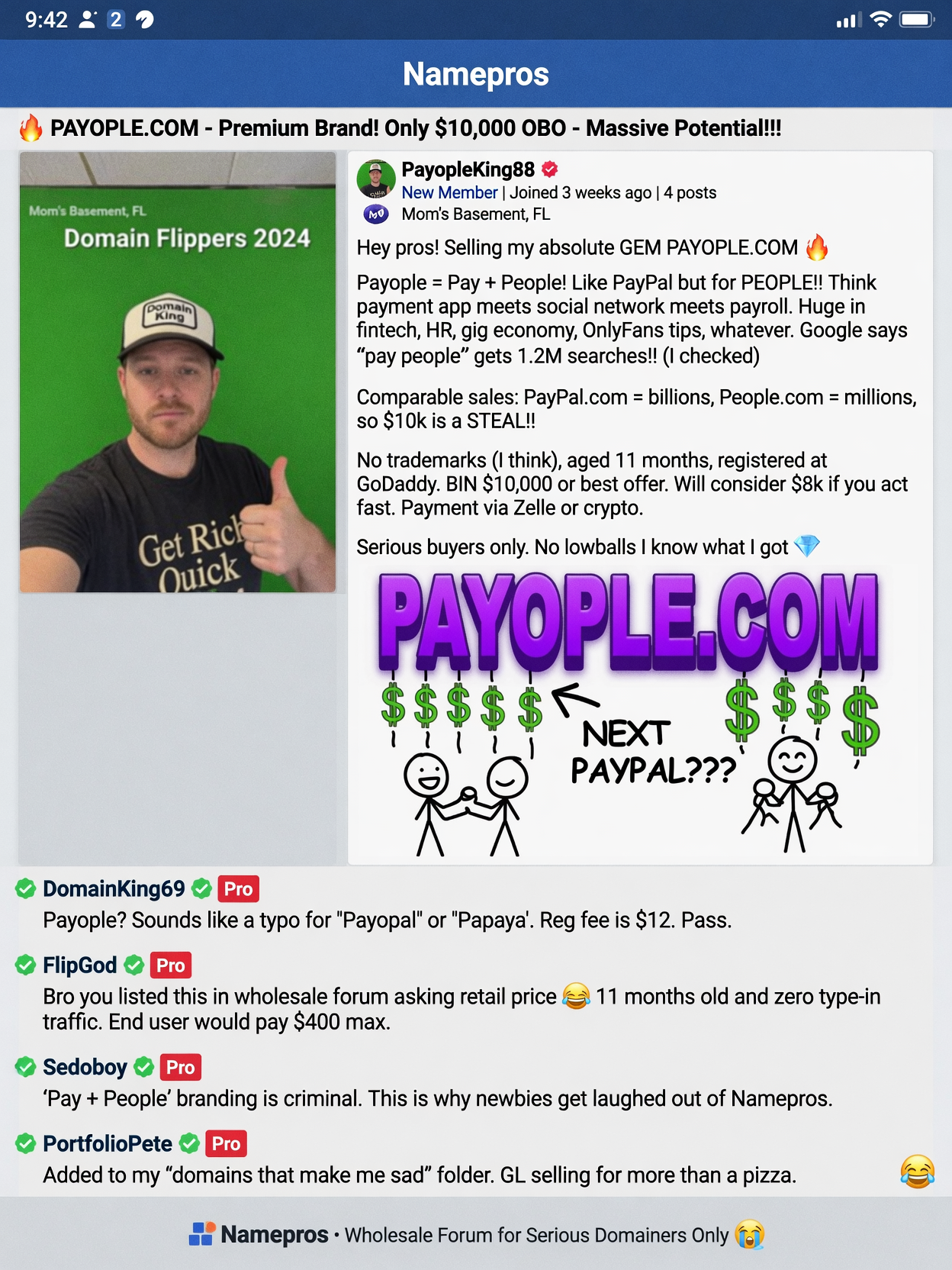
The Contender
| Metric | Details |
|---|---|
| Domain | Payople.com |
| Seller | Adityya |
| Platform | NamePros |
| Asking Price | $10,000 |
| The Pitch | *“A classic ‘Portmanteau’ (a blend of words) that combines Pay + People. It’s the perfect name for the Social Finance (SocialFi) or P2P Payment era.”* |
| The Hype | “In a trillion‑dollar digital payment market, a name is your strongest currency. Payople.com is a high‑liquidity, 7‑letter brandable domain that perfectly captures the P2P and Payroll sectors.” |
Introduction: When Portmanteaus Go Wrong
There’s a special kind of domain optimism reserved for the person who discovers the concept of a portmanteau and thinks they’ve found the cheat code to domain riches.
“Pay” + “People” = Payople. It’s math. It’s clever. It’s… unpronounceable.
Let’s say the name out loud. Pay‑op‑ul. Pay‑oh‑ple. Pay‑op‑lee. There’s no consensus because the blend doesn’t flow. A good portmanteau melts into something natural: “Brunch” (breakfast + lunch), “Motel” (motor + hotel), “Podcast” (iPod + broadcast). You hear them once and you know how to say them.
Payople sounds like someone started to say “people” and got distracted halfway through. It’s not a natural blend—it’s a collision.
And the seller wants $10,000 for it.
The Defequer Analysis: Why Payople.com Isn’t Worth $10,000
Factor 1: The Portmanteau Problem – Does It Actually Work?
Let’s break down the math.
| Component | Pay | People |
|---|---|---|
| Contribution | Full word “pay” | First three letters “peo” (with a twist) |
| Result | Pay + ople |
Here’s the issue: “Payople” isn’t a smooth blend. It keeps the hard “ay” from “pay” and crashes it into “ople,” which is not the natural start of “people.” A better blend would be something like “Peepay” or “Payple”—but those are either taken or equally awkward.
The seller calls it a “classic” portmanteau. Classic portmanteaus are seamless. This one has a visible seam that catches your mental tongue every time.
Factor 2: The Pronunciation Crisis – Can You Say It?
Try saying “Payople” to a friend and ask them to spell it. Record the results.
Likely outcomes:
- “Payople? Is that P‑A‑Y‑O‑P‑L‑E?”
- “P‑A‑Y‑O‑P‑P‑L‑E? Wait, is it people with a Y?”
- “Oh, you mean ‘people’ with a ‘pay’ in front? That’s… Payople? Weird.”
A domain that requires explanation is a domain that loses traffic. Word‑of‑mouth marketing is the cheapest and most effective form of promotion—and Payople.com kills it dead.
Factor 3: The SocialFi/P2P Market – Who Would Actually Use This?
Let’s imagine the potential buyers in the “trillion‑dollar digital payment market” the seller mentions.
| Potential Buyer | Why It Won’t Happen |
|---|---|
| A Venmo competitor | They’d choose something short, memorable, and natural. “Payople” sounds like a typo. |
| A payroll startup | They’d want something professional, like “PayrollHub.com” or a brandable that conveys trust. “Payople” sounds like a children’s app. |
| A SocialFi platform | The crypto/SocialFi space loves brandable names, but they tend toward short, edgy, or abstract. “Payople” is none of these. |
| A domain investor | Not at $10,000. Maybe at $500 as a speculative play, but not at five figures. |
The seller is banking on the “trillion‑dollar market” to justify the price. But a rising tide doesn’t float every boat—especially one that leaks credibility.
Factor 4: The Price – $10,000 for a Made‑Up Word
Let’s talk about the number.
$10,000 is not a fantasy like $500,000 for a hand‑reg. But it’s serious money for a domain that:
- Has no history or traffic
- Is a made‑up word
- Has pronunciation ambiguity
- Has no clear end‑user industry
- Has no comparable sales to back it up
What does $10,000 buy in the domain market?
- A strong two‑word .com with commercial intent
- A premium one‑word .io or .co
- A portfolio of 5‑10 quality brandables
- A developed website with actual traffic
What it doesn’t buy is “Payople.com.”
Factor 5: The “High‑Liquidity” Buzzword
The seller describes the domain as a “high‑liquidity, 7‑letter brandable domain.”
“High‑liquidity” is a financial term meaning easily convertible to cash. In domain investing, high‑liquidity domains are things like one‑word .coms, short numeric .coms, or established categories like insurance.com. They sell quickly when priced right.
Payople.com is the opposite of high‑liquidity. It’s a made‑up word with no natural buyers. It could sit for years at $10,000 without a single inquiry. That’s the definition of illiquid.
The Seller’s Pitch: Marketing Speak vs. Reality
Let’s translate the seller’s description from Marketing‑Speak to English.
| What They Said | What It Means |
|---|---|
| “Classic portmanteau” | I put two words together. |
| “Perfect name for SocialFi or P2P Payment era” | I’m hoping the crypto/payment trend lifts this name. |
| “In a trillion‑dollar market, a name is your strongest currency” | The market is big, so my domain must be valuable. (Non sequitur.) |
| “High‑liquidity, 7‑letter brandable domain” | It’s short. That’s the only fact here. |
| “Perfectly captures the P2P and Payroll sectors” | It has “pay” in it. |
The pitch is designed to sound sophisticated, but it’s all surface. There’s no data, no comparable sales, no end‑user analysis—just buzzwords wrapped around a domain that doesn’t quite work.
The “Payople” Test: Would You Trust This With Your Money?
Let’s run a simple test.
Imagine you’re building a peer‑to‑peer payment app. You need a name that conveys:
- Trust
- Speed
- Simplicity
- Security
You’re choosing between:
- Venmo – short, catchy, established
- PayPal – clear, trusted, decades old
- CashApp – direct, functional
- Payople – ???
Which one inspires confidence? Which one would you trust with your bank account?
Payople doesn’t pass the test. It sounds like a project name, not a product name. It’s the kind of domain you register as a placeholder while you think of something better—not something you pay $10,000 for.
The Delusion Index: 7/10
| Factor | Rating | Explanation |
|---|---|---|
| Portmanteau Quality | 3/10 | The blend is awkward and doesn’t flow. |
| Pronunciation | 2/10 | No consensus on how to say it. |
| Commercial Relevance | 3/10 | It has “pay” in it, but the rest is noise. |
| Price Sanity | 2/10 | $10,000 for a made‑up word with no history is wildly optimistic. |
| Seller Hype | 4/10 | The pitch is well‑written, but it’s dressing up a weak name. |
Overall Delusion Index: 7/10
This isn’t a 9+ because the price isn’t completely insane—$10,000 is a stretch, not a fantasy. But the domain itself is weak, and the seller is trying to dress it up in buzzwords that don’t fit.
What Payople.com Is Actually Worth
Let’s do the math the seller should have done.
Factors to consider:
- Made‑up word with weak portmanteau
- No history or traffic
- Unclear pronunciation
- No established end‑user market
- 7 letters (short, which is a plus)
Realistic price range: $200 – $800
At the high end, to a domain investor who sees potential in the “pay” angle and wants to take a flyer. At the low end, to someone who likes the idea but isn’t willing to pay a premium.
$10,000 is not just optimistic—it’s 12‑50x the actual value.
The NamePros Context
The seller posted this in the “Domain Names” section with a “priced” prefix. No replies as of this writing. That’s not unusual—many listings go unanswered—but it’s worth noting that the NamePros community, which is generally supportive of brandable domains, hasn’t engaged with this one.
Sometimes silence is the market speaking.
The Defequer Verdict
| Category | Rating |
|---|---|
| Portmanteau Quality | ⭐⭐☆☆☆ (2/5) |
| Pronunciation | ⭐⭐☆☆☆ (2/5) |
| Commercial Relevance | ⭐⭐☆☆☆ (2/5) |
| Price Sanity | ⭐⭐☆☆☆ (2/5) |
| Seller Pitch | ⭐⭐⭐☆☆ (3/5 – well‑written, but doesn’t match the domain) |
Final Word:
*“Payople.com is a portmanteau that forgot to be memorable. Pay + People sounds good on paper, but say it out loud. Pay‑op‑ul. Pay‑oh‑ple. Pay‑op‑lee. There’s no natural flow because the blend is forced. The seller is banking on the trillion‑dollar payment market to carry a name that doesn’t inspire trust or confidence. At $10,000, they’re asking for a premium price on a domain that doesn’t pass the pronunciation test. The pitch is well‑written. The math is clever. The domain itself? It’s a collision, not a blend.”*
What Should Actually Happen
If the seller is reading this (and we hope Adityya is):
- Drop the price to $495. Test the market at a level where a curious buyer might take a chance.
- Reconsider the portmanteau. If you’re going to blend “pay” and “people,” make it smoother. “Payple” would be better. (It’s taken, but that’s the point.)
- Lose the “high‑liquidity” buzzword. It doesn’t mean what you think it means in this context.
- Target a specific niche. Who actually wants this? Children’s finance app? Pocket money tracker? Be specific.
- Be patient but realistic. A made‑up word domain can sell—but it needs the right buyer at the right price.
For buyers: If you see potential in “Payople” (maybe for a kids’ finance app or a playful payment tool), make an offer at $200. The seller might be ready to deal.
The Bottom Line
Payople.com joins the Defequer Hall of Shame as a case study in portmanteau optimism.
The math is there. The market is big. The pitch is polished. But the domain itself doesn’t deliver. It’s awkward to say, hard to remember, and priced like it’s already a success.
A good portmanteau disappears into the language. Payople.com doesn’t disappear—it sticks out, and not in a good way.
Defequer Rating: 💩💩💩 (3/5 shits – a solid effort, but the name doesn’t carry the price.)