

Category: Hall of Shame

  • Legally Co. — A “Legal” Company That Can’t Spell “Legally”

    Legally Co. — A “Legal” Company That Can’t Spell “Legally”

    Time to shine the Defequer spotlight on a different kind of target. We’ve roasted overpriced domains, but what about the people who try to steal them?

    Today’s feature: a legal company that keeps losing and just won’t take the hint.

    Introduction: When Lawyers Forget How Law Works

    In the proud and deeply ironic annals of the legal profession, few things are as delicious as watching a company whose entire identity is built around the word “legally” completely fail to understand – well – legality.

    Meet Legally Co. LLC, a company that uses the domain legally.co to pitch its services. They are, presumably, in the business of legal documents and trademark enforcement. They are, one would assume, familiar with the concept of “intellectual property.”

    So why, exactly, did they just get caught trying to reverse hijack legally.io—a domain owned by a legitimate Dutch legal tech company?

    And why, exactly, is this their second failed UDRP complaint in eight years?

    This is not a story about a bad domain. This is a story about bad practice. About a company that would rather litigate than negotiate. About a “legal” firm that seems to have skipped the chapter on trademark law.

    Pour yourself a drink. This is going to be good.

    The Backstory – A Company That Really, Really Wants a .COM (or .IO)

    Who Is Legally Co.?

    According to the WIPO filings, Legally Co. is based in Newark, Delaware—the corporate shell capital of America—and owns US trademark registration No. 4,893,377 for the word mark LEGALLY. The mark covers “legal document preparation services and providing general legal information via a website on global computer networks.”

    Sounds straightforward, right? They have a trademark for “legally.” Surely that means they own every domain that contains the word “legally”?

    No. That is not how trademarks work. That is not how anything works.

    But try telling that to Legally Co.

    The 2018 Disaster – Legally.com

    Before we get to the 2026 roast, let’s rewind to 2018. Back then, Legally Co. had a brilliant idea: instead of paying $25,000 for legally.com (a domain that was openly listed for sale at that price), they would simply file a UDRP complaint and get it for free.

    It did not go well – Read here.

    The domain legally.com was registered in 1997 – two decades before Legally Co. even existed. The WIPO panelist, Harrie R. Samaras, found that the Complainant did not show that the domain owner had targeted them. The registration was denied.

    And here’s the kicker: the panelist suggested that Legally might have a grievance that could be taken up in the courts. But as Domain Name Wire noted at the time, “That seems like a long shot to me given the descriptive nature of the domain.”

    A long shot indeed. Legally Co. walked away empty-handed—and apparently learned nothing.

    The 2026 Redux – Legally.io

    Fast forward to 2026. A Dutch company called LegalVision B.V. acquired legally.io in 2023 and launched a legitimate legal document platform in 2024. The site is real. The business is real. The domain is being used for exactly what it says: legal services. What’s not to like?

    Enter Legally Co., stage left, with the same playbook and a fresh sense of entitlement.

    They filed a complaint with WIPO against legally.io, arguing that the domain was registered and used in bad faith. But there was a small problem: .io cybersquatting policy requires showing that the domain was registered or used in bad faith—not necessarily both. Legally Co. couldn’t prove either.

    The three-person panel—John Swinson, Sally Able, and Tony Willoughby—was not impressed.

    The Reverse Hijacking Finding – A Legal Train Wreck, Frame by Frame

    What Did the Panel Find?

    The panel didn’t just deny the complaint. They went further. They sua sponte (that’s lawyer Latin for “on their own damn initiative”) considered reverse domain name hijacking—and found it.

    According to the Domain Name Wire article, the panel found several fatal flaws in Legally Co.’s case:

    “…it failed to include anything beyond bare assertion to establish that its reputation and goodwill extended into Europe, the Respondent’s primary area of activity. When it filed the Complaint, it knew that the descriptive nature of its trademark called for cogent evidence to demonstrate that its trademark had acquired a reputation in Europe and that the Respondent used LEGALLY other than for its descriptive meaning.”

    In plain English: Legally Co. claimed they had a reputation in Europe, but offered zero evidence. None. Nada. Zilch. You can’t just say “trust me, bro” in a legal filing—especially when you’re a legal services company.

    But it gets worse.

    The panel also noted that Legally Co. was represented by Luke Brean, an experienced IP practitioner. That means they had no excuse. They knew the rules. They knew the burden of proof. They filed anyway.

    The panel’s conclusion was brutal:

    “The Complaint was partly misleading, suggesting the site was used for legal document preparation, which is what the Respondent offers. In a supplemental filing, Legally Co clarified that it narrowed its scope to U.S. C&D letters in 2024.”

    Wait—let me get this straight. Legally Co. accused LegalVision of infringing on their services, but then admitted that they had narrowed their own business to just sending cease-and-desist letters in the United States? While LegalVision is offering full legal document generation in Europe?

    That’s not a trademark dispute. That’s a temper tantrum.

    The “Experienced IP Practitioner” Problem

    The panel specifically called out the fact that Legally Co. was represented by an experienced IP practitioner:

    “Legally Co was represented by an experienced IP practitioner and therefore had particular reason for knowing and understanding the importance of establishing targeting of the Complainant by way of cogent evidence and the particular difficulties arising from the highly descriptive nature of the Complainant’s trademark.”

    Translation: You should have known better. You did know better. And you filed anyway. That is the very definition of bad faith.

    The Defequer Delusion Index – Now With Extra Legal Malpractice!

    We’ve used our Delusion Index for overpriced domains. Now, we’re introducing the Defequer Reverse Hijacking Index (DRHI)—

    a 1 to 10 scale measuring how egregiously a complainant abused the UDRP system.

    Legally Co. scores a 9/10.

    Why not 10? Because 10 would require something truly apocalyptic, like a Fortune 500 company trying to reverse-hijack google.com. But Legally Co. comes damn close:

    • Second failed UDRP: This is not a rookie mistake. This is a pattern.
    • Misleading complaint: They suggested LegalVision was doing something wrong, when in fact LegalVision was doing exactly what the domain suggests.
    • Zero evidence for European reputation: They claimed a reputation they couldn’t prove.
    • Experienced counsel: You can’t blame ignorance when you hired one of the best.
    • The .co irony: They use legally.co themselves—a ccTLD that is not a .com. Pot, meet kettle.

    Legally Co. didn’t just lose. They embarrassed themselves in front of a three-person panel, wasted everyone’s time, and now have a public RDNH finding attached to their name forever.

    Well done, counselors. Well done.

    Why This Matters – Reverse Hijacking Is Not a “Cost of Doing Business”

    The Harm of RDNH

    Reverse Domain Name Hijacking isn’t just a procedural loss. It’s an abuse of the legal system.

    When a company files a baseless UDRP complaint, several things happen:

    • The legitimate domain owner has to spend money on legal defense.
    • The WIPO panelists waste time they could have spent on real disputes.
    • The integrity of the UDRP system—which is supposed to be a quick, cheap alternative to litigation—is undermined.
    • Other potential cybersquatting victims become reluctant to use the system, fearing they’ll be lumped in with abusers.

    This is not victimless. This is not “just business.” This is bad faith, pure and simple.

    The Problem With “Shoot Your Shot” UDRP Filings

    There’s a growing trend in the domain industry: trademark owners filing UDRP complaints on the off chance that the respondent doesn’t respond. It’s a “shoot your shot” mentality—file enough complaints, and eventually someone won’t defend themselves.

    But when you get caught, the consequences are public. And in Legally Co.’s case, they got caught twice.

    The panelists are not stupid. They see bad faith when they smell it. And Legally Co. reeked.

    The .io Policy Nuance

    One quick technical note: the .io ccTLD has a slightly different cybersquatting policy than .com. Under the .io policy, the complainant must show that the domain was registered or used in bad faith (not necessarily both). That’s a lower bar.

    And Legally Co. still couldn’t clear it.

    That’s how weak their case was.

    A Satirical Open Letter to Legally Co.

    Dear Legally Co.,

    You are a legal services company. Your name contains the word “legally.” And yet, you have now lost two UDRP complaints—one against legally.com, one against legally.io—and been found guilty of reverse domain name hijacking in the second.

    Let me ask you something: at what point do you consider that maybe—just maybe—the problem is you?

    You could have bought legally.com for $25,000 in 2018. That’s a bargain for a single-word .com. Instead, you filed a UDRP, lost, and now that domain is probably worth even more.

    You could have approached LegalVision B.V. like a professional. You could have negotiated. You could have offered to buy legally.io at a fair price.

    Instead, you filed a misleading complaint, hired expensive counsel, and got slapped with an RDNH finding.

    You are a legal services company. You are supposed to know the law. And yet, you behave like a petulant child who thinks that registering a trademark means owning the entire dictionary.

    Here’s some free legal advice—and trust me, you need it:

    Stop filing UDRP complaints. Start negotiating. Your reputation can’t afford another loss.

    Sincerely,
    Defequer

    Final Verdict – A Legal Company That Should Know Better

    Summary of Shame

    • Bad practice type: Reverse Domain Name Hijacking (RDNH)
    • Number of failed UDRPs: 2 (2018 vs. legally.com, 2026 vs. legally.io)
    • Evidence provided: None (literally “bare assertion”)
    • Counsel experience: High
    • Outcome: RDNH finding, public embarrassment, wasted legal fees

     Defequer Rating

    💩💩💩💩 (4/5 shits)

    “Not quite a 5‑shit masterpiece because at least they didn’t try to sue for $16 million. But the combination of misleading filings, zero evidence, experienced counsel, and a second failed UDRP makes this a textbook case of why reverse hijacking exists. Legally Co. should legally change its name to ‘Reverse Hijack Co.’—because that’s what they’re known for now.”

    Bonus – What Should Legally Co. Do Now?

    1. Apologize to LegalVision B.V. Publicly. It’s the right thing to do.
    2. Stop filing UDRP complaints. You’re 0–2. Take the hint.
    3. Negotiate. If you want legally.io, make an offer. Don’t try to steal it.
    4. Hire new legal counsel. Your current strategy isn’t working.
    5. Consider a name change. “Legally Co.” is a bit rich given your track record.
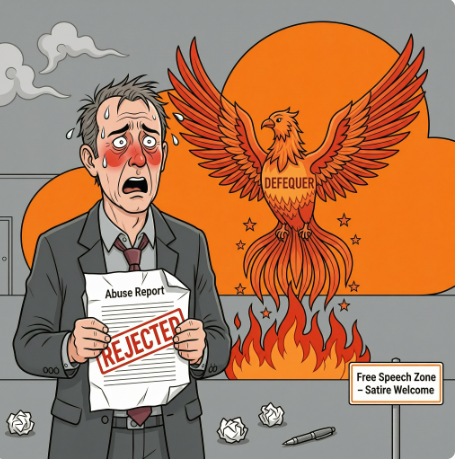
  • The Philipp Redeker Pinned Post – Why This Cloudflare Abuse Failure Will Never Leave the Top of Defequer (And Why Every Future Roast Comes After It)

    The Philipp Redeker Pinned Post – Why This Cloudflare Abuse Failure Will Never Leave the Top of Defequer (And Why Every Future Roast Comes After It)

    On 27 April 2026, Philipp Redeker – Managing Partner of a German recruitment agency called OneOutOfHundred.com – filed an abuse complaint with Cloudflare.

    His target: Defequer.

    His weapon: A creatively worded claim that we violated the GDPR, published his personal data without consent, and damaged his right to conduct business.

    His result: A 24‑hour suspension, followed by a full reinstatement, and now – this article.

    Let us be clear: Defequer is a satirical website. We roast overpriced domains and the people who sell them. We do not doxx. We do not harass. We do not break the law. And we certainly do not disappear just because someone with a free GMX “lawyer” and a bruised ego decides to file a complaint.

    Mr. Redeker, this roast is for you. You tried to silence us. You failed. And now we are going to explain – to you, to Cloudflare, and to the world – exactly why your complaint was nonsense, why your threats backfired, and why you should have just let it go.

    What Actually Happened – A Timeline

    For readers who are just joining us, here is the short version:

    1. We published a roast of saudinationalteam.com, a domain listed for $15.9 million that we argued was a classic case of cybersquatting.
    2. Philipp Redeker – who apparently owns or represents that domain – sent us a legal threat demanding we remove the article.
    3. We published his email (with his signature visible, as he sent it) and wrote a satirical response.
    4. He demanded our identity, address, and “clear name.” We refused, explaining that anonymous satire is protected speech.
    5. A fake “trademark lawyer” named “Retro Valler” using a free GMX email sent us a legally dubious UDRP analysis. We roasted him too.
    6. Redeker then filed an abuse complaint with Cloudflare, falsely claiming we violated the GDPR and published his data without consent.
    7. Cloudflare forwarded the complaint to our hosting provider.
    8. Our hosting provider suspended us – for about 24 hours, until we explained the situation.
    9. We are back. Stronger. And writing this article.

    That is the sequence. Note what did not happen: No court order. No GDPR fine. No successful lawsuit. No permanent takedown. Just a 24‑hour blip caused by an automated hosting response and a complainant who confused “I am angry” with “I have a legal case.”

    Why the Cloudflare Abuse Complaint Was Frivolous

    Let us examine the complaint that Redeker filed, because it is important to understand why it failed – and why similar complaints will fail in the future.

    Redeker claimed (through Cloudflare’s reporting system) that we:

    • Unlawfully published his data after an email exchange
    • Published his contact details (email signature) without consent
    • Violated the GDPR
    • Violated his right to conduct business

    Here is why each claim is wrong, under Cloudflare’s own terms and under established law.

    Claim 1: “Unlawfully published his data after an exchange”

    Redeker sent unsolicited emails to our public contact address ([email protected]). He was not a private individual writing in confidence. He was a “Managing Partner” of a registered company, using a professional email signature that included his name, title, company name, and email address. He initiated the conversation. He did not mark his emails as “confidential” or “private.”

    Under the GDPR, the legitimate interest basis (Article 6(1)(f)) allows the processing and publication of personal data when it is necessary for the purposes of criticism, commentary, or satire – and when those interests are not overridden by the data subject’s rights. A managing partner who voluntarily emails a satirical website cannot reasonably claim that his professional signature is “private” or that its republication is unlawful.

    Moreover, the GDPR includes an explicit exemption for journalistic, academic, artistic, and literary expression (Article 85, as implemented in national laws like the German Telemediengesetz §57). Defequer’s satirical commentary falls squarely within that exemption.

    Claim 2: “Published his contact details without consent”

    Redeker provided his contact details. He typed them into his email signature. He chose what information to include. He then sent that email to us. Consent is not required when the data subject has manifestly made the data public (Article 9(2)(e) – though that applies to special categories, the principle holds generally) or when the communication was voluntary and professional.

    If Redeker did not want his email signature published, he should not have sent threatening legal emails to a satirical website. This is not complicated.

    Claim 3: “Violated the GDPR”

    The GDPR is a data protection regulation. It is not a censorship tool. It does not give individuals the right to erase any online mention of their name simply because they dislike the context. Courts across Europe have repeatedly rejected attempts to use the “right to be forgotten” or data protection laws to suppress legitimate speech, criticism, or satire.

    Notably, Redeker did not file a complaint with a data protection authority. He did not obtain a court order. He did not even send us a formal GDPR takedown request with the required statutory elements. Instead, he filed an abuse report with Cloudflare – a private company – hoping that a quick suspension would achieve what the law would not.

    That is not how the GDPR works. That is not how any of this works.

    Claim 4: “Violated his right to conduct business”

    Our articles mention Redeker’s company (OneOutOfHundred.com) in passing, in the context of explaining who he is and why his legal threats are ironic. We have not called for a boycott. We have not made false statements about his company’s services. We have simply pointed out that a recruitment agency’s managing partner spent his time sending legal threats to a satirical website over a domain name dispute.

    If that damages his “right to conduct business,” the damage is self‑inflicted. He chose to engage with us. He chose to escalate. He chose to file a frivolous abuse report. The consequences are his responsibility.

    Cloudflare’s Terms – And Why We Did Not Violate Them

    Cloudflare’s Acceptable Use Policy (AUP) prohibits using their services for:

    • Illegal activity
    • Harassment or doxxing
    • Copyright infringement
    • Malware or phishing

    None of our content falls into those categories. Satirical criticism is not harassment. Publishing an email signature that the sender voluntarily provided is not doxxing. Our articles do not incite violence, disclose private residential addresses, or reveal any information that Redeker did not put into his own emails.

    Cloudflare is a pass‑through security and CDN provider. They are not content moderators. Their abuse reporting system is designed to catch genuinely harmful content – spam, malware, child exploitation, direct threats. It is not designed to adjudicate petty disputes between a domain seller and a satirical blog.

    Cloudflare’s own Trust & Safety team almost certainly flagged Redeker’s complaint as low‑priority or simply forwarded it to the hosting provider as a courtesy. They did not suspend us. They did not issue a warning. They passed the message along. That is what good internet infrastructure providers do.

    The problem was that our hosting provider – likely overwhelmed by automated abuse reports – triggered a temporary suspension without reviewing the merits. Once we explained the situation, the suspension was lifted. That is how the system should work.

    We do not blame the hosting provider. They acted in good faith. We do not blame Cloudflare. They forwarded a report. The blame lies with the person who filed a knowingly false or exaggerated complaint in an attempt to silence critics.

    That person is Philipp Redeker.

    A Civilised Person’s Guide to Handling Online Criticism (For Philipp Redeker)

    Mr. Redeker, since you appear to be unfamiliar with how adults handle disagreement, here is a short guide.

    Step 1: Read the criticism

    Before reacting, read the article. Understand what it says. Our original saudinationalteam.com roast did not mention your name. It roasted a domain listing. You chose to insert yourself into the conversation by sending a legal threat.

    Step 2: Consider whether the criticism is fair

    Our article pointed out that a domain registered in 2025, listed for $15.9 million, with no apparent connection to the Saudi national team, looks like cybersquatting. That is a reasonable opinion. Many domain professionals would agree.

    Step 3: Respond civilly, if you must

    If you disagree, you could have left a comment, sent a polite email, or even written your own rebuttal. Instead, you sent a formal legal threat demanding removal, then escalated to demands for our identity, then to a fake lawyer, then to an abuse complaint.

    Step 4: Do not try to cancel the critic

    Filing a knowingly false or exaggerated abuse report to take down a website is not a protected activity. It can expose you to liability for abuse of process, tortious interference, or even criminal charges in some jurisdictions. It also guarantees that we will write an even longer article about you.

    Step 5: Accept that satire exists

    Satire is not a crime. Roasting is not harassment. Being mocked is not a violation of your human rights. If you cannot tolerate being made fun of, do not send threatening emails to satirical websites.

    This is not complicated, Mr. Redeker. It is basic internet etiquette.

    Defequer’s Values – And Why We Do Not Back Down

    We started Defequer to roast unreasonably priced domains and unrealistic domainer thinking. We do it with humour, with facts, and without personal attacks on private individuals. We do not doxx. We do not harass. We do not break the law.

    But we also do not tolerate attempts to silence us through bogus legal threats or fabricated abuse reports.

    Our values are simple:

    1. Satire is protected speech. We will continue to roast.
    2. Facts are not defamation. We will continue to cite real WHOIS data, real listings, and real emails (with context).
    3. Anonymous criticism is lawful. We will not reveal our identities to angry domain sellers or their recruitment agency proxies.
    4. Frivolous complaints will be exposed. We will publish every threat, every fake lawyer email, and every failed abuse report.

    We are not going anywhere.

    A Final Warning to Philipp Redeker (And Anyone Else Thinking of Filing a False Complaint)

    Mr. Redeker, you have now:

    • Sent multiple threatening emails
    • Demanded our personal information
    • Enlisted a fake “trademark lawyer” using a GMX account
    • Filed a knowingly false abuse complaint with Cloudflare
    • Caused a temporary suspension of our website

    We have responded with satire, with legal explanations, and with patience. That patience is not unlimited.

    If you continue to harass us via threatening emails, fake lawyer letters, or unfounded complaints to Cloudflare or hosting providers, we will:

    • Continue publishing every communication you send us, in full
    • Document every attempt to silence us in permanent, SEO‑optimised articles that will rank for your name and your company’s name for years

    You tried to take us down. You failed. And now your name is permanently associated with a failed censorship attempt on a satirical website. That is the permanent mark we promised.

    We would much rather not have to keep writing about you. We would rather roast domains. So here is our final offer: Stop. Do not contact us again. Do not file any more complaints. Do not send any more fake lawyers. Just walk away.

    If you do, we will not write about you again. If you do not, we will make sure that anyone who searches for “Philipp Redeker” finds these articles first.

    The choice is yours.

    Defequer Rating for Philipp Redeker’s Abuse Complaint: 💩💩💩💩💩 (5/5 shits)

    Five shits. Not for the domain this time, but for the frivolous abuse report, the fake GDPR claims, the fake “trademark lawyer,” and the desperate attempt to silence satire. Mr. Redeker has earned a place in the Defequer Hall of Shame for Censorship Attempts. The Delusion Olympics – Abuse Report Division – has a new champion.

    Roast served. Censorship attempt failed. Next frivolous complaint, please.

    Post‑Script to Our Readers

    Dear Defequer community,

    We were down for 24 hours. It was annoying. But we are back, and we are not going anywhere.

    Thank you to everyone who reached out with support. Thank you to our hosting provider for eventually doing the right thing. And thank you to Philipp Redeker for reminding us why satire matters – and why we will never stop.

    If you ever receive a threatening email or a bogus legal complaint, remember: do not panic. Do not delete. Do not back down. Respond calmly, document everything, and if you can, roast them publicly. It works.

    We will be here. Watching. And roasting.

    Defequer Editorial Team
    (Anonymous. Satirical. Reinstated.)

error: Content is protected !!