

There is a particular kind of domain investor who does not study markets – they study vibes. They see one extension mentioned in a forum thread, one sale reported in a newsletter, one influencer whispering about “the next big thing,” and they immediately register a handful of domains in that extension, convinced they have arrived early to a gold rush.
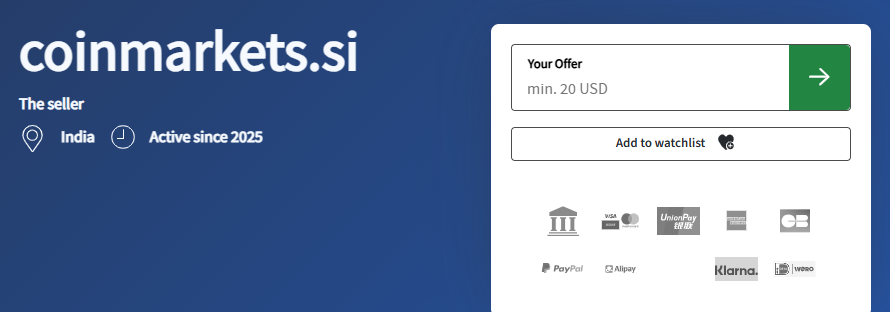
This week, Defequer found one of those investors on Sedo. The domain: coinmarkets.si. The seller: based in India, active in domaining since 2025. The listing format: “Make offer.” No price, no reserve, no auction – just a hopeful fishing line cast into the internet.
Because there is no price to roast, we will focus entirely on the domain itself. And the domain itself is a masterclass in trend‑chasing without a trend, keyword selection without a market, and extension choice without a clue.
Let us begin with the extension, because that is where the fantasy starts.
The .si Problem – Slovenia Is a Country, Not a Trend
Let us get the facts straight. .si is the country‑code top‑level domain (ccTLD) for Slovenia – a small Central European nation of roughly two million people. It is administered by ARNES, the Slovenian academic and research network. It is a legitimate extension with a real purpose: serving Slovenian websites, businesses, and institutions.
What it is not is a trend.
There is no .si gold rush. There is no wave of .si sales making headlines on NameBio. There is no community of domain investors swapping .si registrations like Pokémon cards. Public sales data for .si is sparse, and the reported sales that do exist are overwhelmingly Slovenian businesses buying Slovenian names for Slovenian audiences – not international investors flipping English keywords to each other.
So why would an investor in India, who started domaining in 2025, register coinmarkets.si?
The most charitable explanation is confusion. Perhaps they saw .si mentioned somewhere and mistook it for something else. Perhaps they confused it with .ai – which genuinely is a trend, driven by the artificial intelligence boom. Perhaps they saw the two letters, thought “that looks trendy,” and hit the register button without checking what the letters actually stand for.
The less charitable explanation is that they assumed any country‑code extension could be repurposed as a global brand. That assumption is wrong. Country‑code domains carry the identity of their country. A .si domain signals “Slovenia” to anyone who recognises it – and to everyone else, it signals “typo” or “I could not get the .com.”
Which brings us to the next problem: the name does not even fit the extension.
The Name–Extension Mismatch – English Keyword, Slovenian ccTLD
coinmarkets is an English phrase. It is plural. It reads like a directory, an aggregator, or a marketplace – not a brand. And it is bolted onto a Slovenian ccTLD.
This creates a fundamental mismatch. A Slovenian business would not use an English plural generic as its brand. A Slovenian crypto exchange would likely choose a Slovenian word, a short brandable, or – if it wanted international reach – a .com or .eu. An international crypto business would never choose .si, because the extension signals a market of two million people, not a global audience.
So who is the buyer supposed to be?
- A Slovenian crypto exchange? They would prefer a local, brandable name – not an English plural generic.
- An international crypto marketplace? They would use
.com,.io,.xyz, or.ai. Not.si. - A domain investor? They would look at the sparse
.sisales data and pass. - An end‑user building a “coin markets” directory? They would want the
.com, and if it were taken, they would choose a different name entirely rather than accept a country‑code extension that misrepresents their geography.
The domain sits in a no‑man’s‑land between local and global. It is too foreign for Slovenia and too obscure for everyone else. That is not a “premium geo‑service combination” – that is a positioning failure.
And then there is the wordplay problem. In Italian and Spanish, “si” means “yes.” A clever marketer could theoretically use .si as a pun – “coinmarkets, si!” But that requires a level of linguistic creativity that coinmarkets does not display. The plural generic kills the joke before it starts. CoinMarket.si might raise a smile. CoinMarkets.si just raises an eyebrow.
The Keyword – “Coinmarkets” Is a 2017 Word in a 2026 World
Let us talk about the keyword itself. “Coin markets” is crypto vocabulary from a previous era.
The domain “coin” peaked during the 2017 ICO boom and the 2021 bull run. During those years, investors registered thousands of CoinSomething.com domains, convinced that every crypto startup would need one. Most of them are still unsold. The market has since moved on – toward .ai, toward short brandables, toward .xyz for Web3 projects, and toward meaningful single words rather than generic “coin” compounds.
In 2026, “coinmarkets” is not a term that a modern crypto business would build on. The mental real estate is already occupied by CoinMarketCap – a brand so dominant that any variation on “coin market” invites confusion rather than opportunity. A startup called CoinMarkets would spend its entire marketing budget explaining that it is not CoinMarketCap. That is not a brand; that is a liability.
There is also the plural problem. Plural generics are almost always weaker than singulars. CoinMarket is a place. CoinMarkets is a category. Brands want to be the place, not the category. Compare CoinMarket.si (still mediocre, but at least a concept) with CoinMarkets.si (a directory of things that do not exist yet). The plural adds length, vagueness, and zero brandability.
And length matters. coinmarkets is eleven characters. Add the dot and the extension and you have a domain that is awkward to type, awkward to say, and awkward to remember. A crypto brand wants to be short – Coin.si, CM.si, Trade.si. Not a mouthful that sounds like a stock‑ticker description from a newspaper.
The “Make Offer” Tell – When You Don’t Know the Price, You Don’t Know the Domain
The listing is “make offer.” This is not a neutral detail. It is a confession.
A seller who has done their homework sets a price. They look at comparable sales, assess the extension’s liquidity, estimate the buyer pool, and arrive at a number – even if that number is low. A seller who has not done their homework lists “make offer” and waits to see what the universe sends them.
“Make offer” is what you do when you suspect your domain might be worthless but you are afraid to say so out loud. It is what you do when you registered a name on a whim and now hope a stranger will tell you what it is worth. It is what you do when you are not an investor, but a lottery ticket holder.
Worse, “make offer” actively repels serious buyers. Professional domain investors rarely bother making offers on unpriced domains, because they know the seller’s expectations are probably disconnected from reality. Why spend time negotiating with someone who has not even committed to a number? The silence that follows a “make offer” listing is not mysterious. It is the predictable result of asking the market to do your valuation for you.
If the seller genuinely believed coinmarkets.si was worth thousands, they would have priced it. The absence of a price is the absence of conviction – and buyers can smell it.
The Seller – Started in 2025, Already Chasing Ghosts
Sedo shows that the seller began domaining in 2025. That is approximately one year of experience. Nothing wrong with that – every investor starts somewhere. But one year is not enough time to develop the instincts that separate a good domain from a bad one. It is, however, exactly enough time to absorb a lot of bad advice from social media.
The pattern is familiar. A new investor joins the game, watches a few videos about “undervalued extensions,” sees a list of “trending ccTLDs,” and decides to register a handful of keyword domains in an extension nobody is talking about. They convince themselves they are “early.” In reality, they are not early – they are alone.
The .si extension is not undervalued. It is illiquid. Those are different things. An undervalued asset has demand that has not yet been priced in. An illiquid asset has no demand to price. .si falls into the second category for English keyword domains: there is essentially no secondary market for them outside Slovenia.
A 2025‑era investor, based in India, registering an English plural crypto keyword on a Slovenian ccTLD, is not executing a contrarian strategy. They are performing a random act of optimism and calling it investing.
The Bottom Line – A Domain That Misreads the Market, the Extension, and the Buyer
coinmarkets.si fails on every axis that matters.
The extension is a small country’s ccTLD with no meaningful secondary market for English keywords. The keyword is a stale crypto plural that peaked years ago and collides with a far more famous brand. The name–extension fit is nonexistent: an English generic on a Slovenian domain signals confusion to every potential buyer. The format – “make offer” – reveals a seller who does not know what the domain is worth. And the seller’s experience – one year, in a different continent – explains how all of this happened at once.
This is not a hidden gem. It is not an early bet on an emerging trend. It is not even a mediocre domain with a niche use case. It is a registration made in the belief that “trendy‑looking extension plus trendy‑looking keyword equals money,” with no step in between where anyone checked whether that belief was true.
The domain will sit on Sedo, unpriced and unloved, until the seller either lowers their expectations to the point of realism or lets the renewal lapse. Given the seller’s one year of experience, we suspect the latter – after a few more renewals and a few more “make offer” listings in extensions they have never researched.
Defequer Rating: 💩💩💩💩 (4/5 shits)
Four shits. Not five, because the domain is merely misguided rather than actively harmful – there is no trademark infringement, no fake appraisal, no spam campaign. But the nonexistent .si trend, the stale crypto plural, the name–extension mismatch, and the “make offer” confession earn a solid four. This is trend‑chasing as a substitute for research, and it deserves to be roasted.
Roast served. Trend debunked. Next ghost‑chaser, please.
Post‑Roast Note to the Seller
Dear seller who started in 2025,
We are not going to be cruel about this one, because you are new and the mistake is common. But we are going to be honest, because honesty is the only thing that will save you money.
You did not find a trend. You found an extension you did not understand, attached an English keyword to it, and hoped the internet would sort out the rest.
Here is what you should do next:
- Check what the extension means before you register.
.siis Slovenia. It is not a trend, not a meme, and not a shortcut to.ai. If you cannot name the country, do not register the domain. - Check whether the keyword is still alive. “Coin” domains peaked years ago. The crypto market moved on. Registering a “coin” domain in 2026 is like registering a “MySpace” domain in 2015 – technically possible, commercially pointless.
- Check the name–extension fit. An English plural generic on a Slovenian ccTLD has no natural buyer. If you cannot describe the buyer in one sentence, there is no buyer.
- Price your domains. “Make offer” does not attract offers. It attracts silence. Set a number based on comparable sales – even a low one – and learn from the response.
- Study before you speculate. One year in, you have time to learn. NameBio, Sedo’s sales reports, and domain forums are free. Use them. The next registration you skip is the one that saves you money.
You are not stupid for trying. You are only stupid if you keep making the same registration twice.
We will be here. Watching. And hoping your next domain is one you can actually explain.